Sign In
 Free Newsletter

Arizona lawmaker proposes pay raise and term limits to attract candidates
Howard Fischer, Capitol Media Services//December 8, 2025//
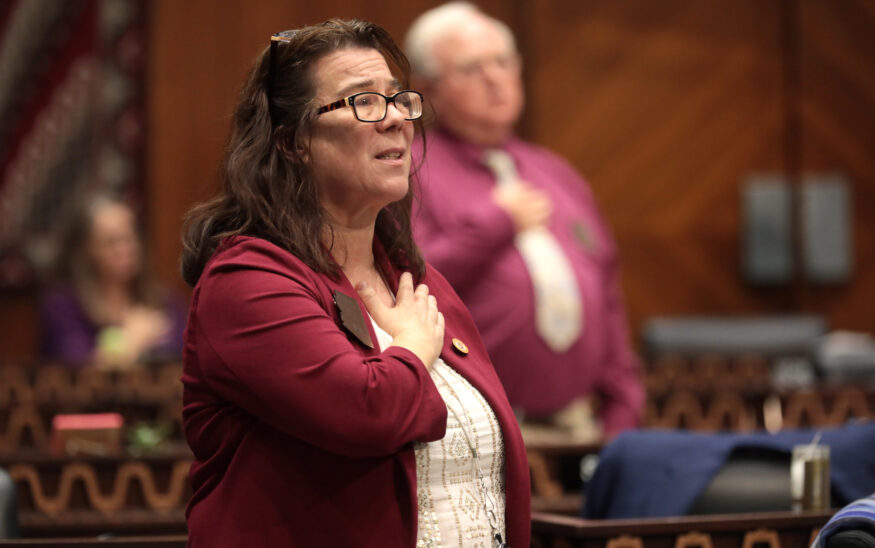
State Rep. Stacey Travers, D-Phoenix, speaking on the floor of the Arizona House of Representatives at the Arizona State Capitol building in Phoenix, Arizona. (Gage Skidmore / Flickr)
Arizona lawmaker proposes pay raise and term limits to attract candidates
Howard Fischer, Capitol Media Services//December 8, 2025//


Key Points:
-
Rep. Stacey Travers proposes pay raise for Arizona legislators
-
Lawmakers’ salaries have not increased since 1998
-
Arizona lawmakers struggle to make ends meet on $24,000 annual salary
Rep. Stacey Travers thinks she’s found a way to convince Arizonans to approve the first pay raise for legislators since 1998: Impose true — and enforceable — term limits so that lawmakers would no longer be able to remain in office forever.
And that is drawing opposition from one long-term Republican lawmaker who wants higher salaries — even more than what the Phoenix Democrat is proposing — and argues it makes no sense to tell Arizonans they can’t vote for who they like.
At the heart of Travers’s proposal is her belief that the current $ 24,000-a-year salary is insufficient to attract qualified candidates for the job.
As originally envisioned — and how it ran for years — the Arizona Legislature was designed to be a “citizen legislature,” populated by people with other jobs who would come to the Capitol for four months a year, take care of the state’s business, adopt new laws and approve a budget, and then go back to their regular occupations.
In recent decades that idea has turned out to be more myth than reality, with sessions lasting up to six months and a host of meetings, both formal and with constituents, for the rest of the year. And that, in turn, limits the ability of some to run for office.
Travers figures that voters, who constitutionally must approve legislative pay but have not since the 1998 vote, could be persuaded to hike salaries to $35,000 a year. And after that, the pay would go up every two years, after each election, to keep pace with inflation.
But in what she said would sweeten the deal for some voters, her proposed constitutional amendment would impose firm limits on how long someone could serve: no more than four two-year terms in the House and the same in the Senate. And after that 16 years — assuming they can win the biennial elections — their time at the Legislature would be done.
Voters approved term limits in 1992, with the same four-term limits in each chamber. But there’s a huge loophole: Lawmakers who “term out” of one chamber can move to the other. And when they term out there, they can go back to the first chamber.
Exhibit No. 1 is Sen. John Kavanagh. First elected to the House in 2006, the Fountain Hills Republican has bounced back and forth between chambers several times and now serves as a state senator. And he already has announced he wants another term after the 2026 election.
Rep. Gail Griffin, R-Hereford, has actually been around the Capitol much longer, since 1996. But she took a decade-long break after losing a bid for state Senate. She has been back since the 2010 election and has announced plans to run for the Senate in 2026.
Travers said that, as far as she is concerned, 16 years as a legislator is plenty long enough.
“After 16 years, I just think you need new blood and new ideas,” she said. And Travers, first elected in 2022, said she personally plans to leave long before that.
That, however, leaves the question of whether forcing out lawmakers after 16 years means a loss of institutional knowledge, a problem Travers said she sees from a different perspective.
“We don’t know who’s out there in our future that will lead the state,” she said. “So why not allow our state the opportunity for change?”
Kavanagh called it “bad policy.” He said there is a learning curve, with it taking some time before people fully understand not just the process but also the details of state government.
“It takes two years to figure out where all the restrooms are,” Kavanagh quipped.
As it turns out, he would likely be unaffected even if the measure is approved.
That’s because Travers’ HCR 2002 is structured so the clock starts running only when lawmakers are sworn in in 2027, meaning the years they’ve already served don’t count. And Kavanagh, at 75, acknowledged he’s unlikely to want another 16 years at the Capitol.
But he does agree with Travers on one point: Lawmakers deserve more.
There is some evidence supporting the argument that the current salary can be a burden.
Last year, Sen. Eva Burch, D-Mesa, who had just been reelected to a second term, quit.
Some of it, she said, was her belief that it was hard for her to accomplish her goals as a Democrat in a Republican-controlled Senate. But that’s not all.
“It must also be said that I have been struggling to make ends meet and find balance with my legislative work and my job as a health care provider,” said Burch, who has credentials as a nurse practitioner.
“I know that I am not the first, nor will be the last, good person to find themselves to be a casualty of legislative pay,” she said. “I hope the future will see Arizona lawmakers earning a living wage so that our constituents can be represented by working class citizens who understand the pressure of raising a family and struggling to make ends meet here in Arizona.”
Kavanagh actually introduced a measure last year to take the current $24,000 salary, adjust it for inflation, and make that the new starting point for future adjustments. And that would compute out to $48,000 or more.
A measure to do that actually cleared the Senate 22-5 with bipartisan support. But it never got a final House vote to put the issue to voters, a move that Kavanagh blames on House Speaker Steve Montenegro.
Montenegro declined to comment.
Still, Kavanagh says his proposal, which he plans to reintroduce this year, is fairer than Travers’s. He said all it does is keep lawmakers’ pay even — after inflation — with what they approved in 1998.
And he said that $48,000 is more likely to attract more candidates than the $35,000 that Travers is offering.
That, however, still leaves the question of whether what Travers wants — a pay hike with the promise of imposing real, enforceable term limits — would be more acceptable to voters than Kavanagh’s plan to double the pay with no change to how long lawmakers can serve.
History of legislative pay:
– Original 1912 Arizona Constitution: $7 per day
– 1932 initiative – $8 per day.
– 1958 referendum – $3,600 per year
– 1968 referendum – $6,000 per year
– 1980 salary commission recommendation approved by voters – $15,000
– 1998 salary commission recommendation approved by voters – $24,000