Arizona officials keep close eye as voting rights case goes to Supreme Court
By
Published: February 27, 2013 at 7:56 am
WASHINGTON – When the U.S. Supreme Court hears an Alabama challenge to a federal voting-rights law Wednesday, Arizona officials and civil rights activists will be keeping a close eye on the case.
Shelby County, Alabama, is challenging the constitutionality of one part of the 1965 Voting Rights Act that requires certain states with a history of discrimination – including Arizona – to have any change to voting laws approved by the Justice Department.
Supporters say the provision is still needed to head off discriminatory voting practices.
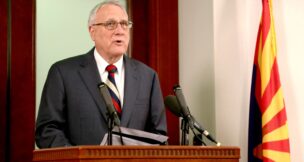
But Arizona Attorney General Tom Horne, who filed a legal brief supporting Alabama’s position in the case, said federal review is unnecessary because Arizona has not violated voter rights in years.
Horne, who in 2011 pressed a similar case from Arizona that was later dropped, said federal review is a burden on his office. Two lawyers and a paralegal spend several weeks preparing Department of Justice reviews, he said, running up costs to comply with oversight that is not needed to protect minority voters.
“Nobody is trying to interfere with their right to vote,” Horne said.
But advocates who represent Hispanic and Native American voters in Arizona say that federal review is still very much needed because it is not a thing of the distant past, as opponents claim.
They pointed to the Justice Department’s decision in 2003 to reject the method of election for school board members in Arizona because it unfairly limited the number Native American representatives that could be elected.
Cases like that show the need for continued oversight, said Patty Ferguson-Bohnee, a law professor at Arizona State University who filed a brief with the Supreme Court in support of the federal voting law.
She added that election districts in Arizona are routinely rejected by the Department of Justice. She credits the federal reviews for encouraging equality throughout the state.
“We’re on a trajectory that’s positive,” Ferguson-Bohnee said.
Under the 1965 law, states that are subject to review can “bail out” or be released from oversight if they meet requirements that show they are no longer discriminating against voters.
Among the criteria to bail out is a requirement that the state is not facing any lawsuits that allege voting discrimination. This is not the case in Arizona, where the Inter Tribal Council of Arizona is suing the state over 2004 voter ID law, Proposition 200, that is also scheduled to be heard by the Supreme Court in this term.
Thomas Saenz, the president of the Mexican American Legal Defense and Education Fund, said that federal oversight is actually a more efficient way of protecting voters, because it heads off lawsuits that governments would otherwise have to grapple with.
Even though the federal review is not applied to every state, the decisions made by the Justice Department set precedent that protects votes nationwide, Saenz said.
“It’s a very powerful piece of civil rights legislation,” he said.


February 27th, 2013 at 9:26 am
In the article: ““Nobody is trying to interfere with their right to vote,” Horne said.”
This might be true when it comes to minorities, but it certainly is not true when it comes to people that must work for a living. In many states around the country, politicians like Horne have been exercising the questionable practice of inhibiting the right to vote by causing excruciatingly long lines in selected communities, especially those communities that favor Horne’s political opponents. The US Supreme Court may interpret the term ‘minorities’ narrowly, thus appearing to approve the practice of creating long lines at the polls, as well as appearing to approve the practice of gerrymandering in many states.
No matter how the US Supreme Court rules, the practice of inhibiting the right to vote – along the lines of class status – will remain under attack throughout the country.
February 27th, 2013 at 6:57 pm
[...] Ready to Send Voting Rights Issue to CongressNational JournalU.S. News & World Report -Arizona Capitol Times -Washington Examinerall 433 news [...]
February 28th, 2013 at 12:50 am
[...] Of Racial Entitlement': Scalia Attacks Congress Over Voting …TPMNational Journal -Arizona Capitol Times -PolicyMicall 475 news [...]
February 28th, 2013 at 3:56 am
[...] seem certain to strike down or change the Voting Rights Act. What …National JournalTPM -Arizona Capitol Timesall 493 news [...]
February 28th, 2013 at 4:53 am
[...] seem certain to strike down or change the Voting Rights Act. What …National JournalTPM -Arizona Capitol Timesall 492 news [...]