Everything old is new again 
By dmc-admin
Published: January 26, 2007 at 1:00 am
The Times Past section is a weekly staple of the Arizona Capitol Times. It began as an old photograph feature started by Ned Creighton’s wife, Diana. With contributors from around the state, the feature provides another perspective on people and events that have shaped Arizona, and often touches on issues that still exist today. Here are some of the favorites, taken from the paper’s archives.
‘But it’s a dry heat’
In his 1878 book Picturesque Arizona, Enoch Conklin quotes Dr. A. M. Loryea: “The heat in Arizona, though high, is endurable in consequence of the dryness.” His statement may be the precursor to Arizona’s most quoted weather phrase: “but it’s a dry heat.”
Anyone who has spent a summer in southern Arizona usually chuckles after hearing this phrase, yet there’s enough truth in the observation to keep it circulating like an oscillating fan in July.
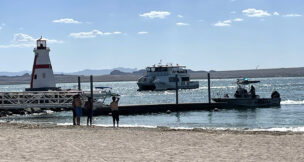
And then there are those who never had a choice in the matter. For health seekers more than a century ago, it was either live in Arizona or die almost anywhere else. Dr. Loryea dubbed Yuma “Nature’s Turkish Bath” and “The Great Sanitarium of America.” Conklin agreed.
“The very Indians take their sun bath here every day,” he said. “For centuries this people have been reclining at certain times of day on their heated sand-mounds, at a high temperature, and checking the heat by a plunge in the cooling waters of the Colorado. For centuries they have been working wondrous cures from the aid of these medical properties of the soil and atmosphere.”
Stories of Arizona’s fabled “enjoyable heat” didn’t begin with these men, however. Spanish officials in the early 1700s may have coaxed prospective colonists to settle near the missions of southern Arizona with similar complimentary phrases. Southwestern Indians also may have had similar ideas on the subject.
So, the phrase persists, partly a joke now, but still used by entrepreneurs and doctors to lure retirees and invalids to Arizona. Judging from the growing population in places where the summers are hottest, perhaps it is a dry heat that millions of new arrivals don’t mind all that much.
Roosevelt Dam
On Feb. 7, 1903, a 25-member Salt River Valley Water Users’ Association was incorporated. The association represented 4,800 individual landowners who pledged their land as collateral so the Salt River reclamation project could receive federal funding. The loan eventually would be repaid from water and power revenues generated after the system went into operation.
On March 14, 1903, the Roosevelt Dam project was authorized. Louis C. Hill, supervising engineer, Arthur Powell Davis, chief engineer of the Reclamation Service, and Fred Teichman, design engineer, were put in charge of the project.
Construction of the dam was set for Aug. 24, 1903, but before it could begin, a road to the proposed dam location needed to be built. The road would follow a route known as the Apache Trail. Congress passed special legislation granting the towns of Phoenix, Mesa and Tempe permission to bond themselves and borrow money to complete the road.
On Feb. 23, 1905, 20 bids for construction of the dam were offered, and the John O’Rourke firm of Galveston, Texas, was awarded the winning bid. O’Rourke proposed to complete the dam in two years at a cost of a little over $1.1 million. The design of the dam was a traditional curved, gravity masonry dam. Laborers carved 444,000 cubic yards of limestone for the faces of the dam, and large boulders and mortar were used to fill the spaces in between.
President Theodore Roosevelt considered the naming of the Roosevelt Dam after himself, his greatest honor. At the dedication ceremony, he told the audience, “I do not know if it is of any consequence to a man whether he has a monument. I know it is of mighty little consequence whether he has a statue after he is dead. If there could be any monument which would appeal to any man, surely it is this.”
Phoenix streetcars
Just about every city of any size in the early days had a streetcar or trolley line. In Phoenix, there was the Phoenix street railway system, which operated from 1887 to 1948. It was owned and operated by the great promoter and subdivision mogul, Moses H. Sherman until 1925, when the city of Phoenix took over operations.
For a nickel (at least in the beginning) you could ride on Sherman’s streetcars anywhere there were tracks. The streetcar company was never a business winner. It was reorganized many times each time acquiring a new name.
It was called variously: Phoenix Railway Company, Valley Street Railroad Company, Arizona Improvement Company, Phoenix City Railway Company and finally Phoenix Railway Company of Arizona.
The first streetcar line, consisting of one car, operated along Washington Street between Seventh Avenue and Seventh Street in 1887. The car was pulled by a mule and there was little effort at maintaining a standard schedule. Passengers could get on and off wherever they wanted to.
Maintenance and general upkeep of the system was costly and a continuing problem. In 1912, the Arizona Corporation Commission conducted safety hearings and ordered changes in the way maintenance was handled. Controversies and disagreements with authorities continued until 1925 when the city of Phoenix finally took over management of the system.
By then the automobile was on the way to replacing the streetcar. In Maricopa County, the number of registered automobiles rose from 646 in 1913 to more than 53,000 in 1929, when it was estimated there was one car for every three people in the metropolitan area.
On Feb. 17, 1948, Phoenix gathered together 150 pioneers, city officials and employees for a ceremonial final ride on the last three cars remaining from the street railway system. The dignitaries made a round trip on the Washington line from the courthouse to the state Capitol.
That closed the chapter on rail mass transit in Phoenix and opened the way for the bus system we have today.
Border duty, 1916
Pancho Villa’s attack on Columbus, N.M., in the early morning hours of March 9, 1916, set in motion a huge mobilization of U.S. regular army and the National Guard. By July 31, almost 111,000 Guardsmen were on the border and another 40,000 awaited orders in mobilization camps around the country.
Among the first Guard units called into federal service was the First Arizona Infantry Regiment, which arrived by train at Camp Harry J. Jones, near Douglas, on May 12 and 13, 1916. More than 1,000 well-wishers had cheered the special train carrying most of the guardsmen as it passed through Tucson at 6 a.m. on May 12.
As with most National Guard units called to the border, the Arizona contingent was undermanned. Arriving in Douglas with 49 officers and 837 enlisted men, it was 29 men short of its required peacetime strength and 1,029 short of the troops it needed to be accepted for federal service in wartime.
In early September, the units were ordered to consolidate near Naco, Ariz. and the troops began to hope they would soon cross over into Mexico to join Gen. Pershing and his troops fighting Pancho Villa. Better yet, they hoped to be released from federal service all together. Instead they spent another seven months in Naco, waiting and watching. Meanwhile, other Guard units were released from duty and returned to their home states.
Finally in late February of 1917, the troops got word they would be released from border duty on March 27. The men, anxious to return to civilian life, began to prepare almost immediately. Military drills were suspended. Physical examinations, inspection of records by regular army officers and a 15-day paid furlough were all prepared for the appointed day. By the 26th, all bed sacks, stoves and company equipment were turned in. The Arizona troops spent their last night in Naco sleeping under the stars.
The next morning as the regiment formed up for the formal mustering out, the men were greeted with a telegram from the War Department notifying them that, because of the possibility of war with Germany, all National Guard units still in federal service were being retained in place. The staff reissued equipment and by March 29, the men were once again sleeping in tents and trudging back to the firing ranges to continue training.
![[Print]](http://azcapitoltimes.com/wp-content/plugins/tdc-sociable-toolbar/print.png)
![[Email]](http://azcapitoltimes.com/wp-content/plugins/tdc-sociable-toolbar/email_2.png)
![[RSS Feed]](http://azcapitoltimes.com/wp-content/plugins/tdc-sociable-toolbar/rssfeed.png)
![[del.icio.us]](http://azcapitoltimes.com/wp-content/plugins/tdc-sociable-toolbar/delicious.png)
![[Facebook]](http://azcapitoltimes.com/wp-content/plugins/tdc-sociable-toolbar/facebook.png)
![[Tumblr]](http://azcapitoltimes.com/wp-content/plugins/tdc-sociable-toolbar/tumblr.png)
![[Twitter]](http://azcapitoltimes.com/wp-content/plugins/tdc-sociable-toolbar/twitter.png)