Sign In


Upcoming Event
 Free Newsletter

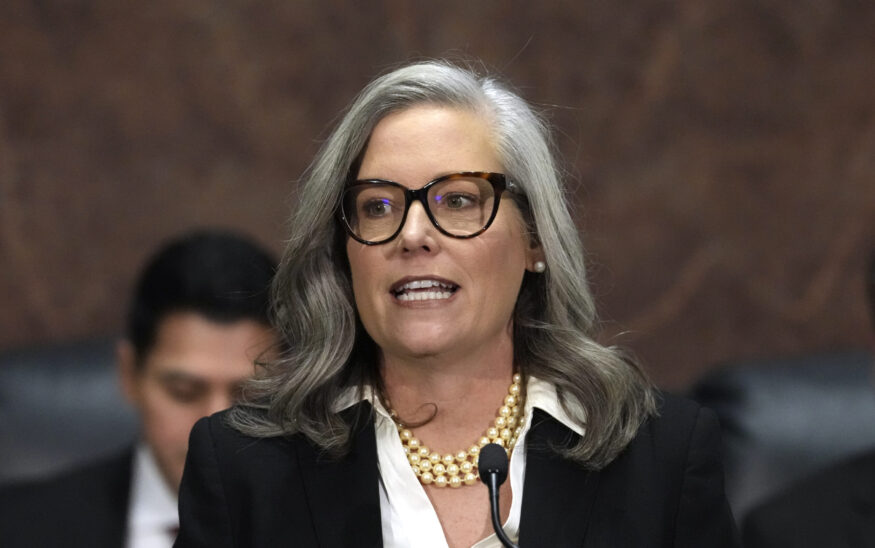
Arizona Democratic Gov. Katie Hobbs gives the State of the State address in the House of Representatives at the Capitol Monday, Jan. 13, 2025, in Phoenix. (AP Photo/Ross D. Franklin)
Hobbs signs $18.3B bipartisan budget
Reagan Priest, Arizona Capitol Times//June 13, 2026//


Key Points:
-
Gov. Katie Hobbs signed a bipartisan budget Saturday after the Legislature adjourned in the wee hours of the morning
-
The $18.3 billion package includes $1.4 billion in tax cuts, 2.5% agency budget cuts and a moratorium on data center tax incentives
-
The budget did not include an extension of Prop. 123, despite the governor’s best efforts
Gov. Katie Hobbs signed an $18.3 billion budget package with $1.4 billion in tax cuts, a three-year moratorium on new data center tax incentives and 2.5% agency budget cuts — capping off the 2026 legislative session.
It wasn’t seamless. The last few months of this year’s session saw a negotiation standstill, a bill moratorium, a vetoed Republican budget proposal, an extended break for House members and finally, a bipartisan deal to keep the state government funded into the next fiscal year.
In a statement released after the Legislature sent the budget to her desk Thursday, Hobbs celebrated the passage of her fourth bipartisan budget during her tenure on the Ninth Floor.
“When I meet with Arizonans, they tell me they want their elected officials to work together to lower costs, create jobs, keep their communities safe, and expand opportunity and freedom in every corner of our state,” Hobbs said. “Today, I’m proud to say that we have delivered.”
Hobbs signed the budget on Saturday following a marathon final day in the Legislature Friday that didn’t end until the early morning hours. Driven by debate and procedural maneuvers over several last minute ballot referrals, the Senate did not adjourn until 12:30 a.m., while the House kept working until 4:45 a.m. Saturday morning.
Like all budgets passed under Hobbs’ first term in office, the 2026 deal featured several provisions that were not exactly popular with some members of both parties. But, the Democratic Governor’s Office and the Republican-controlled Legislature each scored wins and bore losses to reach a deal that could pass both chambers and earn Hobbs’ signature.
For the GOP, the budget fully conforms the state tax code to federal cuts implemented in President Donald Trump’s One Big Beautiful Bill Act. At the beginning of the session, Hobbs introduced her own tax conformity plan that prioritized relief for middle-income earners, while some members of her party balked at the inclusion of tax cuts for corporations and high earners.
After fighting against full federal tax conformity plans pushed by Republicans at the beginning of the session, Democrats were willing to swallow the revenue cuts in part to align the state’s tax codes with forms already filled out and submitted by Arizona taxpayers.
“Arizona is now the only state in the nation fully adopting President Trump’s tax package, and that means workers, families, seniors, and veterans get to keep more of their hard-earned money,” said Senate President Warren Petersen in a statement after the Legislature sent the budget to the governor. “This budget delivers meaningful tax relief while maintaining the services Arizonans rely on and preserving Arizona’s reputation as the best place in America to live, work, and raise a family.”
The tax package will eliminate taxes on tips and overtime, increase the standard deduction and add a new $6,000 deduction for seniors. It also adds a new childcare expense deduction, an increased child tax credit and property tax exemptions for disabled veterans.
The biggest win for Democrats came in the form of a temporary moratorium on tax incentives for new data center projects. Hobbs originally proposed repealing the tax incentives entirely, which allow data center developers to submit applications to the Arizona Commerce Authority to exempt certain projects from transaction privilege and use taxes.
Hobbs’ office says the three-year moratorium will save the state $57 million while still allowing data center development to continue. Before the budget reached her desk, Hobbs told reporters at a June 11 press conference that she views it as a “responsible balance” between data center growth and community concerns.
“We are a top market in the country for data centers, and we need to have hard conversations about what that means, and make sure that we are growing in a way that’s sustainable,” Hobbs said.
However, the governor was unable to secure one of her top priorities: a renewal of the education funding measure Proposition 123. Hobbs signed the budget without it, despite calling off budget negotiations in March and instituting a bill moratorium in April in an attempt to force Republicans to come to the table to discuss it.
“It’s a place where a lot of my colleagues across the aisle were not able to put the partisan politics aside and take advantage of this once-in-a-decade opportunity to deliver much needed public school funding without raising taxes,” Hobbs told reporters on June 11. “I’m not giving up on my commitment to renew Prop. 123, whether that happens this year or not.”
Instead of withdrawing money from the state land trust to fund public schools, the budget backfills around $300 million from the state’s general fund. Democrats were able to secure additional funding for free school meals, food assistance programs and supplemental costs like textbooks, technology and transportation.
The budget also did not secure any reforms to the state’s Empowerment Scholarship Accounts program, a loss made even more bitter by eleventh-hour maneuvering from Republican lawmakers late Friday.
After a shaky deal between Republicans and the Arizona Education Association over school voucher reforms broke down, GOP members in both chambers forced through a ballot referral that could nullify a voter initiative designed to rein in the ESA program.
The teacher’s union originally pledged to drop the Protect Education reform initiative in exchange for similar but softer reforms and additional funding for the Department of Education to administer the ESA program. But when Democrats and one Freedom Caucus Republican killed that deal, GOP lawmakers instead approved House Concurrent Resolution 2048.
The ballot referral pledges to protect ESA funds for military families from being sweeped. But it also contains a clause invalidating the Protect Education initiative if both measures are approved by voters in November.
Members of both parties were concerned to see only $55.8 million allocated to the Department of Corrections, Rehabilitation and Reentry for court-mandated healthcare staffing required by the ongoing Jensen v. Thornell litigation. Hobbs requested $118.3 million for prison health care staff, noting the lawsuit has been a source of frustration for her administration.
“We are playing catch up to try to meet the needs of the court and to treat prisoners according to the Constitution,” Hobbs told reporters on June 11. “So this is what we are able to negotiate in the budget, we’re continuing to work to meet the conditions of the court and this lawsuit.”
The budget will also not include funding for the Independent Corrections Oversight Office created during last year’s legislative session, though an appropriations bill for the office received bipartisan support in committee hearings this year.
Despite pushback from Democrats, the budget includes enhanced eligibility checks for Medicaid and the Supplemental Nutrition Assistance Program as the state works to reduce its SNAP payment error rate to comply with federal requirements. But the package does include funding for more staff positions at the Department of Economic Security and the Arizona Health Care Cost Containment System to implement those eligibility checks, ensuring around 40,000 Arizonans will be able remain on the state Medicaid plan.
Hobbs had to forgo a few lofty proposals, like a data center water user fee, a nightly fee on short-term rentals and a new sports betting fee structure. However, she managed to hold onto priorities like a 4% stipend for correctional officers, $48 million to state childcare assistance programs, and $58 million for child safety operations.
And though the budget has been enacted and the Legislature adjourned sine die, Hobbs will still have to sift through over 200 pieces of legislation lawmakers sent her during their final week at the Capitol.