Sign In




 Free Newsletter
Arizona workers call for stronger heat safety protections
Jordan Gerard, Arizona Capitol Times//August 13, 2026//
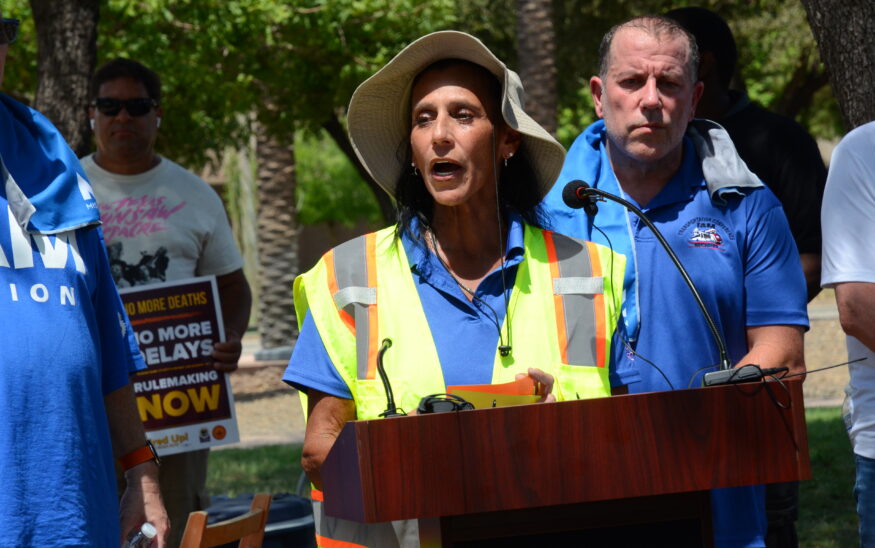
Trina David talked about what workers at Sky Harbor International Airport experience when they load heavy bags onto airplanes in extreme heat.
Arizona workers call for stronger heat safety protections
Jordan Gerard, Arizona Capitol Times//August 13, 2026//


Key Points:
-
Extreme heat kills more people than floods, hurricanes and tornadoes combined
-
The Industrial Commission of Arizona issued new workplace heat safety guidelines for employers
-
Some lawmakers say the protections would help workers, but others worry about the effects on businesses
Extreme heat in Arizona is not just a seasonal inconvenience. It’s a workplace hazard that is increasingly lasting longer and can make even routine work life-threatening.
Given that, workers and job-safety advocates gathered this week in Phoenix on a rare, sub-100-degree summer day to demonstrate the dangers of working outside and call on state lawmakers to enact stricter regulations to protect Arizona laborers. Recent efforts to do so have stalled in the GOP-led Legislature.
The Arizona Heat Standards Coalition hosted demonstrations that simulated loading heavy luggage onto airplanes, wearing pesticide-protection suits in agriculture, and working in roofing and landscaping under intense sun.
Trina David worked on the ground crew at Phoenix Sky Harbor International Airport for 19 years, offloading and loading 4,000 to 6,000 pounds of baggage in less than an hour to get planes out on time.
The tarmac is 20 to 40 degrees hotter than the air temperature, and oftentimes the only breeze is from airplane exhaust, which harms workers’ lungs and throats and dehydrates them, she said.
“Our goal today is simple: to help you feel what we feel, to help you see what we workers see every day, and to help you understand why enforceable heat protection should not be optional; they are necessary because protections save lives,” David said.
Extreme heat kills more Americans than floods, hurricanes and tornadoes combined. According to the National Weather Service, the 10-year average of heat-related deaths between 2016 and 2025 was higher than that of any other disaster.
Arizona follows a “State Emphasis Program” adopted in 2023 under the Arizona Division of Occupational Safety and Health. The plan provides general guidance to employers and relies on the “general duty clause” for enforcement.
That means businesses must be free of hazards likely to cause death or serious physical harm. Employers can also be issued citations, said Phil Murphy, the deputy director of compliance at ADOSH.

Commissioners issued new workplace heat safety guidelines in April, based on recommendations from a task force that Gov. Katie Hobbs established in 2025. A report of how those recommendations affected workers is expected in December.
But it’s still not enough, critics say. They note states like California have state-level standards for heat safety, while Arizona relies on workplace guidelines.
Rep. Mariana Sandoval, D-Goodyear, has tried to pass heat safety legislation for the last three legislative sessions, though none advanced. Part of Sandoval’s district represents Yuma County, a major agricultural hub.
“They are like suggestions,” Sandoval said about the current guidelines. “This is what they should do, but there’s nothing in statute that says this is what they have to do, so that’s the difference between having guidelines and then having actual statutes.”
But Senate Majority Leader John Kavanagh believes that the current regulatory system is working.
He said that if employers expose their workers to dangerous situations, they’ll pay the price through workers’ compensation payments and lawsuits. He added that he believes a one-size-fits-all solution will overburden employers, cause their worksites to shut down, and decrease their profits.
“We’ve been a state for like over 125 years. We’ve survived without one-size-fits-all heat protection, so I’m a little leery of that,” he said. Kavanagh added that if he saw the numbers of heat-related injuries and deaths in workplaces, he’d be open to addressing them.
Industrial Commission says guidelines work
The Arizona Industrial Commission said in a statement to the Arizona Capitol Times that the current heat protections are enforceable, noting that citations have been issued to employers who have not provided adequate protections from heat illness.
“ADOSH works with many employers who employ creative and practical provisions to protect their workforce from heat illness,” the statement said. “The goal is to elevate all employers to that level of safety and awareness.”
The commission plans to use enforcement data to decide whether further action is necessary. It will specifically track heat-related complaints, inspections, citations, employer participation in safety programs, consultation visits and heat-related illness claims.
Since the state issued the original State Emphasis Program, the commission says it has expanded its consultation visits, increased inspections, convened a Workplace Heat Safety Task Force, held stakeholder meetings, supported the ADOSH Advisory Council, held a public meeting to review recommended guidelines and updated the State Emphasis Plan.
The state has also tracked some positive indicators in recent years. Heat-related deaths dropped to 667 in 2025 from 997 in 2024, according to the Arizona Department of Health Services. Emergency department visits for heat-related illnesses also declined after several years of increases, according to the department.
A public health emergency
At a press conference in July, three state lawmakers, two work-safety advocates and Phoenix Mayor Kate Gallego said extreme heat is a public health emergency and should be treated as such all the time.
“This can be a life-or-death issue,” Gallego said. “Each year we learn from past summers and improve upon our heat relief efforts.”
The City of Phoenix was the first in the country to establish a publicly funded, permanent Office of Heat Response and Mitigation, and it plans for summer heat year-round, Gallego said.
But she said the numbers are still too high and one heat-related death is too many. It’s a nonpartisan issue, she added.
It’s also not just a workplace issue.
Sen. Lauren Kuby, D-Tempe, proposed Senate Bill 1608, which would have made it illegal for landlords to set the thermostat higher than 82 degrees or below 68 degrees when seasonal weather conditions apply.
The bill, which also never advanced, would have allowed tenants to take action if the landlord doesn’t comply.
“We cannot treat extreme heat as a simple weather event,” Kuby said. “It’s a public health challenge, an education challenge, a housing challenge and ultimately a human rights challenge.”
As a lifelong public school teacher, Rep. Nancy Gutierrez, D-Tucson, said she had to get 30 students to concentrate in a hot classroom with no windows and no air conditioning because the system was old and in need of repair. She and her students would become nauseous, fatigued and irritable.
“I continue to receive dozens of emails from teachers telling me that their classrooms in northern Arizona begin at 85 degrees because of our climate crisis,” she said. “Arizona hasn’t funded our public buildings in order to make these changes.”