Sign In
Upcoming Event
 Free Newsletter

Biggs and Petersen eye Arizona judiciary, redistricting commission
Reagan Priest, Arizona Capitol Times//August 12, 2026//
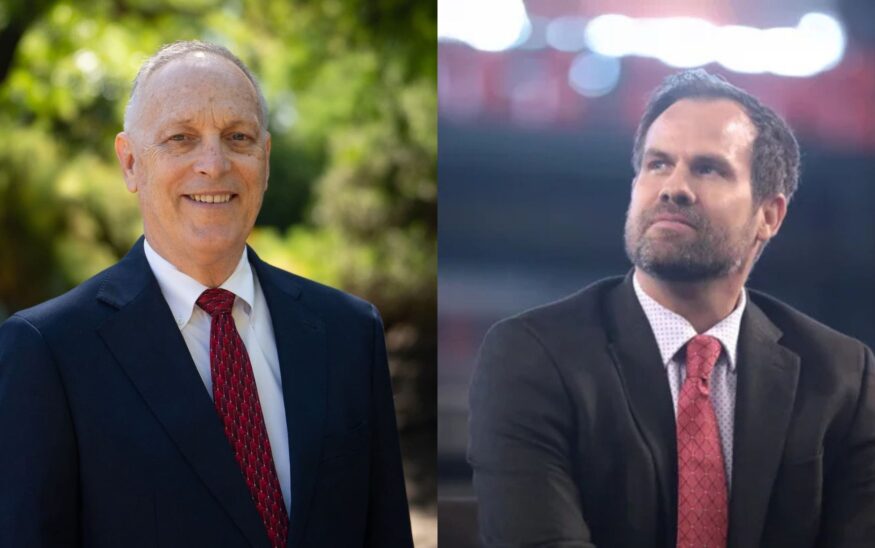
Congressman Andy Biggs and Senate President Warren Petersen speak at two Biggs rallies held on July 17 and July 21. (Biggs for Arizona & Petersen for AG)
Biggs and Petersen eye Arizona judiciary, redistricting commission
Reagan Priest, Arizona Capitol Times//August 12, 2026//


Key Points:
-
GOP candidates Biggs and Petersen are campaigning on moving the judiciary and redistricting commission to the right
-
The next governor could shape the Arizona Supreme Court and redistricting efforts
-
Ducey packed the Appellate Commission, which appoints members of the Independent Redistricting Commission
The two Republicans running to flip Arizona’s governor and attorney general offices are framing the races as a chance to reshape the state’s judiciary and protect GOP influence over political maps through the Independent Redistricting Commission.
Congressman Andy Biggs and Senate President Warren Petersen, the GOP nominees for governor and attorney general, are urging supporters to focus on what they consider the longest-lasting impact of any governor — judicial appointments.
Arizona’s courts have increasingly been deciding the fate of state statutes, election procedures, ballot referrals and even the minute functions of state government. A divided government has fueled that shift, with Democratic Gov. Katie Hobbs and Attorney General Kris Mayes often at legal odds with a litigious Republican-controlled Legislature.
With two justices reaching mandatory retirement age in the next four years, Arizona’s next governor could make multiple appointments to the state Supreme Court. The next governor could also tip the scales on the IRC, which will determine the political makeup of Arizona’s 30 legislative districts and nine congressional districts after the 2030 census.
Biggs and Petersen told supporters at a July 17 rally in Gilbert that voting for Democrats would mean solidifying a liberal state judiciary.
“If you lose your Supreme Court to woke justices, you lose your state,” Petersen told attendees.
Biggs echoed Petersen’s sentiments, pointing to Hobbs’ appointments during her first term.
“You could just look at who she’s appointed to sit on the appellate court,” Biggs told the crowd. “They are radical left-wing activists, and we’re going to get conservative constitutionalists who respect the rule of law.”
Arizona designed its judicial selection system to limit political influence, but observers say politics still plays a role because elected officials remain part of the process.
“When you have political actors constitutionally involved in the process, you cannot get away from politics,” said Doug Cole, a lobbyist with HighGround Public Affairs and the vice chair of the Arizona Commission of Judicial Performance Review.
The governor appoints judges to five county court systems, two appeals court divisions and the Arizona Supreme Court. Five nominating commissions vet candidates and send shortlists to the governor. Those commissions include lawyers and public members from both parties.
Arizona judges don’t need legislative confirmation. However, the Senate must confirm the members of the nominating commissions, giving lawmakers influence before judicial nominees reach the governor.
“The Senate has been very obstructionist, having a Democratic governor, so I think it has really gotten in the way of appointing a lot of good people to those nomination commissions,” said Cathy Sigmon, the director of Civic Engagement Beyond Voting. “Some of the commissions have lost a lot of people, and it’s incredibly difficult to get anybody new appointed.”
Judges periodically face retention elections, with the Commission of Judicial Performance Review making evaluations and recommendations for voters.
The Commission on Appellate Court Appointments is widely considered the most influential of the five commissions. Its members recommend nominees for the two divisions of the Court of Appeals, the Supreme Court and the IRC.
The Legislature selects four of the five IRC members from candidates the Appellate Commission recommends. Those four then choose the fifth member.
At the Gilbert rally, Petersen incorrectly said the next governor will appoint the members of the IRC, a line Biggs repeated to the audience. But both candidates walked that back when questioned by the Yellow Sheet Report, the Capitol Times’ sister publication.
“Practically, though, the governor weighs in heavily on the applicants,” Petersen said.
Cole said former Gov. Doug Ducey is the prime example of that heavy weight.
“Gov. Ducey completely remade the Appellate Court Commission leading into the 2020 census,” Cole said.
No Democrats served on the Appellate Commission that selected the 2021 IRC members. Ducey only nominated Republicans and independents. Democrats in the Legislature at the time likened the move to gerrymandering, preventing Arizona’s electoral maps from reflecting its increasingly purple demographics.
Ducey also appointed six state Supreme Court justices after expanding the court in 2016. He holds the state record for most judges appointed by a single governor, with 113 over eight years.
Five of Ducey’s Supreme Court nominees are still on the court. The remaining two, Chief Justice Ann Timmer and Justice Maria Elena Cruz, were appointed by former Gov. Jan Brewer and Hobbs, respectively.
“There are few things that a governor can do that are more important to that individual’s legacy than judicial appointments,” Cole said.
Hobbs has made 21 judicial appointments in almost four years in office. She has also appointed seven of the nine members of the Appellate Commission, which is statutorily made up of 16 members.
The governor has not pursued judicial nominations as aggressively as her predecessor, but she is on track to appoint a Democrat-friendly Appellate Commission. Five of the current members are Democrats, three are independents and one is a Republican.
But if Hobbs is reelected and the Senate remains under Republican control, it will be much harder for the governor to retread Ducey’s path.