Sign In



 Free Newsletter


No Labels argues it has right to change party name
Howard Fischer, Capitol Media Services//November 9, 2026//
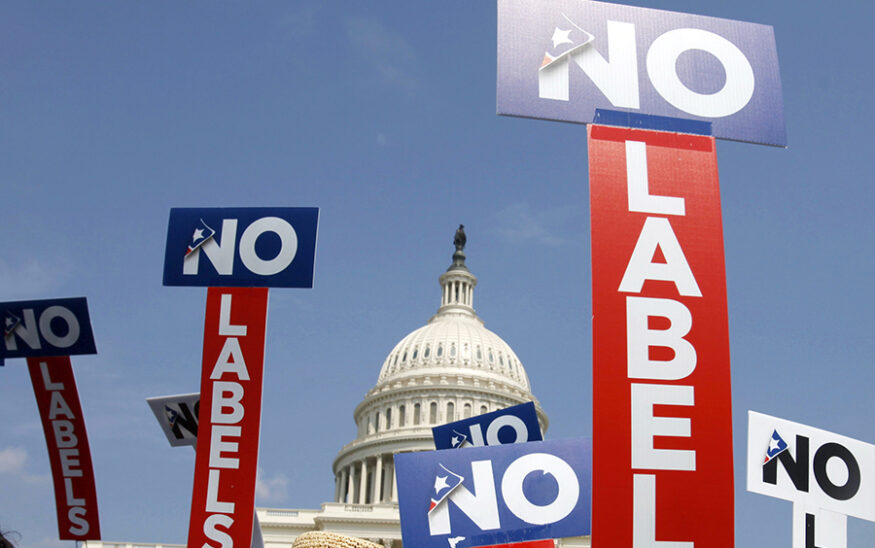
People with the group No Labels hold signs during a rally on Capitol Hill in Washington, July 18, 2011. (AP Photo/Jacquelyn Martin)
No Labels argues it has right to change party name
Howard Fischer, Capitol Media Services//November 9, 2026//


Key Points:
-
The No Labels Party is trying to rename itself the Arizona Independent Party.
-
In a new appeal, an attorney for the political party argues that a judge erred in requiring it to gather signatures and start from scratch
-
Opponents argue that the name change could confuse voters
PHOENIX — The race is over. And all their candidates lost.
But that isn’t stopping the No Labels Party from trying to convince the state Court of Appeals that it has the legal right to change its name to the Arizona Independent Party.
In new legal filings, attorney Matthew Adler argues that Maricopa County Superior Court Judge Greg Como erred in ruling earlier this year that, if party officials want to operate under a new name, they need to start from scratch and complete all the procedures necessary — including gathering sufficient signatures on petitions — to form a new party.
The dispute stems from a 2025 request by former Phoenix Mayor Paul Johnson, who took over the state’s No Labels organization and asked Secretary of State Adrian Fontes to approve the new name. Fontes initially agreed, but reversed course after attorneys for both the Democratic and Republican parties sued to block the change.
“The major parties perceived Arizona Independent Party’s name change as a threat to their electoral hegemony,” he wrote.
Como, however, said the purpose of requiring parties seeking formal recognition on the ballot to get signatures is to show they have “a meaningful level of support” among Arizona voters. He said requiring a new round of signatures also prevents parties with little or no public backing from crowding the ballot.
He also questioned whether voters who signed petitions to recognize the No Labels Party would have supported it under a substantially different name.
“When a person signs a petition on behalf of an aspiring party, it is reasonable to infer that they are largely motivated by how the party describes itself, i.e., the party’s name,” the judge wrote. “Would the same 41,000 people who signed petitions to recognize the No Labels Party have signed to support the ‘Arizona Nazi Party’ or the ‘Arizona Anarchists’?”
Como said that allowing a party to change its name without obtaining the signatures required for a new party could amount to a “political bait and switch.” He said an organization could gather support under an innocuous name and later adopt one with a very different meaning.
Adler rejected that reasoning in his 47-page appeal.
“AIP possesses a baseline constitutional right to choose the name by which it is officially known,” he wrote, adding that Arizona law contains no restriction on a party’s ability to change its name.
“In this country, people are free to exercise their constitutional rights unless and until the government enacts a valid regulation thereof,” he said.
Adler also argued that if state law prohibits the change, that restriction is unconstitutional and should be struck down.
An effort to attract voters
The name change is part of Johnson’s broader effort to make it easier for political independents to run for office by giving them access to the ballot requirements that apply to recognized political parties.
Under current law, unaffiliated candidates, so-called “independents,” can now get their names on the ballot. But a statewide candidate not affiliated with a recognized party must gather at least 44,539 petition signatures.
Organized major parties, by contrast, need a fraction of that number. Based on voter registration totals, Republicans need 7,558, and Democrats need 6,761.
Johnson acknowledged that adding the word “Independent” to the party’s name was meant to attract voters who don’t identify with either major party and to let candidates qualify for the 2026 ballot with just 1,771 signatures.
The Democratic and Republican parties weren’t the only opponents of the change. The Citizens Clean Elections Commission also filed a separate lawsuit, arguing that allowing a political party to use the word “Independent” could confuse voters.
Its attorneys said many Arizonans understand the term to mean someone who is not affiliated with any political party. Voters could mistakenly register with the Arizona Independent Party when they intended to remain unaffiliated.
A matter of law
Como, in his ruling, said it came down to his conclusion that no law allows a party to simply rename itself — and, in doing so, effectively re-register everyone who was already with the No Labels Party as a member of the Arizona Independent Party.
Adler, in his appeal, said that ignores people’s constitutional right to choose whom they associate with. He said that “protects a political party’s right to choose — and change — the name by which it is officially known.”
He also challenged Como’s hypothetical examples, arguing that the possibility of a party someday adopting an offensive name does not justify prohibiting all name changes.
“In essence, the trial court (ruled) that, because it is possible to conceive of a hypothetical political-party name change that might offend the associational rights of the party’s individual members, ergo all party name changes must be illegal,” Adler wrote.
Nor, he said, was there evidence that No Labels members objected to the proposed change.
“No AIP members intervened and challenged AIP’s name change, thereby giving the lie to the idea that AIP’s name change was a ‘bait and switch,’” he wrote.
No Labels candidates
The No Labels Party’s most successful candidate this year was Teri Ann Hourihan, its gubernatorial nominee.
She tallied more than 20,000 votes — less than 1% of the total cast in the race.
Anthony Ramirez won nearly 30% of the vote in the LD 12 state Senate race. But that race featured no Republicans to run against Democrat Patty Contreras, who had previously served in the House.
Others in similar races with no Republican opposition to Democrats include Jason LaForest, who got about 15% of the vote in the state Senate race in LD 5 against Christine Marsh, and Alan Aversa, who was the choice of about 6% of those voting in the race for Congress in CD 3, where incumbent Yassamin Ansari won reelection.