Sign In



 Free Newsletter


State prison director says more funds coming for inmate healthcare
Bob Christie, Capitol Media Services//November 20, 2026//
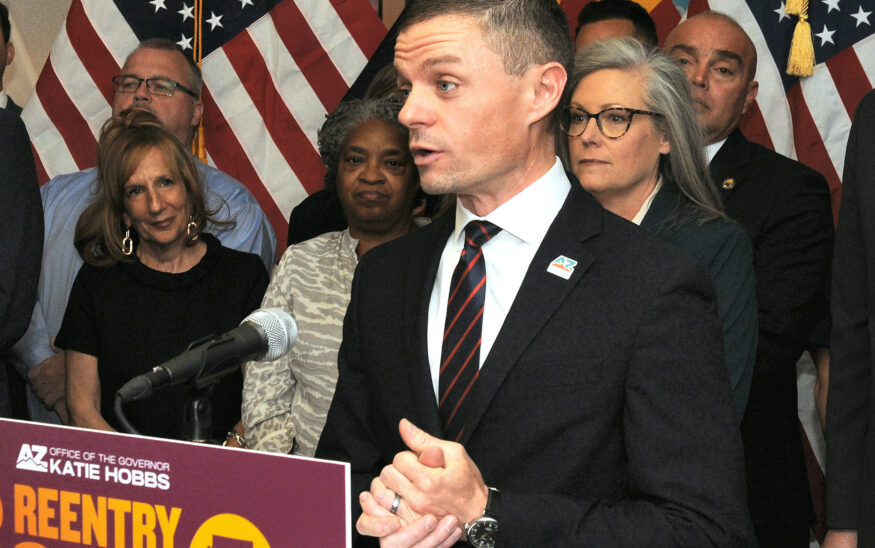
State prisons chief Ryan Thornell at a press conference last year with Gov. Katie Hobbs (Capitol Media Services file photo by Howard Fischer)
State prison director says more funds coming for inmate healthcare
Bob Christie, Capitol Media Services//November 20, 2026//


Key Points:
-
The state prison system renegotiated a contract with its healthcare provider to add more funds
-
A judge has for years ordered the state to invest more in inmates’ healthcare to solve deficiencies
-
Inmate advocates say a receiver is still necessary to ensure the care is provided as promised
The head of Arizona’s prison system said new money in the state budget will go to a new healthcare model to help comply with a federal court injunction that requires improvements in prisoner care.
But an attorney for inmates said while it’s a welcome move, it still doesn’t eliminate the need for a federal receiver to take over the healthcare system.
Ryan Thornell — director of the Arizona Department of Corrections, Rehabilitation and Reentry — told a legislative committee this week that the new model will expand from a few pilot projects in parts of some state prisons to all 10 prisons across Arizona.
The updated contract with private healthcare provider NaphCare would add nearly $36 million to the current contract and help pay for 115 new providers, a 3% cost of living adjustment and increases to reflect the current cost of caring for prisoners. It also wraps in a series of small contract changes made in the past year and a half that compensated NaphCare for its added care costs.
The “Patient Centered Care Model” is one of the major changes ordered by a federal judge when she issued a sweeping injunction last year that found the corrections department was still providing care that failed to meet constitutional requirements despite more than a decade of court orders.
This past February, she said she’d appoint a receiver to run prisoner healthcare and take that role away from the state. While named by U.S. District Judge Roslyn Silver, that receiver has yet to take full control because the state has appealed that order.
The idea is to assign a specific healthcare provider to prisoners with chronic or ongoing mental or physical health issues so that there is a continuity of care in each prison housing unit, Thornell explained.
“We have a healthcare team led by a physician, made up of other providers, nurses, and potentially mental health providers that make up that patient-centered care team at that housing unit,” he told members of the Joint Legislative Budget Committee.
“And the idea here is that every inmate has an assigned provider who is responsible for their overall care, and then they have a team that carries out that care, so that every day that team is discussing patient X’s complications, appointments, considerations, and they have a more well-rounded approach versus patient X coming in and seeing just a random individual every other week, every other month, whatever the frequency is, and that individual doesn’t know their case,” Thornell explained.
Under the current system, a prisoner with complex medical needs could be seen by a doctor or nurse that had never seen them, or had any idea about their case, he said.
“This puts that team at one unit,” Thornell said. “It rounds out a more comprehensive team, it brings mental health together with the medical team, and it provides what I could say wraparound healthcare for the inmate.”
Thornell took the case to the committee, made up of members of both the House and Senate, because they had to approve the contract changes and new spending. They did so on a unanimous vote Tuesday.
In addition to the $35.9 million for new health care providers, the pay raise and contract payments, the committee also approved Thornell’s request to spend $9.2 million on incentives to attract new workers and more than $1.3 million on new medical equipment and IT improvements.
The Legislature and Gov. Katie Hobbs included the additional $46.3 million in spending on healthcare-related costs in the budget enacted in June. That brings the total being directed to inmate healthcare to over $451 million a year.
Lawmakers made the new spending contingent on adding contract language that requires detailed hiring goals, quarterly report, and financial penalties for NaphCare if it fails to meet the goals. The company took over prison healthcare in 2022 and the five-year contract is up for possible renewal next year.
The total state prison system budget is $1.8 billion, including $1.67 billion from the state general fund.
Corene Kendrick, an attorney who is deputy director of the American Civil Liberty Union’s National Prison Project, which brought the lawsuit over inadequate prisoner healthcare in 2012, said in an email that while she was happy to see progress, it is just a start of what is needed to meet standards.
“We’re glad that ADCRR and the Hobbs Administration are finally attempting to get the Legislature to authorize additional health care staffing that Judge Silver ordered them to hire a year and a half ago,” she wrote.
“That said, it has been slow going and the most recent report by the court-appointed monitors detailed ongoing and profound deficiencies in the health care that necessitated the federal court to place the prison health care into receivership,” Kendrick said. “The State would be better served in focusing its attention on complying with court orders and the Constitution, instead of fighting the court orders through expensive appeals.”
More to the point, Kendrick told Capitol Media Services that care for the 25,000 inmates housed in state-run facilities still falls short of what is constitutionally required.
That was the conclusion reached by Silver when she issued an order earlier this year putting a receiver in charge of health care.
In her 83-page order, the judge detailed complaints that go back 14 years about inadequate physical and mental health care at the 10 prison complexes across the state. That included a history of agreements to do better, injunctions, and even multi-million-dollar fines.
“But now after nearly 14 years of litigation with defendants having not gained compliance with the injunction and the Constitution, this approach has not only failed completely but, if continued, would be nothing short of judicial indulgence of deeply entrenched unconstitutional conduct,” the judge wrote.
The Republican-controlled Legislature has been wary of providing all then money the judge says is needed to comply with her rulings, and Hobbs and the prison system run by Thornell have consistently pushed back through appeals.
Republican Rep. David Livingston, who sits on the joint committee and has chaired the House appropriations committee for several years, continued to criticize Silver at Tuesday’s meeting as he has done for years.
“You know, this Jensen case has gone on for a while,” he said, referring to the lawsuit by the name of the lead plaintiff.
“I personally have stated many times from this dais that I think the judge is outside of her boundaries and ordering the state to do way too much without authority,” he said. “On the same token, we did do this in last year’s budget, and I think it’s needed, and I’m willing to approve it. But I just wanted to state what I felt about the lawsuit.”