Sign In



 Free Newsletter


Audit finds ambulance response time reports not properly monitored
Howard Fischer, Capitol Media Services//November 18, 2026//
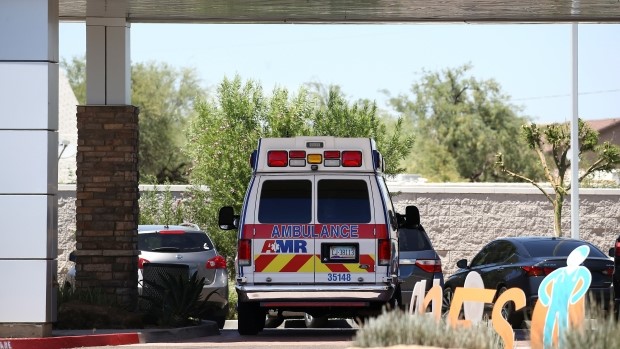
An ambulance is parked June 10, 2020, at Arizona General Hospital in Laveen, Ariz. (AP Photo/Ross D. Franklin, File)
Audit finds ambulance response time reports not properly monitored
Howard Fischer, Capitol Media Services//November 18, 2026//


Key Points:
-
A state audit found issues with reports on response time for state-licensed ambulance services
-
Enforcement of compliance standards has also been lacking, the report found
-
The Department of Health Services vowed to improve its reporting across the state
State health officials aren’t adequately monitoring ambulance response times, a new report says, which could endanger public health.
In a study released Wednesday, Auditor General Lindsey Perry said her staff found that the Department of Health Services did not adequately oversee whether public and private ambulances licensed by the agency comply with requirements to report how quickly they arrive at the scene of a call.
Perry said that, if nothing else, failing to properly monitor the 105 services that hold state certificates to operate ambulances impairs the ability to determine whether state laws and regulations are effective. The report also raised questions about whether the health department was adequately policing entities whose response times fell outside the set limits.
No single response time is set in either state law or rule. Instead, a spokesman said his agency establishes response time standards based on geographic area, population density, and what the department describes as other “geographic and medical considerations.”
“Response time requirements are tailored to individual service areas,” said J.P. Martin, adding that they are spelled out in each provider’s certificate. “Standards vary across the state rather than using a single statewide benchmark.”
Auditors randomly picked 10 reports from certificate holders that the department said met its response-time requirements. They found that eight of those reports “were inaccurate, incomplete, or lacked sufficient information needed to assess accuracy and completeness.”
For example, one unnamed provider said it was in 100% compliance with its requirement to respond to calls within 42 minutes. But supplemental information found that was not true in 23 of 827 calls.
Yet the health department still listed the provider as fully compliant — even with the inaccurate response time report — “but did not document its justification for this determination.” In six cases, certificate holders did not provide the required supplemental information.
“Without complete and accurate information, the department cannot ensure that certificate holders are compliant with their response time requirements established based on public need, which may impact public health if people do not receive timely ambulance services during health emergencies and events,” the report states.
Ensuring compliance
Then there’s the question of ensuring compliance. Auditors reviewed 14 corrective action plans and found that, in eight cases, certificate holders said in quarterly reports they still did not comply with the response time requirements.
In seven cases, the department required continuation of the corrective action plan, but decided that was not necessary in one case. It renewed two of the eight certificates for three years and renewed the remaining six for one year.
“We did not identify any evidence in the department’s files documenting any aggravating or mitigating factors to justify these inconsistencies in the approval of corrective action plans or its inconsistent renewal actions for certificate holders with continued noncompliance,” the report says.
The files include providers’ claims about why they were not complying. The department reported approving different corrective actions based on identified needs, such as amending response times due to population growth in a service area or a certificate holder’s staffing levels.
“But it did not document its justification for doing so,” the audit says.
The problems, the report says, extend beyond timely response.
GPS waivers
Auditors noted that state law requires ambulance providers to have a GPS monitoring device in each vehicle to track response time, defined as the time from when the ambulance provider is contacted to when it arrives at the dispatched location.
It also permits the health department to waive that GPS requirement for any provider that can “reasonably demonstrate it is unable to meet the statutory requirement.” The agency granted all 32 such applications it received in the 2025 fiscal year that was studied.
But the report says the agency has no policies or procedures in place to determine whether to grant such a waiver. Instead, auditors found, the agency gave the go-ahead for a variety of reasons.
Some said that they were unable to connect to Wi-Fi. Others argued that the equipment had been ordered but not yet delivered because it was on backorder.
And in two cases — one by a hospital and one by a fire district — the argument was that the cost of the devices was too high.
‘Committed to improvements’
DHS Director Debbie Johnston acknowledged the findings.
“The department agrees that annual response time reporting requirements have not been consistently implemented and monitored,” she wrote in a prepared response.
Johnson also noted that during the 2025 fiscal year, 90% of all 911 responses in the state arrived within 15 minutes.
Still, she acknowledged that a statewide average may not reflect what is happening in each service area. And Johnston said her agency “is committed to improvements that will strengthen the department’s ability to identify and address local variation and performance.”