Sign In



 Free Newsletter


Corporation Commissioners spar over last-minute ethics code rewrite
Reagan Priest, Arizona Capitol Times//November 18, 2026//
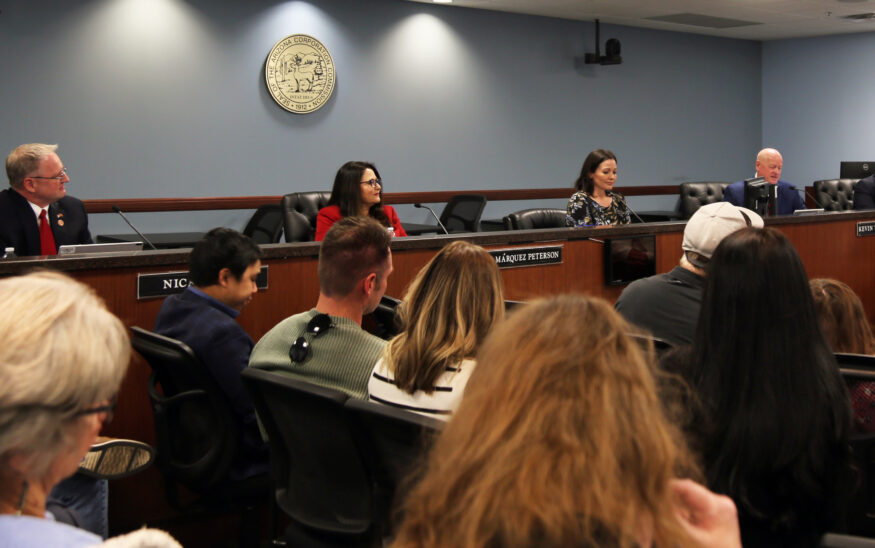
Members of the Arizona Corporation Commission sit at the dais during a swearing-in ceremony on January 6, 2025. (Reagan Priest/Arizona Capitol Times)
Corporation Commissioners spar over last-minute ethics code rewrite
Reagan Priest, Arizona Capitol Times//November 18, 2026//


Key Points:
-
Outgoing Commission Chair Nick Myers proposed the ethics code revisions
-
Some commissioners argued the changes only strengthen the authority of the ACC’s executive director
-
The draft also removes language barring political contributions from utility companies and loosens conflict-of-interest guidelines
A last-minute proposal to overhaul the Arizona Corporation Commission’s code of ethics sparked a contentious debate among the all-Republican commissioners Tuesday, with some questioning both the substance of the changes and the process behind them.
Outgoing Commission Chair Nick Myers introduced the ethics code revisions Monday afternoon, saying they were prompted by feedback he had received during his four years on the commission. But the proposal drew immediate criticism for expanding Executive Director Doug Clark’s authority, relaxing restrictions on political contributions and conflicts of interest, and because commissioners had little time to review or debate the proposed changes.
The dispute comes amid a series of controversies over the commission’s internal authority and commissioners’ conduct in utility rate cases. It also raises questions about the timing of the proposed changes, as Myers prepares to leave office and has expressed interest in returning to the agency in a staff position.
“I’ll be honest, when these [rules] were written, they weren’t very good,” Myers told his fellow commissioners. “The way it was done was piecemealed and in a rushed environment because of all the political stuff that was going on. So that’s a big part of the reason why we decided to go down the path of cleaning them up. And my office did spearhead a lot of the changes.”
Several commissioners and stakeholders said they felt blindsided by the proposals and didn’t know they were in the works.
Commissioner Lea Márquez Peterson recused herself from the conversation entirely, arguing the commission could be violating open meeting law since the revisions hadn’t been docketed within 24 hours of the meeting’s posted start time. Commissioner Rachel Walden said neither she nor Márquez Peterson had an opportunity to weigh in on the changes before they were filed.
“We’ve had nothing sent to us, so I continue to get left out of what legal counsel is working on and working on with other offices,” Walden said.
The Residential Utility Consumer Office and the Arizona Public Interest Research Group also filed letters to the commission questioning how the revisions were developed.
“Prior codes were adopted only after workshops, invitations for public comment, a proposed order, exceptions, multiple open meeting discussions, and time for Commissioners to propose amendments and debate the merits of the provisions,” wrote RUCO Director Cynthia Zwick. “This Draft was filed less than 24 hours before it is to be voted on, invited no feedback or opportunity to comment, and provided no time for Commissioners to prepare, let alone file, amendments.”
More authority for ACC’s director
The ACC created its first code of ethics in 2018 amid increased public scrutiny of utility companies’ campaign contributions that could lead to friendlier decisions. It was updated in 2021, but recent controversies at the commission have prompted calls for further revisions.
Though the commission’s Tuesday agenda originally included a vote on the ethics code, Myers said he only intended to discuss the revisions ahead of a possible vote in December. Even so, Walden took issue with several of the changes.
She and several stakeholders argued the new code would only strengthen Clark’s power just a month after Márquez Peterson accused him of exceeding his authority by firing her policy advisor in October.
Under the code’s revisions, the executive director would be responsible for “implementing, monitoring, supervising and advising the Commissioners on day-to-day operations” and would serve as the agency’s head. Personnel matters involving commissioner-hired staffers would go to a vote of the commissioners, but Clark would be called upon to cast the deciding vote in the event of a tie.
The ACC plans to hire outside counsel to examine what authority, if any, Clark has over hiring and firing commissioner-hired staff members. Additionally, Attorney General Kris Mayes is examining the issue at Myers’ request.
“We don’t have all of the information about [that], and now we have an ethics document that’s trying to solidify the executive director as an agency head, as having control over our staff,” Walden said.
She also questioned Myers’ judgment, noting that he told the Arizona Capitol Times in October he would be interested in returning to the commission as a staff member after he leaves office in January.
“If you’re voting on ethics rules that give authority to the executive director that usurps authority of the commissioners, are you, in a sense, protecting your ability to have a job in the future?” Walden asked.
Myers argued there is no conflict because the position he is interested in, deputy executive director, still hasn’t been formally created.
New conflict of interest rules
In addition to provisions that strengthen Clark’s power and position, Myers’ proposed revisions also remove language prohibiting political contributions from regulated utilities and loosen conflict-of-interest guidelines.
After Myers and Commissioner Kevin Thompson were asked multiple times to recuse themselves from two ongoing rate cases, the ethics code revisions appear to protect a commissioner’s public comments from being considered as conflicts of interest.
“Political views and policy views are not a form of bias that warrants disqualification as the Commissioner has been elected specifically because of these policy and political views,” the revised code reads.
Thompson, who lost his reelection bid, said he has no plans to vote on the revisions if they come before the commission in December.
“I think the new commission should have an opportunity to review these rules and vote on them,” Thompson said. “I can provide my feedback, and that’s what I plan to do, and probably nothing beyond that.”
Walden argued the discussion shouldn’t have happened at all, since commissioners had already spent the entire day Tuesday working through and voting on Tucson Electric Power’s rate case. She made it clear that she would not support the revisions as written.
“If we have ethics rules that continue to take away our authority, then people aren’t electing commissioners,” Walden said. “They’re electing bureaucrats. And that’s part of the problem in government in general. People get into office, and they try to get things done, and they can’t because they’re undermined by bureaucrats.”