Sign In



 Free Newsletter


What’s next for Arizona Republicans now in the minority?
Jakob Thorington, Arizona Capitol Times//November 12, 2026//
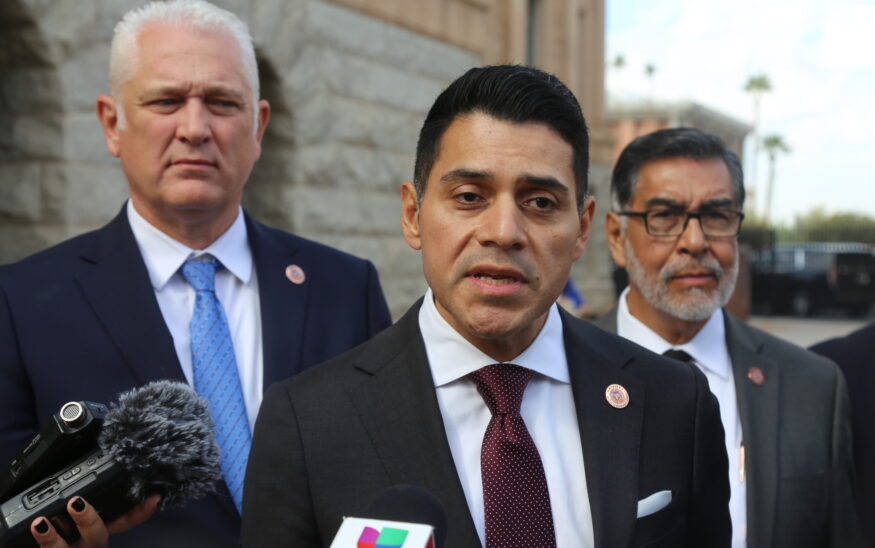
Incoming House Minority Leader Steve Montenegro, Assistant Minority Leader Michael Carbone, and Minority Whip Lupe Diaz speak to reporters after a House Republican caucus organization meeting on Nov. 6, 2026 (Jakob Thorington/ Arizona Capitol Times).
What’s next for Arizona Republicans now in the minority?
Jakob Thorington, Arizona Capitol Times//November 12, 2026//


Key Points:
-
Republicans are entering the 2027 legislative session with minorities in both chambers and a Democrat as governor
-
The midterms reflect a growing pattern of Democratic electoral momentum in Arizona over the last decade
-
Election analysts say Republican turnout was low compared to previous years
Democrats last took control of Arizona’s Legislature in 1964 — the same year U.S. Sen. Barry Goldwater announced he would seek the Republican presidential nomination, and The Beatles topped the music charts with “I Want to Hold Your Hand.”
Republicans now must decide how to respond after ceding legislative and executive power to Democrats for the first time in more than 60 years. The next two years will be a significant change of the guard at the Capitol, especially for GOP lawmakers who have never known what it’s like to be the minority party.
“It’s a big change for Democrats, but it’s going to be a really big change for the Republicans coming back who are used to having the best parking spots, the best offices, the best secretaries,” said political consultant and former House majority communications director Barrett Marson.
Republicans will go from a 17-member Senate majority and a 33-member House majority to minorities of 10 and 23, respectively, once the next legislative session starts. With Gov. Katie Hobbs heading into a second term, Republicans have few options to block Democratic bills.
GOP leadership will mostly remain the same. House Republicans on Friday elected outgoing Speaker Steve Montenegro, R-Goodyear, as its incoming minority leader, and Senate Republicans on Monday elected current Senate Majority Leader John Kavanagh, R-Fountain Hills, as Senate minority leader.
Kavanagh acknowledged this week that Democrats will entirely control the legislative agenda.
“They can dismantle everything we’ve done in the last 30 to 40 years,” Kavanagh said in a Tuesday interview with the Arizona Capitol Times.
Senate Republicans are bringing in outgoing Senate President Warren Petersen, R-Gilbert, as minority chief of staff next session. Kavanagh said the 10-member caucus was in a “crisis” after the election because Chief of Staff Josh Kredit will not return for a minority role, but he expressed confidence in Petersen’s ability to do the job.
“We realized that there was somebody hiding right in front of us and that was Warren Peterson, who will be available, who has the skillset, who has the knowledge, who already has relationships with members on both sides of the aisle,” Kavanagh said. “He’s probably the most powerful person we could have selected.
Party priorities
Kavanagh said Republicans’ top priority is to regain their legislative majorities, but he recognized they can mostly only inform Arizonans about the issues they see with Democratic legislation and provide input on nonpartisan bills.
Democrats have not yet outlined a specific legislative agenda for 2027. But Senate President-elect Priya Sundareshan, D-Tucson, said Friday that Democrats will introduce many of the bills that went unheard last legislative session that aim to lower costs of housing, healthcare and utilities.
“We are ready to pick right back up and make sure that they’re still relevant to today, but I think they absolutely are,” Sundareshann said.
Montenegro told reporters that Republican legislative priorities remain the same, even as Republicans understand that voters have made their decision. One of Republicans’ main priorities is to keep the Empowerment Scholarship Account program universally eligible. Republicans expanded the program in 2022, making Arizona the first state in the union to create a universal school voucher program.
“We’ll have time to take a look at what happened,” Montenegro said. “Right now, we’re focused on preparing our caucus and being united to be prepared for January to get to work.”
So what happened?
Election results are still unofficial, but HighGround Public Affairs Consultants CEO Chuck Coughlin said he suspects that the midterm results will show low Republican turnout compared to previous elections. His firm also found that independents broke away from Republicans by significant margins leading up to the election.
A surprise result in this election cycle is two likely legislative victories for Democrat House candidate Mary Rose and Senate candidate Stephanie Walsh in the Gilbert-area Legislative District 14, where Republican registered voters outnumber Democrats 66,000 to 34,000, according to the Secretary of State’s latest voter registration report.
Another 54,000 voters in the district are unaffiliated, but few expected a Democrat to win after Petersen won the 2024 Senate race by more than 20 points .
By Wednesday, Walsh’s Republican opponent, Mylie Biggs, had received about 46,000 votes in the district. Petersen got 76,000 votes in 2024 and 64,000 in 2022.
Sen. T.J. Shope, R-Coolidge, also underperformed compared to recent elections in the swing district. Shope, who many thought would lead Senate Republicans, has conceded to Democrat Elaine Aldrete. He had received 39,000 votes by Wednesday. He got 58,000 votes in 2024 and 41,000 votes in 2022, winning both elections by double-digit margins.
Is Arizona trending blue?
Samara Klar, a political science professor at the University of Arizona, said she was surprised to see Democrats take as many legislative seats as they did, but the results indicate a trend of growing Democratic momentum in Arizona over the last decade.
“Republicans have been losing control pretty consistently for the last 10 to 15 years,” Klar said. “The margin of their majority has been shrinking, but I’m not sure if anyone was prepared to see the Democrats sweep. … I think everyone’s a little surprised that Republicans in these smaller districts are also being held accountable for dissatisfaction with Donald Trump.”
Kavanagh said he expects Democrats to feel pressure to get “left-wing” bills passed since there’s a possibility they may only be in the majority for two years, but Democrats in swing districts have said after the election they recognize that votes for them this year may be more about opposition to Republicans and an increasingly higher cost of living that voters are experiencing.
“We have to deliver [on affordability],” said Rep.-elect Julia Gusse, a city of Maricopa Democrat who ran for the House in the swing district of LD 16. “We have to deliver for the people of our communities; otherwise, this blue wave is going to turn into a blue puddle.”