Sign In
Upcoming Event
 Free Newsletter

Democrats attempt affordability bills in Republican-controlled committees
Jordan Gerard, Arizona Capitol Times//February 6, 2026//
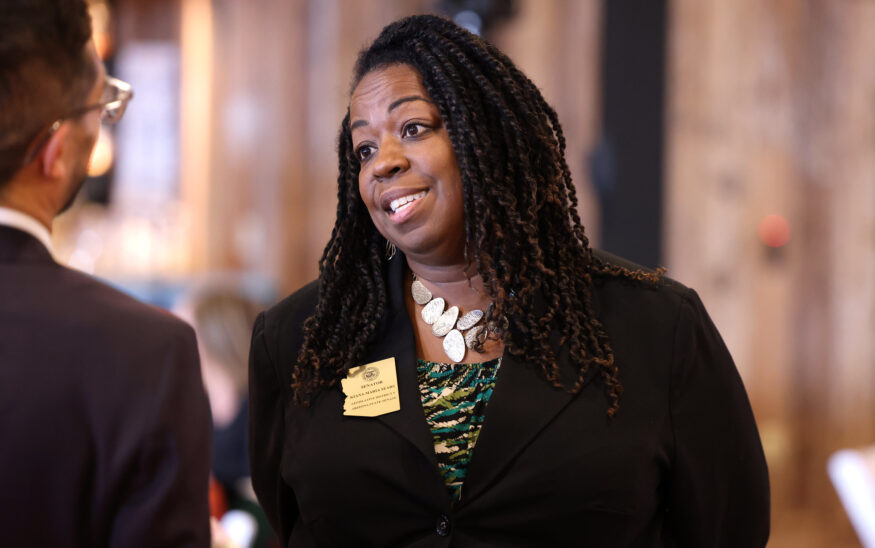
Sen. Kiana Sears, D-Mesa, speaking with attendees at the 2025 Annual Awards Celebration hosted by the Arizona Chamber of Commerce & Industry at Republic National Distributing Company in Phoenix, Arizona. Sears’ yet-to-be-heard Senate Bill 1797 would prohibit price gouging for manufacturers and wholesale distributors of essential generic drugs. (Gage Skidmore / Flickr)
Democrats attempt affordability bills in Republican-controlled committees
Jordan Gerard, Arizona Capitol Times//February 6, 2026//


Key Points:
-
Democrats file 257 bills this session, emphasizing affordability
-
Many affordability bills will require bipartisan support for approval
-
Approval would impact health care, education, housing and other industries
Arizonans are facing an affordability crisis, but Democrats are determined to address at least some of those issues if they can only get their bills heard in committee.
Democrats started the legislative session with a unifying message of “An Arizona We Can Afford,” which includes tackling housing issues, education, and myriad rising costs in health care, child care and utilities.
The minority party has introduced at least 257 pieces of legislation (including resolutions), far fewer than the Republicans’ 600 bills, according to an Arizona Capitol Times analysis. But they’re going for quality over quantity, Senate Minority Leader Priya Sundareshan told the Capitol Times earlier this year.
“I’m certain that we have not held back,” she said. “We, continually, are finding new issues that crop up that we want to address with new bills, and then, of course, there is the backlog of Democratic bills that Republicans never hear.”
Senate Democratic bills are rarely heard in committees these days. Many of the bills are assigned, but the Republican lawmakers leading the committees haven’t put them on the agenda and so they go unheard.
At a news conference on Feb. 5, legislative Democrats, along with the advocacy organization Opportunity Arizona, reiterated this issue. They pointed out several pieces of Republican legislation that won’t help affordability, such as Sen. Janae Shamp’s Senate Bill 1070, which would direct the Department of Health to study so-called “Trump Derangement Syndrome,” and several senators’ bills that would support anti-immigration efforts.
“We are in the minority, but we are also critical votes for many important things that need to happen in this state. We eventually need to sign a budget, so we will be looking at all of the tools available to us to ensure that these affordability bills are heard,” Sundareshan said. “Republicans need to give these bills a hearing so that we can have an Arizona that we can afford.”
It’s unlikely though, as the philosophical divide hasn’t been crossed too many times this session.
“Republicans want to grow the economy by cutting taxes so people have more money and businesses can grow. Democrats want to deal with the needs by increasing taxes so the government can run programs,” Senate Majority Leader John Kavanagh, said. “We’re philosophically different. Never the twain shall meet.”
There will be a large number of bills that are not controversial, such as those needing changes to accommodate for changing conditions or changing federal law, and likely a good number of bipartisan bills that will make it to the other chamber and possibly Gov. Katie Hobbs’ desk, he said.
The plethora of bills paves the way to mid-term elections, allowing voters on both sides to see what their parties supported or opposed. It also speaks to what bills Hobbs approves or vetoes.
“We send bills up knowing they’ll be vetoed. The people see what the governor vetoed, and if they agree, they can vote for the governor. If they disagree, they can vote against the governor next time,” Kavanagh said.
With two parties standing on the philosophical divide over how to address affordability, Arizonans are caught in the middle, still fighting rising costs of living.
“The hope here is that Republican legislators will start to talk with Democrats about our affordability ideas, either hear our bills or incorporate our ideas into the bills that they’re moving forward so that the governor actually can sign them and help address, give relief to Arizonans who need it,” Sundareshan said.
But nothing gets done in a divided government, Kavanagh said.
Both parties have introduced bills that would impact affordability for many people, and the following list is the best example of each category, according to an Arizona Capitol Times analysis.
Democrats:
Housing:
Senate Bill 1442 would prohibit a corporation from purchasing single-family homes unless the home has been on the market for more than 90 days or there is a change in the asking price. It would also require annual reporting of single-family home purchases and sales by corporations and impose a $20,000 fine per violation for noncompliance.
Sen. Analise Ortiz, D-Phoenix, authored the bill and it has been referred to Regulatory Affairs and Government Efficiency (RAGE) and Rules, but hasn’t been heard.
Health care:
Senate Bill 1797 would prohibit price gouging for manufacturers and wholesale distributors of essential generic drugs. The attorney general would be able to investigate significant price increases, require cost and access expansion disclosures and enforce penalties. If found guilty, manufacturers may be required to sell the drug to the state medical assistance program participants at pre-violation prices for up to one year.
Sen. Kiana Sears, D-Mesa, is the author, but the bill has not been assigned to any committee.
Child care:
Senate Bill 1597 would amend eligibility and funding provisions for child care assistance, including income thresholds, prioritization of waiting lists and criteria for denial or termination of assistance. It would also allocate money to eliminate the current waiting list and provide assistance to eligible families with incomes up to 165% of the federal poverty level.
Sen. Lela Alston, D-Phoenix, is the author, but the bill has not been heard in either Health and Human Services, Appropriations, Transportation and Technology or Rules.
Utilities:
Senate Bill 1384 would prohibit utility companies and corporations from using ratepayer funds for political contributions, charitable giving, advertising, lobbying and other nonrecoverable expenses.
The author is Sundareshan and the bill has not been heard in the Natural Resources Committee.
Republicans:
Housing:
Senate Bill 1431 would prohibit municipalities from imposing certain design or aesthetic standards on single-family homes and accessory dwelling units in subdivisions or developments, unless federally mandated. It would not apply to historic districts, tribal lands and military noise zones.
The author is Sen. Shawnna Bolick, R-Phoenix, and there is bipartisan support for this one, as Sen. Flavio Bravo, D-Phoenix, also signed on. It has not been heard in RAGE or Rules.
Health care:
Senate Bill 1316 establishes the Arizona Rural Health Transformation Fund, which would be managed by the Arizona Health Care Cost Containment System. It would use money from the Rural Health Transformation Program, a federal program that promotes rural health innovation, strategic partnerships, infrastructure development and workforce investment. The bill would require three public meetings in each of Arizona’s largest metropolitan areas to gather input and feedback on how the money should be spent. An expenditure plan must also be submitted to the Joint Legislative Budget Committee for approval.
The author is Sen. Hildy Angius, R-Bullhead City, and the bill passed the Health and Human Services Committee on a 4-3 vote, with Democratic senators voting against it.
Child care:
Senate Bill 1867 would amend laws related to the Empowerment Scholarship Accounts. If a parent does not renew their student’s ESA, any remaining money will be returned to the Department of Education and the account will be closed. After a student graduates high school, the funds can be used for college but any unused funds would go back to the state.
Sen. Jake Hoffman, R-Queen Creek, is the author, but the bill has not been assigned to a committee.
Utilities:
Senate Bill 1558 addresses regulations for mobile home parks and the requirement that landlords specify utility charges. It also provides remedies for tenants, including giving a written notice to a landlord and then filing a civil complaint.
Senate Majority Leader John Kavanagh, R-Fountain Hills, is the author, but the bill has not been heard in RAGE or Rules.