Sign In
Upcoming Event
 Free Newsletter

Corp Comm incumbents accept ‘prohibited donations’ despite claims to the contrary
Reagan Priest, Arizona Capitol Times//July 15, 2026//
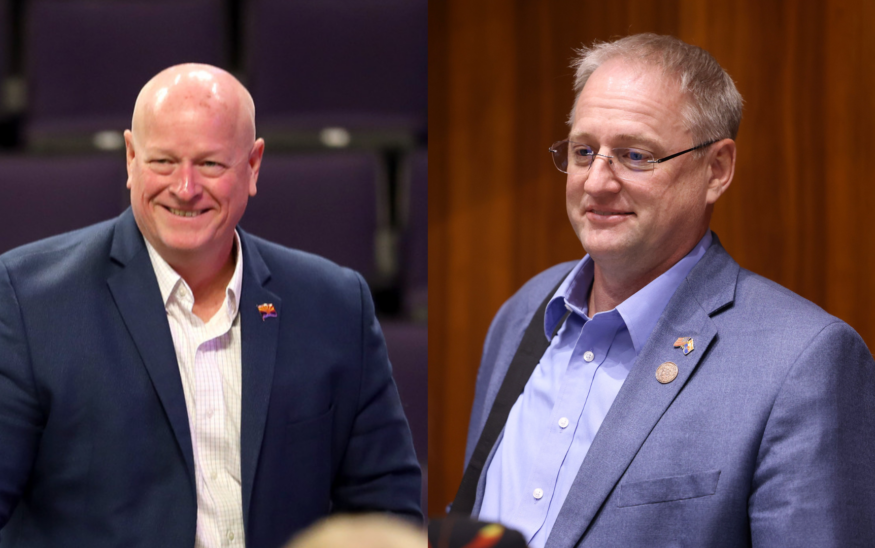
This combination photo features Arizona Corporation Commissioners Kevin Thompson (left) and Nick Myers. (Photos by Gage Skidmore)
Corp Comm incumbents accept ‘prohibited donations’ despite claims to the contrary
Reagan Priest, Arizona Capitol Times//July 15, 2026//


Key Points:
-
Two incumbent Arizona Corporation Commissioners accepted 212 donations from individuals with ties to utility companies
-
Commission Chair Nick Myers and Commissioner Kevin Thompson accepted donations from individuals registered as lobbyists with the ACC
-
The donations could violate the commission’s own code of ethics policies on campaign contributions
Two Arizona Corporation Commissioners seeking reelection have said they aren’t influenced by the utility companies they regulate.
But campaign finance reports reviewed by the Arizona Capitol Times show they have each accepted small-dollar donations from individuals with vested interests in their decisions, potentially violating the Commission’s own code of ethics.
Commission Chair Nick Myers and Commissioner Kevin Thompson have outpaced their opponents in taking more small-dollar donations from utility executives, lobbyists, energy industry executives, real estate developers and attorneys who appear before the ACC, the reports show.
Since 2021, Myers’ campaign committee has reported more than $15,000 in small donations from those donor types, while Thompson’s committee accepted over $23,000 in similar contributions.
Additionally, the two have accepted contributions from individuals registered as lobbyists with the ACC, which appears to be a direct violation of the commission’s own code of ethics.
The Arizona Capitol Times provided both commissioners with a list of the individual contributions reviewed for this story. In separate emailed statements, Myers and Thompson said they do not personally monitor their campaign donations and have not let those contributions influence their decisions at the commission.
“I am my own man. I follow my convictions and do what I think is right for ratepayers and our utilities,” Thompson said. “I applied that same conviction while I was on (Mesa) City Council, receiving traditional campaign donations. I believe my track record proves it on both counts.”
Myers said the two candidates participate in the Clean Elections system to avoid taking large donations from PACs and corporations.
“Because (Clean Elections) is set up to be a fair process and no money can be taken from corporations, it is fair to say that I have never taken any money from the entities that we regulate,” Myers said.
In his statement, Myers deflected criticism to his opponents, claiming one of the two Democrats in the race is not running as a Clean Elections candidate. However, Clara Pratte and Jonathon Hill have both qualified for Clean Elections funding.
Pratte and Hill have received individual donations similar to those accepted by Myers and Thompson, though in much smaller amounts and from individuals with far more distance from the ACC. Many of their donations came from energy industry lobbyists working in other states or on federal policy issues.
By comparison, Pratte received $2,296 in similar donations, including one from a commission-registered lobbyist. Hill received $3,315 in similar donations, with two donations coming from commission-registered lobbyists.
Rep. Ralph Heap, R-Mesa, is hoping to unseat one of the incumbents in the Republican primary and received even less money in individual donations from those donor types. He netted $1,105 from lobbyists and real estate developers, none of whom were lobbyists registered with the commission.
Myers, Thompson and the three challengers running for ACC seats this year are all participating in the Clean Elections Commission’s public financing system.
Such candidates receive a taxpayer-funded lump sum from Clean Elections to finance their run for office by agreeing to reject large donations from political action committees, labor unions, businesses and corporations.
Small donations, big connections
The Commission’s code of ethics prohibits commissioners from accepting donations from “any regulated public service corporation” and any “person or entity in a generic docket or rulemaking proceeding that is registered as a lobbyist … or represented by a lobbyist that is registered with the Commission.”
Additionally, the code requires commissioners to return “prohibited donations” or recuse themselves from decisions related to that donor if a donation cannot be returned.
Myers and Thompson, who ran a successful joint campaign for the ACC in 2022, are running as a team again this year. Together, they accepted 212 donations from individuals with direct ties to Arizona utility companies, lobbying firms, energy industry companies and law firms since their campaign committees were established in 2021.
Clean Elections rules prohibit individuals from contributing more than $220 to an individual candidate. Most of the 212 individual donors in question maxed out their donations to the two commissioners.
Both commissioners accepted donations from 10 individuals who are registered as lobbyists with the commission.
The donors represent or previously represented several water, gas and electric utilities regulated by the commission, including Arizona Water Company, APS and EPCOR. They also represent energy and water industry groups, business organizations and housing developers who stand to benefit from the construction of certain utility infrastructure and energy projects.
Many donations also came from executives at utility companies such as EPCOR and Global Water, lobbyists for groups such as the American Gas Association, and attorneys representing utilities such as Tucson Electric Power and UNS Electric.
NextEra Energy, a renewable energy development company that also provides electricity to customers in Florida, made a slew of maxed-out donations to campaign committees for Myers and Thompson in fall 2025. According to campaign finance reports, 18 individuals employed by NextEra donated to Myers and 19 individuals donated to Thompson.
NextEra has built several solar farms and battery storage projects in Arizona, all of which must obtain line-siting approval from the ACC. The Commission’s line siting committee is currently considering an interconnection application for the company’s Vulcan Energy Center, which will ultimately provide solar and battery energy storage to Salt River Project.
In March 2025, Picacho Water Company and Picacho Sewer Company filed rate cases for the first time in decades. The companies serve the Robson Ranch retirement community near Eloy and were sold to Colorado-based JW Water in 2024 via a stock sale.
JW Water’s CEO donated $220 each to Myers and Thompson’s campaigns in August 2025. According to the Secretary of State’s campaign finance portal, those donations were the CEO’s first and only contributions to candidates in Arizona.
The ACC ultimately approved a 22% water rate increase and a 154% wastewater rate increase for the Picacho companies in March, with Myers voting in favor and Thompson voting against. Neither commissioner disclosed the donation from JW Water’s CEO nor recused themselves from the March vote, despite the commission’s code of ethics requiring disclosure at the beginning of any open meeting in which a vote will be taken on a matter.
Ethics code designed to build trust
ACC candidates began running as Clean Elections candidates around 2020, a few years after the commission adopted a code of ethics meant to prevent allegations of shady dealings that had plagued the body for years.
In one instance, a former commissioner was indicted on bribery and fraud charges related to a “dark money” campaign alleged to have been waged by APS.
The case was ultimately dismissed, but had a drastic impact on public trust in utilities and the ACC. APS, the state’s largest electric utility, pledged to stop donating to commission races in 2020 after spending millions of dollars supporting political organizations that funded ACC candidates in previous elections.
Diane Brown, the executive director of the Arizona Public Interest Research Group, was one of several stakeholders who helped the ACC develop its new code of ethics. She said the commission’s unique, “quasi-judicial” role necessitated special rules and policies governing commissioners’ behavior.
Even though ACC candidates use the Clean Elections system, it is not required by the commission’s code of ethics, and disclosure of potential conflicts of interest relies on the assumption that commissioners will routinely monitor their campaign committees and point out potential conflicts themselves. Brown said that alone is not enough to prevent the appearance of a conflict, whether real or perceived.
“Commissioners and commission candidates should make it clear to regulated utilities, corporations, and other entities that appear before the body that they will not and cannot accept campaign contributions,” Brown said. “Utility leadership should also make it clear to their employees that they are not to give a donation in order to help avoid the potential appearance of access or influence that may not be enjoyed by other Arizonans.”
Additionally, Brown noted that the donations allowed under Clean Elections rules may be small compared to the millions of dollars utility companies previously poured into ACC races, but they can still shake voters’ confidence in the commission’s independence.
“A candidate may or may not be influenced by any one contribution,” Brown said. “However, compounding contributions from a regulated entity or corporation that financially stands to gain from a commission decision elevates at least the potential for impropriety.”