Sign In
Upcoming Event
 Free Newsletter

Conservative group sues Fontes over Prop. 144 explainer
Howard Fischer, Capitol Media Services//August 4, 2026//
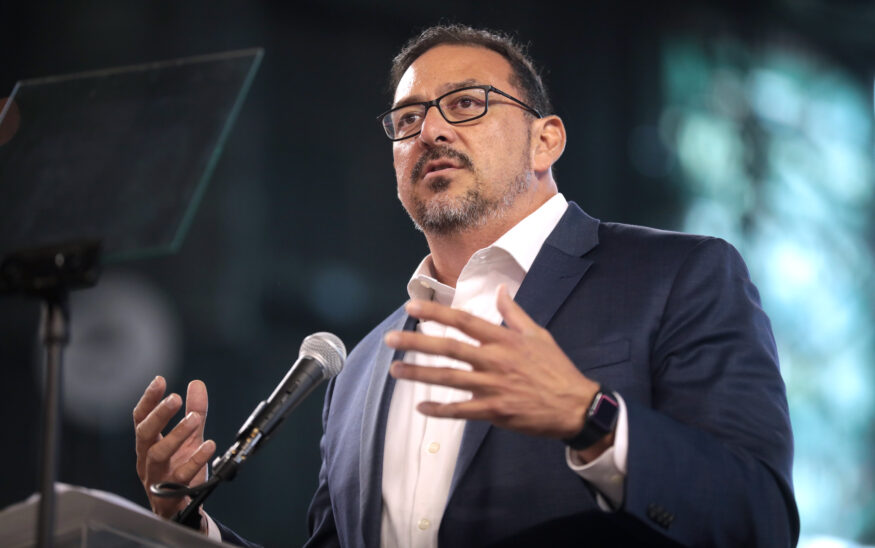
Arizona Secretary of State Adrian Fontes speaking with attendees at the 2023 Legislative Forecast Luncheon hosted by the Arizona Chamber of Commerce & Industry at Chase Field in Phoenix. (Gage Skidmore / Flickr)
Conservative group sues Fontes over Prop. 144 explainer
Howard Fischer, Capitol Media Services//August 4, 2026//


PHOENIX — A conservative legal group is accusing Arizona Secretary of State Adrian Fontes of trying to mislead voters about a Republican ballot measure that would change state election laws.
In a new lawsuit, America First Legal notes that state law requires Fontes to prepare a neutral explanation of the effect of each measure on the ballot. That explanation, along with a description of the effect of voting for or against it, appears on the actual ballot.
But attorney James Rogers contends that what Fontes prepared for Proposition 144 runs afoul of that law. He said it omits critical information about what is in the measure and misleads voters about the effects of some of the provisions.
And now he wants Maricopa County Superior Court Judge Adele Ponce to order the secretary to reword it.
Fontes’ press aide, Calli Jones, said the explanation is legal and provides voters what they need to know.
Multiple election law changes proposed
Prop. 144 proposes multiple changes in law that its prime sponsor, Scottsdale Republican Rep. Alexander Kolodin, contends would make elections “more secure.”
One key provision states that “only citizens may register to vote in Arizona elections.” It would also require that Arizona elections “be decided solely by the votes of eligible citizen voters.”
Fontes’ explanation does not mention those provisions. But he argues that those are currently state laws.
And Jones said, given the amount of space on each ballot to provide the explanation, “reiterating their talking points about requiring citizenship and voter ID was taking up unnecessary space.”
The lawsuit also targets Fontes’ description of the measure’s restrictions on foreign spending in Arizona elections. His summary says the provision is similar to existing federal law.
Rogers argues that comparison is inaccurate because federal law bars foreign contributions to candidates but does not broadly prohibit foreign spending on ballot measures, as Proposition 144 would.
Voter ID at center of dispute
Much of the dispute, however, centers on the measure’s voter ID provisions.
Proposition 144 would amend the Arizona Constitution to require voters to present valid identification before casting a ballot. This would be the case whether they are voting in person or by another method.
The measure does not specify how that requirement would apply to the more than 80% of Arizona voters who cast ballots by mail. Instead, it leaves those details to future legislatures.
It would also amend the Arizona Constitution to state that all new election laws — including on early and mail voting — are presumed to be legal as long as they are connected to a “legitimate state interest.” That would include everything from getting timely election results to “preserving public confidence in the integrity of elections.”
Fontes told voters that would create a new judicial review standard “which may make it harder to challenge election laws.”
Rogers argues that language crosses the line from explanation into advocacy.
Rogers calls that “a contested legal conclusion and litigation prediction.” Given that, he said the statement should be removed because it describes a potential legal consequence rather than the measure’s actual text.
‘Political interests’ at play?
Jones said there’s nothing wrong with Fontes’ explanation.
“What was included by the office was necessary, neutral, and provided voters with the needed information regarding the legitimately proposed statutory changes,” she said. “We have a responsibility to make sure people know that these referrals actually do and how they may change existing law, not regurgitate talking points.”
Rogers, however, sees politics at work.
He noted that Kolodin is now the Republican nominee for secretary of state. That means he will face off in November against Fontes, a Democrat.
Rogers told Ponce he is not arguing that Fontes is disqualified from preparing ballot explanations because of his “political interests.” But he said those interests “explain how the ballot language came to resemble an argument against Proposition 144 and underscore the need for exacting judicial review.”
“Secretary Fontes had one job here: tell Arizona voters the truth about what’s on their ballot,” Rogers said in a statement.
No date has been set for a hearing.