Sign In


 Free Newsletter

Multistate litigation a driving force in federal policy
Kiera Riley, Arizona Capitol Times//July 29, 2026//
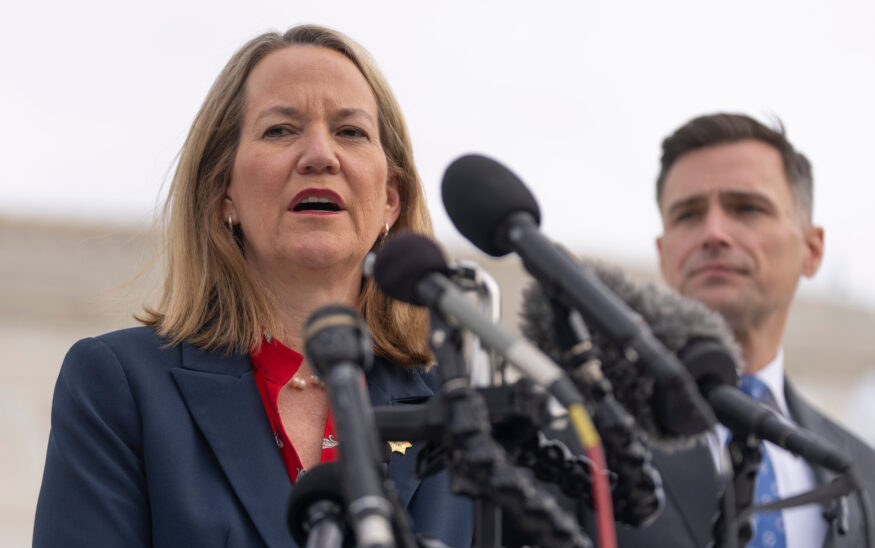
Arizona Attorney General Kris Mayes speaks to reporters as Oregon Attorney General Dan Rayfield listens outside the Supreme Court on Wednesday, Nov. 5, 2025, in Washington. (AP Photo / Mark Schiefelbein)
Multistate litigation a driving force in federal policy
Kiera Riley, Arizona Capitol Times//July 29, 2026//


Key Points:
- Multistate lawsuits led by attorneys general are increasingly shaping federal policy
- Attorneys general now wield growing political influence
- Arizona’s attorney general race stands to shift litigation priorities statewide
The race for Arizona Attorney General will not only determine the state’s next top lawyer but also which side of the nation’s escalating fights with the White House and corporate America the state joins.
Democratic, Republican and bipartisan coalitions of attorneys general are increasingly suing the federal government and major corporations over issues ranging from immigration and healthcare to elections, consumer protection and antitrust enforcement.
Such coordinated litigation is not new. But over the last decade, the number of these cases has grown sharply and, as a result, has increasingly become a powerful tool in reshaping federal policy.
“I would describe it like a machine, like an investigation and litigation machine that is very efficient and effective at targeting companies or the federal government in ways that push policy in their preferred direction,” said Paul Nolette, a professor and director of the Les Aspin Center for Government at Marquette University. “That machine didn’t exist 20 years ago.”
Arizona’s current attorney general, Democrat Kris Mayes, will face Republican challenger Senate President Warren Petersen this fall.
Mayes has frequently joined and led multistate litigation, a tactic she said she will continue if reelected in November. But if Petersen prevails, the state will likely shift gears in a long list of lawsuits.
“It is a position where you can create your own priorities and pursue them in a way that even governors can’t, or U.S. senators or [representatives] or state legislators,” Nolette said. “They have much more freedom in terms of doing what they think is good in terms of pursuing policy.”
It started with Big Tobacco
In 1998, 52 states and territories succeeded in suing the nation’s four largest tobacco companies.
The lawsuit led to a master settlement agreement restricting tobacco advertising and marketing, dragging health risks into the open, raising the price on cigarettes, and providing funds for states to fund smoking prevention and youth education programs.
“That was a big political issue, and AGs were on it,” Nolette said. “After years and years of failures in the courts, they actually brought the tobacco industry — big tobacco — to their knees.”
Though multistate legal efforts were waged before this case, the 1998 litigation set off a steady increase in attorneys general working together to influence national industries and national policies.
“Their portfolio has grown dramatically in terms of what they’re interested in and the types of issues that they get involved in,” Nolette said.
A ‘thorn in the side’ of the White House
States’ top law enforcement officers have expanded their status from government defense attorneys to consumer advocates to now, a “thorn in the side of the opposite party whenever they’re in office in the White House,” Nolette said.
The number of multistate lawsuits against presidential administrations has grown significantly over the decades:
- Ronald Reagan: 30 over two terms
- George H.W. Bush: 20 over one term
- Bill Clinton: 42 over two terms
- George W. Bush: 76 over two terms
- Barack Obama: 80 over two terms
- Donald Trump: 160 in first term, 120 so far in second term
- Joe Biden: 133 over one term
Though Democratic states have filed against Republican presidential administrations since Reagan was in office, and Republicans heavily litigated against President Barack Obama, Democratic efforts to block policy in Trump’s first term set a new standard.
Democratic attorneys general sued over immigration policies, travel bans, and swaths of energy and environment issues. In turn, a surge of Republican litigation befell Biden during his time in office over issues ranging from vaccine mandates to student debt relief to greenhouse gases.
According to Nolette’s research, Democratic attorneys general saw an 83% success rate in litigating against Trump in his first term, while Republican attorneys general prevailed in 74% of cases filed against Biden.
“It just shows you how powerful the states can be,” Nolette said.
National litigation
The Democratic Attorneys General Association reports 120 total lawsuits filed against the Trump administration during his second term. And of the 77 rulings so far, multistate coalitions have won, at least initially, in 63 cases.
In the weeks after Trump’s second inauguration, he issued an executive order attempting to wipe out birthright citizenship.
Attorneys General from Washington, Illinois, Oregon and Arizona sued. The district court in Washington issued a nationwide stop on the executive order, and the U.S. Court of Appeals for the Ninth Circuit ruled the order unconstitutional.
From there, Democratic state attorneys general kept filing and, in the process, halted funding freezes and the dismantling of federal agencies and public programs.
One lawsuit from 23 states successfully challenged the administration’s refusal to fund the Supplemental Nutrition Assistance Program during the government shutdown.
Another — led by California, Massachusetts, Nevada and Washington — recently succeeded in striking down Trump’s executive order restricting mail-in voting and voter eligibility.
A 23-state coalition led by Oregon, Washington and New York succeeded in blocking a law cutting off Medicare and Medicaid funding to any doctor or hospital providing gender affirming care.
Arizona v. Trump
Mayes has joined around 60 multistate lawsuits, 46 of which have been filed against the Trump administration.
“You really have the expertise of all the AG’s offices that are involved,” said Richie Taylor, spokesperson for Mayes.
He added collaboration can fill in areas where the Arizona Attorney General’s Office may be lacking in resources — pointing to antitrust as one example.
“Other states have beefed up their antitrust units. Obviously, the Legislature hasn’t given us money to do that. But the benefit is that you get access to a wide range of attorneys to work on a specific case and also to the pooling of resources,” Taylor said. “It makes good use of tax dollars.”
Arizona has joined litigation efforts to protect birthright citizenship, vaccine schedules and federal funding for education, healthcare, public health grants, emergency response assistance and homelessness.
Mayes’ office joined in litigating against Trump’s tariffs, federal employee lay-offs, restrictions on mail-in voting and federal access to state-level election data.
Arizona v. Corporate America
Not all of Mayes’ litigation has been against the federal government nor solely propelled by Democratic attorneys general. Her office, in multistate litigation, has taken Meta, Live Nation and Ticketmaster, Apple, John Deere, Walmart, Zillow and Redfin, and Paramount and Warner Brothers to court in the name of consumer protection.
Taylor again pointed to antitrust litigation against the likes of Paramount and Warner Bros, Kroger and Albertsons, and Live Nation and Ticketmaster as an area where states have had to step in where the federal government failed to act.
“There are major issues of national importance that maybe aren’t being addressed from the federal level,” Taylor said. “It really was left to the states, who said, ‘No, this is a problem in our states. This is going to cause job loss in our states. This is going to cause higher prices in our states, and so it’s going to be up to us to step up when the federal government has done what it would do traditionally.’”
Taylor noted most, but not all, litigation from the Attorney General’s office has been in concert with fellow Democrats, though it’s not out of line with the trend in multistates.
“The large balance of the multistate cases have been with other Democratic AGs because they share policy priorities,” Taylor said. “It’s the same on the Republican side. [Former Attorney General Mark] Brnovich also did multistate cases. I would assume any Republican AG that comes at some point in the future would do that too.”
How would Petersen act?
Petersen did not respond to multiple requests for comment on how he envisioned using multistate litigation in the Attorney General’s office if elected.
But Petersen has sought political power akin to the Attorney General as a plaintiff in litigation on behalf of the Legislature, often serving as a legal counterweight to Mayes.
Petersen and House Speaker Steve Montenegro have moved to defend state laws in federal and state courts and have gone so far as to file multiple amicus briefs with the U.S. Supreme Court in support of Republican multistate litigation.
Nolette said he expects the use of multistate lawsuits to continue to grow alongside partisanship and polarization, especially as attorneys general across parties become “more active and activist.”
“It’s really important to just remember that they are very much political players,” Nolette said. “These are political decisions, and that matters. And it’s not bad … but I think as they’ve gotten more and more involved in all sorts of policy issues, politics has really become a bigger part of the whole story.”