Sign In


Upcoming Event
 Free Newsletter

Report identifies keys to nuclear development
Humberto Sanchez, Pluribus News//August 17, 2026//
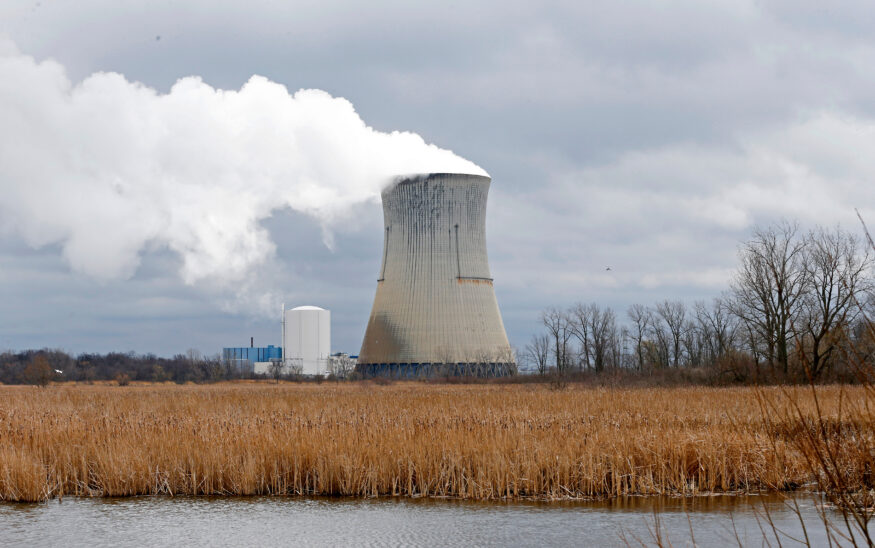
FILE – Plumes of steam drift from the cooling tower of FirstEnergy Corp.'s Davis-Besse Nuclear Power Station in Oak Harbor, Ohio, April 4, 2017. (AP Photo/Ron Schwane, File)
Report identifies keys to nuclear development
Humberto Sanchez, Pluribus News//August 17, 2026//


Focusing on workforce development, expediting permitting and lowering financial risk will help states develop nuclear power, according to the Nuclear Innovation Association’s 2026 guide for state policymakers.
“The real intent of this guide is to provide state policymakers with the knowledge necessary to understand how they can bring new nuclear energy to their states,” Zach Koshgarian, who authored the document, said on a call Tuesday unveiling the annual update. “The guide ultimately answers this question ‘What can states do?’ by highlighting these policies, partnerships, and initiatives that can help advance new nuclear energy in their states.”
The Nuclear Innovation Alliance is a nonprofit nuclear energy think tank. Koshgarian is an NIA analyst.
Over the last few years, states have increasingly explored nuclear power as demand for electricity is projected to rise with the rapid expansion of artificial intelligence and data centers, a rise in domestic manufacturing and industrial onshoring, and the widespread electrification of transport and heating.
According to consulting firm ICF, electricity demand is projected to increase 25% by 2030 and 78% by 2050.
Around 250 bills aimed at advancing nuclear energy were introduced this year, including measures to declare nuclear power a clean energy source, make it easier to site projects, remove moratoriums, provide incentives, develop the workforce and study nuclear power development.
Workforce development is key to building new nuclear power plants as skilled workers retire at a greater rate than those seeking to take their place.
The report points to Tennessee, which in 2023 provided $95 million to ramp up nuclear power in the state, including workforce training. The state used the funds to establish nuclear programs at universities, such as the University of Tennessee, and partnered with technical colleges and K-12 networks to build a nuclear talent pipeline.
Other states have since set up similar funds, including New York and Iowa. Connecticut enacted legislation to study nuclear workforce development.
The legislation comes as the U.S. Department of Energy recently identified Idaho, Louisiana, Oklahoma, Tennessee, and Utah as the five possible host states for proposed Nuclear Lifecycle Innovation Campuses. Hosting a campus will also help spur nuclear workforce development.
The Energy Department intends to locate fuel fabrication, enrichment, used-fuel recycling, and waste management in a unified regional hub. The agency plans to select three final host sites by the end of the year.
Expediting permitting for nuclear projects has also gotten attention from states, which have sought to create a single point of contact for nuclear developers.
“States can… align permitting and provide clarity on timelines and requirements to
developers by creating a state-wide ‘one-stop shop’ for nuclear energy,” the report says.
Lawmakers in at least nine states this year have introduced legislation establishing a centralized office to help shepherd nuclear development and expedite the permitting of new nuclear power projects.
Those states include Colorado, Iowa, Missouri, New Jersey, New York, Oklahoma, South Carolina, Utah and West Virginia. The Utah bill, which creates a state nuclear energy regulatory office within the Utah Division of Waste Management and Radiation Control, was signed into law in March.
Nuclear power is also very expensive, typically costing billions of dollars. To help reduce the financial risk, states have sought to work together.
All six New England governors issued a joint statement in March committing to explore advanced nuclear technologies while supporting continued operation of the region’s existing nuclear fleet.
The Midwestern Governors Association plans to explore deploying advanced nuclear power in the Midwest.
States are also looking for incentives and pilot programs to entice developers to help defray the costs.
In Kentucky, Gov. Andy Beshear, a Democrat, signed legislation in April to establish the Nuclear Reactor Site Readiness Pilot Program. The initiative provides up to $75 million total for up to three selected projects. The law would provide up to $25 million per project to cover a third of costs for early site permits, construction permits, and federal licensing.
Kenya Stump, executive director of the Kentucky Office of Energy Policy, who was also on the call, said the idea was to help ease the risk associated with early site development and send a signal to developers that the state is serious about nuclear power.
“We just wanted to send the right market signal, de-risk it, and say that the state was all in on securing at least three sites for development,” Stump said. “I’m not trying to go find the billions yet. I’m really just trying to provide certainty that Kentucky has sites for you, and then we’ll move to the next step of how we’re going to fund it.”