Sign In


Upcoming Event
 Free Newsletter

Prop. 141 could complicate Arizona’s highway funding conundrum
Reagan Priest, Arizona Capitol Times//September 23, 2026//

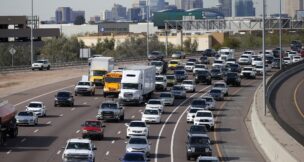
In this Jan. 24, 2020 file photo, early rush hour traffic rolls along I-10 in Phoenix. (AP Photo/Ross D. Franklin, File)
Prop. 141 could complicate Arizona’s highway funding conundrum
Reagan Priest, Arizona Capitol Times//September 23, 2026//


Key Points:
-
Arizona’s gas-tax-dependent highway fund is falling behind as electric vehicles become more popular
-
Proposition 141 would ban the state from taxing EVs based on miles traveled, citing privacy concerns
-
Opponents of the measure say every option should remain on the table; others argue a more creative solution is needed
With Arizona’s primary source of highway improvement funds stalling, voters will be asked to close the door on one potential solution in November.
For over a decade, Arizonans’ shift toward electric vehicles has raised alarms about declining fuel-tax revenues from gas-powered vehicles. But state policymakers have been reluctant to adopt new tax policies that account for inflation and changing consumer behavior.
This funding issue isn’t unique to the state’s Highway User Revenue Fund, which relies on Arizona’s 18-cent-per-gallon fuel tax to invest in road improvement projects. But it is the only struggling state fund facing a fight at the ballot box. And, according to one estimate, the state is already $1 billion short of the funding it needs to keep up with highway and road maintenance.
U.S. Department of Energy data shows that nearly 3,000 electric vehicles were registered in Arizona in 2020. By 2025, that number jumped to almost 150,000.
That growth curve could flatten, though, since the federal government has rolled back tax incentives to purchase EVs.
Proposition 141 will ask voters to decide whether to prohibit government entities from imposing a tax or fee based on vehicle miles traveled, or to monitor and limit vehicle miles traveled. Advocates for Arizona infrastructure projects say the ballot measure will tie the state’s hands as it looks for ways to ensure electric and hybrid vehicle owners pay their fair share for road upkeep.
“[Prop. 141] really is hurting our opportunities in the future to address what is becoming a very critical shortfall for state and local infrastructure funding,” said Ted Maxwell, the current chair of the State Board of Transportation.
Maxwell, who was appointed to the board by former Gov. Doug Ducey in 2021, said stagnant HURF revenues have been a constant topic of conversation since he joined. He estimates that declining gas tax revenue leaves Arizona $600 million to $1 billion short of the funding needed for infrastructure projects in the near and long term.
“The fact of the matter is our funding for infrastructure is not keeping anywhere up with the needs for our infrastructure,” Maxwell said.
HURF improvements elusive
He noted that state lawmakers want to change HURF collections, but motivation has been elusive. A 2025 bill from Sen. David Farnsworth, R-Mesa, that would have allowed the Arizona Department of Transportation to establish a gas tax equivalent for EVs never made it out of committee.
“There’s desire, but anytime you say ‘tax’, you’re going to get folks that are going to be against it,” Maxwell said.
Farnsworth’s bill did not contain the vehicle miles traveled (VMT) proposal that Prop. 141 seeks to ban. Four states currently have voluntary VMT programs for EVs or hybrids that track miles via annual vehicle inspections or odometer plug-ins, according to the National Conference of State Legislatures.
Sen. Jake Hoffman, R-Queen Creek, sponsored the 2025 legislative referral that put Prop. 141 on the ballot this year and argued during a floor vote on the measure that it is meant to protect Arizonans from government surveillance.
“Freedom of mobility is a fundamental freedom that is uniquely American,” Hoffman said in February 2025. “This, at its core, says that the government shall not tax or track you for the miles that you drive.”
Maxwell said he understands privacy concerns, but argues the Legislature could have taken a more direct approach if lawmakers worried VMT programs could be weaponized to track citizens or limit their movements.
“If your concern is security and your concern is privacy, the way to [address] that is to pass a law that prohibits the government from putting tracking devices on your vehicle,” Maxwell said.
More taxes unlikely
Revenue declines are also hitting other state funds.
The Early Childhood Development and Health Fund is seeing a drop in tobacco tax revenue as e-cigarette use increases. And the Telecommunications Fund for the Deaf could reach a deficit in the next fiscal year as revenue from taxes on wired telephone services dries up.
But, with Arizonans themselves struggling economically, tax increases or additional fees are a hard sell for lawmakers.
“In a situation where affordability is an issue, there’s no desire to increase taxes or fees on Arizonans, and yet there are still all of these needs,” said Katie Ratlief, the executive director of the Common Sense Institute. “The solution is to really kind of roll up your sleeves and dig into the state budget and figure out where the state’s priorities ought to be.”
Ratlief argued lawmakers should look at more creative ways to use the state’s general fund to invest in areas like highway improvements, rather than imposing a new tax or fee. She said the now-dormant battle over Proposition 123 is a prime example.
Without an agreement to extend the education funding measure, which withdrew 6.5% annually for 10 years from the state’s Permanent Land Endowment Trust Fund, the Legislature took $300 million from the general fund in the last two fiscal years to make up the difference.
“That was $300 million that was coming from the trust that no longer is [and] just went onto the general fund with very little fanfare,” Ratlief said. “Is that the best use of $300 million while the trust is bigger than ever and continuing to grow?”
Maxwell isn’t convinced that an increased gas tax or a new VMT program is the right way to go either. But he argues the Legislature needs every tool at its disposal to solve the infrastructure funding problem, a fix he only sees occurring in a non-election year.
“The only time to address it is in those odd-numbered years,” Maxwell said. “So I’m hoping there will be a push in 2027, and I’m hoping vehicle miles traveled is still something that we can discuss with the Legislature to see if they want to go that way.”