Sign In


Upcoming Event
 Free Newsletter

Arizona prepares for deeper Colorado River water cuts
Reagan Priest, Arizona Capitol Times//September 1, 2026//

A bathtub ring of light minerals shows the high water line of Lake Mead near water intakes on the Arizona side of Hoover Dam at the Lake Mead National Recreation Area on June 26, 2022, near Boulder City, Nev. (Photo by John Locher/Associated Press)
Arizona prepares for deeper Colorado River water cuts
Reagan Priest, Arizona Capitol Times//September 1, 2026//


Key Points:
-
Cuts to Arizona’s Colorado River allocation spur renewed conversation on alternatives.
-
Water officials say the initial 31% cut over two years will be manageable
-
Alternative water supplies will be needed as the feds contemplate large cuts and the river remains in a drought
With Arizona now guaranteed to face Colorado River cuts over the next two years, the region’s water experts are turning to both short-term reserves and long-term alternatives as they prepare for an increasingly dry future.
Following the Bureau of Reclamation’s Record of Decision on Colorado River negotiations, Arizona Department of Water Resources Director Tom Buschatzke toured the state to discuss its implications for cities, industries and the state as a whole. Buschatzke told the Arizona Corporation Commission on Aug. 26 that the state is looking beyond the operating guidelines approved by the federal government for 2027 and 2028.
Arizona can absorb the initial 31% reduction in its Colorado River supply, largely because it has spent decades banking water underground, experts say.
But that reserve is finite, and state and local water officials are already looking for additional supplies — from water recycling and new groundwater infrastructure to desalination — as they prepare for potentially deeper cuts to the river in the years ahead.
In short, long-term alternatives are needed to counter the Colorado River’s dwindling flows.
“The scientists are telling us that the flow of the river is going to decline over time,” Buschatzke said. “What we have to do is not a short-term issue. The drought is not going away.”
The politics of water
The future of the state’s water supply has become increasingly politicized, especially as the finalization of the next decade’s Colorado River operating guidelines coincides with midterm elections.
Gov. Katie Hobbs has steered Arizona through several years of negotiations with the Upper Basin states and has tried to twist the federal government’s arm in the state’s favor.
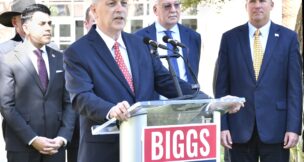
But Congressman Andy Biggs, the Republican hoping to unseat her, and his supporters argue Arizona’s significant share of the cuts is a direct result of her inability to get a better deal — either from the immovable states of Colorado, Utah, Wyoming and Nevada, or from a Department of the Interior that is perplexingly unwilling to impose cuts on the Upper Basin.
Republicans in the Legislature have made their dissatisfaction known, though there isn’t much they can do to alter a federal Colorado River management plan.
They will have to approve the Lower Basin agreement Arizona plans to make with California and Nevada to formalize the 2027 and 2028 cuts. But that approval is widely viewed as a formality.
And so far, neither party has offered any big, new legislative proposals this election year.
Arizona’s sunny day fund
As the state looks to shoulder the manageable but still uncomfortable initial cut to its Colorado River supply, it will turn first to the Arizona Water Banking Authority. Created in 1996 to store unused Colorado River water, the AWBA now holds 4.4 million acre-feet of water that can be used to help offset shortages.
Cities that receive water from the Central Arizona Project, the 336-mile canal system that pumps Colorado River water throughout the state, have been storing excess water in AWBA-managed facilities in exchange for long-term storage credits.
With cuts looming, some cities will be looking to cash in on those credits. Better-prepared cities could also receive federal funding or additional credits in exchange for making voluntary reductions to their CAP water.
Sarah Porter, director of Arizona State University’s Kyl Center for Water Policy, said the AWBA likely has decades’ worth of water in storage, but that its supply cannot be replenished once depleted.
“It is the emergency savings account,” Porter said. “And nobody feels joyful about turning to the emergency savings account.”
Near-term alternatives
But while the AWBA can help Arizona weather the immediate cuts, it cannot permanently replace the state’s declining Colorado River supply. That has cities and other water users looking for ways to diversify their water sources.
The ideas range from proven options, like advanced water purification, to novel ones, like unused groundwater transfer basins. Most of those alternative sources will cost money to develop, meaning water utilities will have to find funding to pursue them.
At the Arizona Corporation Commission, private utilities like Arizona Water Company and EPCOR are already pursuing some of those options. Britton Baxter, the director of the ACC’s utilities division, told commissioners at a hearing on Aug. 26 that those funding mechanisms are already in place.
“The utilities have been coming forward in rate cases and asking for certain mechanisms, like sustainable water surcharges, that will allow them to go out and seek additional sources of water to offset potential losses,” Baxter said.
But that means higher water bills for both municipal and private utility ratepayers, an increasingly hard sell as Arizonans grapple with a nationwide affordability crisis.
Water could also be purchased from alternative sources, like Arizona tribes with higher priority on the Colorado River, corporations buying agricultural land to sell the water rights, or a California desalination plant with excess water.
Buschatzke told the Corporation Commission on Aug. 26 that the state is putting together the “legal framework” needed to purchase desalinated water from the San Diego County Water Authority.
Porter said all avenues have their advantages and drawbacks, and all are likely to be explored and implemented.
“It is these little bits and pieces that are going to add up to be the portfolios of the future, partly because there isn’t a big thing out there that’s attainable [and] affordable,” Porter said.
Pie-in-the-sky solutions
Conditions on the Colorado River are unlikely to return to the levels once contemplated by the 1922 Colorado River Compact. And Porter noted the CAP could even run dry under some of the operating guidelines outlined for the next 10 years by the Bureau of Reclamation.
“Cities need to be prepared for extremely deep, historic cuts, because we cannot discount that risk,” Porter said.
That means that no proposal is too small or too large for consideration, especially as water leaders attempt to secure Arizona’s future for decades to come.
The Water Infrastructure Financing Authority, a state agency specifically created to field those proposals, recently approved the initial development of two desalination plants in California or Mexico.
The plants likely would not come online for eight or 10 years and could cost anywhere from $5-10 billion.
Others have floated the possibility of new water infrastructure projects that could bring water from the East or Pacific Northwest down to the Southwest.
Earlier this year, Biggs joined Rep. Gail Griffin, R-Hereford, in calling on President Donald Trump to solve Arizona’s Colorado River woes by building the “Donald J. Trump Imperial Dam.”
Their proposal suggested reviving one of several previously abandoned reservoir projects, likely to hold water pumped from the East. Still, it did not go so far as to name a river that could be diverted for Western water use.
Porter said it is currently unclear whether piping in more water from other areas of the U.S. or desalinating large quantities of ocean water will even be necessary. If so, those projects likely won’t be needed anytime soon, given their exorbitant cost.
“Those probably won’t be the first [option]; those need to be deployed once the cheap options are exhausted,” Porter said.