Sign In



 Free Newsletter


Whoever wins governor’s race will face biggest test after Election Day
Reagan Priest, Arizona Capitol Times//October 30, 2026//

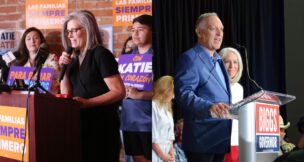
Gov. Katie Hobbs, left, and Congressman Andy Biggs, right, will face off in Tuesday's gubernatorial election. (Reagan Priest & Jordan Gerard/Arizona Capitol Times)
Whoever wins governor’s race will face biggest test after Election Day
Reagan Priest, Arizona Capitol Times//October 30, 2026//


Key Points
-
Gov. Katie Hobbs leads Congressman Andy Biggs in the polls ahead of Election Day
-
The next governor will inherit several pressing issues with long-term stakes
-
Hobbs and Biggs diverge sharply on the Colorado River, education and affordability
 Editor’s Note: Elections are about more than who wins. They determine who will govern — and what comes next. The State Affairs 6 focuses on six races, issues or ballot questions in each state that could shape political power and public policy well beyond Election Day. In the weeks leading to Nov. 3, our reporters will explain the people, forces and stakes behind each one — and what the outcome could mean for how Arizona is governed.
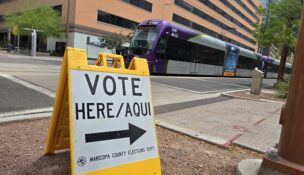
On Tuesday, Arizona voters will decide whether to stay the course with Democratic Gov. Katie Hobbs or return to Republican leadership under Congressman Andy Biggs.
Either way, the person sitting on the Ninth Floor in January will be tasked with navigating increasingly fraught Colorado River negotiations, cost of living concerns, potential school voucher reforms, education funding, data center policies and preparing for redistricting after 2030.
Hobbs and Biggs have almost completely divergent approaches to Arizona’s biggest challenges. As it stands, voters appear to favor the governor’s pitch, boosted by the millions of dollars she’s spent to deliver her message and attack her opponent.
Hobbs led Biggs by 12 points in a HighGround Public Affairs poll conducted just over a week out from Election Day. While that margin is higher than most, every survey conducted after the primary election has put the governor ahead of the congressman.
Most of Arizona’s political observers attribute those numbers to a general lack of enthusiasm for Republicans nationwide amid President Donald Trump’s second term. But while Biggs’ staunchly conservative views earned him five terms in ruby-red Congressional District 5, they have complicated his pivot to a statewide audience.
“Andy Biggs is having to learn a different language because he’s never had to speak to independents or Democrats or moderate Republicans,” said Barrett Marson, a GOP public relations consultant. “And so he’s literally having to learn how to speak their language, and it’s not going well, given his history.”
—————
Previously in the State Affairs 6:
Election could reshape Arizona’s $1B ESA program
Just a few seats could flip control of Arizona’s Legislature
Arizona’s groundwater future hinges on 2026 election
Corporation Commission race draws unusual attention over utility costs and data centers
Arizona attorney general’s race will determine state’s legal landscape
—————
Hobbs was never expected to run away with the contest, though. Pay-to-play allegations dogged her first term as she struggled to put major policy wins on the board while working with a hostile, Republican-controlled Legislature.
Some consultants argue the governor’s campaign still hasn’t given Arizonans much to vote for, focusing instead on who they should vote against.
“Voters need to be given an aspirational message to support you, to say, ‘Why do I want to vote? Why am I enthusiastic about supporting this guy?’” said Chuck Coughlin, CEO of HighGround. “That’s generally not because it’s not a message based on, ‘Well, the other guy sucks.’”

Colorado River
Once an obscure policy issue, Arizona’s Colorado River supply has become a key focus for both campaigns.
No matter who wins next week, the state will still face drastic, federally imposed water cuts in 2028 if it can’t reach a more favorable, negotiated deal with the six other Colorado River Basin states. Arizona is facing cuts of up to 77%, and Hobbs and Biggs are split over how to move forward.
“It is imperative that no matter who is governor, they take on the role of the sober-minded adult who is fact-driven and is minimizing the politics of water and maximizing the science of water,” said Stan Barnes, a longtime lobbyist and former state lawmaker. “And I think both will, because they simply have to. Anything else would be letting down the constituency and perhaps leading to a very difficult future for Arizona.”
Hobbs said she is taking the necessary steps to lessen the cuts by joining Nevada’s lawsuit against the federal government. But Biggs said she hasn’t done enough.
“She advocated for this deal, and now she’s trying to have it both ways as Election Day draws closer and more Arizonans express how concerned they are with our access to water,” Biggs’ campaign said of the lawsuit. “Katie Hobbs has failed to secure our water future, and her flip-flopping on this deal won’t fix anything.”
Meanwhile, Hobbs’ office claims Biggs is a day late and a dollar short on the Colorado River conversation.
“For the last decade in Congress, Andy Biggs has been completely MIA on Arizona’s water security,” said Christian Slater, Hobbs’ communications director, in a statement. “Andy Biggs’ cheap talking points are no substitute for real leadership.”
Affordability
Voters increasingly frustrated with Arizona’s cost of living will also decide whether to continue Hobbs’ first-term initiatives or give Biggs’ bold tax-cut proposal a shot.
Biggs hopes to deliver immediate relief to Arizonans by eliminating the state’s 2.5% flat income tax during his potential first term. The income tax made up 31% of the state’s fiscal year 2026 budget, meaning Biggs will have to get creative to make the cuts work.
Hobbs hasn’t made any specific promises on affordability, instead highlighting programs she created over the past four years providing down payment assistance for first-time homebuyers, forgiving medical debt, offering utility bill relief and shortening childcare waitlists.
But 2027 will bring even more financial challenges as the federal One Big Beautiful Bill’s impacts continue to materialize.
More than 400,000 Arizonans were removed from the state’s Supplemental Nutrition Assistance Program after the bill passed in 2025. The Department of Economic Security has struggled to process applications under new, federally mandated work requirements while also attempting to lower the state’s payment error rate.
Arizona is also facing new Medicaid eligibility requirements and expiring Affordable Care Act subsidies that will raise insurance premiums by 27.9%.
The two candidates found common ground on data centers. Hobbs secured a three-year moratorium on tax incentives for data center developers, and both have pledged to eliminate them entirely. They have also rejected calls to pause data center development.
Education
After a referendum on Arizona’s controversial Empowerment Scholarship Accounts program fell short earlier this year, the Legislature and the governor will decide the future of the school voucher system in 2027.
Hobbs has tried and failed several times to place guardrails on the ESA program, which allows students to receive state funding for private school tuition or homeschooling materials. Biggs has pledged to protect and expand it, largely dismissing calls for reforms.
But a pro-ESA group warned Republican state lawmakers in September that voters still want changes to the program, which costs taxpayers around $1 billion a year. The American Federation of Children urged lawmakers to add safeguards to give families using the program certainty, rather than leaving it exposed to future citizen initiatives.
Arizona’s public schools are also in a precarious financial position, as lawmakers and Hobbs could not reach a deal to extend Proposition 123 before it expired in 2025. The education funding measure, originally passed in 2016, provided money to public schools through a 6.9% withdrawal from the state land trust.
Both Hobbs and Biggs support an extension of Prop. 123, but Biggs told reporters in September that he would want to see guardrails ensuring that the funding from the state land trust goes into classrooms directly. Hobbs previously proposed increasing the annual withdrawal rate to 8.9%, but pledged to leave all options on the table for renewal conversations if reelected.
Redistricting and the courts
Arizona Republicans are already eyeing the 2030 redistricting cycle, and the next governor would have a large say in the process.
The state’s Appellate Court Commission recommends candidates for the Independent Redistricting Commission to legislative leaders, who ultimately select the commissioners. Ahead of the 2020 census, former Gov. Doug Ducey nominated only independents and Republicans to the Appellate Court Commission, effectively ensuring no Democrats weighed in on the IRC applicant pool.
So far, Hobbs has only appointed Democrats to the Appellate Court Commission. Meanwhile, Republicans like Biggs, Senate President Warren Petersen and Congressman Paul Gosar are attempting to galvanize the GOP base around a future redistricting fight.
“Arizona could gain as many as three seats,” Gosar said at a Trump rally in Bullhead City. “And that’s why we need to make certain that Andy Biggs is our governor to help us ensure that we have fair redistricting.”
Biggs has also told supporters that Hobbs, if reelected, could appoint as many as three state Supreme Court justices. Hobbs has already made one appointment to Arizona’s highest court, and Biggs characterized her judicial appointees as “radical left-wing activists.”
Both the redistricting cycle and judicial nominations put either candidate in a position to shape Arizona’s governance far beyond their terms in office, Doug Cole, a lobbyist and member of the Commission of Judicial Performance Review, noted.
“There are few things that a governor can do that are more important to that individual’s legacy than judicial appointments,” Cole said.
Stay ahead of Arizona politics.
Get essential reporting on political developments, campaign finance, elections and the people shaping state government. Subscribe or sign up for our free Morning Report.