Sign In


 Free Newsletter

Arizona’s groundwater future hinges on 2026 election
Reagan Priest & Jakob Thorington, Arizona Capitol Times//October 1, 2026//
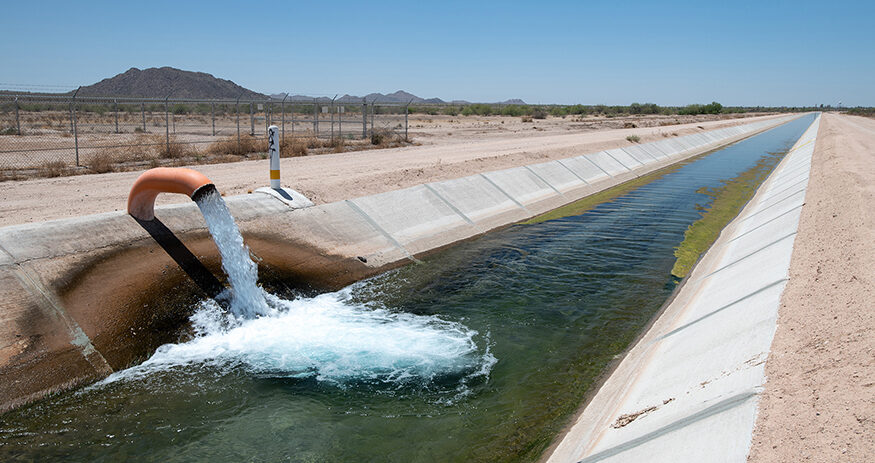
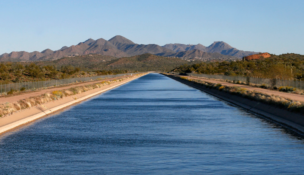
Water enters an irrigation canal on the Gila River Indian Reservation on May 7, 2021. (Photo by Associated Press)
Arizona’s groundwater future hinges on 2026 election
Reagan Priest & Jakob Thorington, Arizona Capitol Times//October 1, 2026//


Key Points:
-
Arizona’s gubernatorial candidates have starkly different views on groundwater regulation
-
Legislative reform has stalled, but the election could break the logjam
-
Rural communities aren’t waiting around, instead taking matters into their own hands
There is widespread agreement that Arizona needs to modernize its nearly 50-year-old Groundwater Management Act, but how that happens and how much regulation is imposed to do so could depend on the results of this year’s election.
The ongoing drought and impending cuts to the state’s Colorado River allocation are adding urgency to the debate over Arizona water policy, particularly in rural areas where groundwater is often the primary water source.
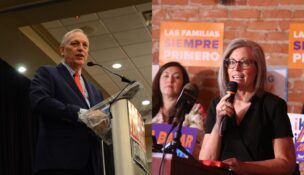
And while Gov. Katie Hobbs and Republican gubernatorial nominee Andy Biggs have sharply differing views on how the state should manage groundwater, the election could also reshape the Legislature, which could also determine whether long-stalled efforts to give rural communities new tools for managing their aquifers finally advance in 2027.
Meanwhile, some communities, unwilling to wait for lawmakers, have already begun pursuing their own solutions.
“It’s worth noting that water as an issue is in the top three in the gubernatorial debate during the election of 2026,” said Stan Barnes, a long-time lobbyist and former state lawmaker. “In my 35 years of being active in Arizona politics, we’ve never seen that before.”
Polling from the Center for the Future of Arizona found that 64% of likely voters surveyed are not confident that government leaders are taking necessary steps to secure the state’s water future. And 78% believe the state needs to strengthen groundwater management in rural parts of Arizona.
Groundwater makes up the largest portion of the state’s water supply, at around 41%. But recent studies show Arizona has been losing groundwater at a rapid pace over the past two decades.
Solutions have remained elusive, owing in part to the competing interests of farmers, conservationists, developers, cities, schools, small towns and the politicians hoping to please them all.
Many hope the outcome of the gubernatorial contest between Hobbs and Biggs, along with some shakeups in the Legislature, could bring meaningful policy changes. But not everyone can afford to be so optimistic.
To regulate or not to regulate
Hobbs made groundwater a priority early in her administration, using the regulatory tools granted to the governor and the Arizona Department of Water Resources by the 1980 Groundwater Management Act to circumvent legislative inaction.
Biggs has pledged to make undoing those regulations an early cornerstone of his own potential administration.
“Gov. Hobbs has demonstrated a willingness to be more open to the regulation of groundwater in rural Arizona than is supposed by a Republican governor,” Barnes said. “It’s a fair thing to ponder, and there’s no right or wrong answer.”
In response to ADWR’s 2023 model that showed “unmet demand” for groundwater in the area, Hobbs and the department announced certificates of assured water supply would no longer be issued to housing developers relying solely on groundwater in the Phoenix Active Management Area (AMA).
Developers seeking to build in AMAs — areas where groundwater pumping is closely monitored and regulated — must obtain service from a designated water provider that has demonstrated a 100-year groundwater supply. If no designated water provider exists in the area, developers must demonstrate the 100-year supply on their own to obtain a certificate of assured water supply.
Housing development in areas like Buckeye and Queen Creek was hit the hardest, since neither was served by a designated water provider. To soften the blow, ADWR created a program allowing developers to obtain certificates by identifying other water sources to serve a subdivision for 100 years — with the caveat that they also demonstrate an additional 33% of that 100-year supply.
Biggs and Republican lawmakers have disputed ADWR’s groundwater model, arguing that developer-provided models showed significantly more water in Phoenix-area suburbs.
An undue ‘water tax?’
The Home Builders Association of Central Arizona and Republican leaders in the Legislature sued over both the “unmet demand” rule ADWR relied on to pause development and the Alternative Designation of Assured Water Supply program. The parties argued that ADWR exceeded its regulatory authority in imposing the moratorium and that the ADAWS program created an undue “water tax.”
A Maricopa County Superior Court judge agreed and struck down the rule and program earlier this year, though neither ruling has been finalized. While Hobbs and ADWR pledged to explore their legal options, Biggs has promised to throw the regulations out entirely if elected.
“We will codify the repeal of Katie Hobbs’ housing moratorium that cut off the supply of new single-family homes in our fastest-growing areas,” Biggs told reporters on Sept. 22.
Sandy Bahr, the director of the Sierra Club’s Grand Canyon chapter, argues that abandoning the “unmet demand” rule will hurt the state’s ability to manage groundwater in both rural and urban areas.
“If you don’t challenge the court ruling, then you really don’t have a program, and you’ve cut the heart out of the Groundwater Management Act to some degree,” Bahr said.
Republican lawmakers share Biggs’ sentiments, but voters may be more inclined to side with Hobbs. A Center for the Future of Arizona poll showed that 78% of likely voters surveyed favor limiting housing development in areas where a long-term water supply isn’t guaranteed.
In 2024, Hobbs and ADWR also established the Willcox groundwater basin AMA in southeastern Arizona, the first new AMA since the original five in 1980, excepting the voter-established Douglas AMA. That was followed by the creation of a new AMA in western Arizona’s Ranegras Plain in 2025.
Biggs stopped short of pledging to repeal any new AMAs, but questioned the legality of the Willcox AMA and accused the governor of using the framework as “a sword and not a shield.”
Christian Slater, the communications director for the governor’s office, said in a statement that ending any recently created AMA “would dry up family-owned farms in favor of out-of-state special interests exploiting Arizona’s groundwater for their own profit.”
Legislative efforts have been unsuccessful
In 2023, Hobbs established the Governor’s Water Policy Council to modernize the 1980 Groundwater Management Act. The council recommended the Rural Groundwater Management Act, which House and Senate Democrats have introduced in multiple sessions.
The bill would offer an alternative management tool to active management areas and irrigation non-expansion areas. A coalition of rural Republicans, including La Paz County Supervisor Holly Irwin, has supported the bill and called on GOP leaders to get it to Hobbs’ desk.
“The administration that we have right now has been very supportive of rural Arizona and their issues with groundwater,” Irwin said.
Despite Republican opposition, lawmakers came close in 2025 to negotiating a deal. However, the bill stalled in the final weeks of the legislative session.
“I would love to see the rural groundwater framework implemented because it gives rural communities more flexibility and it’s a better framework than the AMA, quite frankly, for rural communities,” Hobbs told reporters on Sept. 3.
Rep. Chris Mathis, D-Tucson, said lawmakers wanted to see the results of the 2026 election before resuming groundwater negotiations. He sponsored the Rural Groundwater Management Act in the House. Mathis said he believes the Legislature can pass the bill regardless of who is elected governor.
“If [Hobbs] is re-elected, we would be able to really focus on that as one of the top priorities after we get back next year,” Mathis said. “If the election goes the other way, then we’ll just have to see where the dust settles. But I know there is a bipartisan coalition that would like to see some further regulation in this area because we just can’t continue on the way we have been.”
Differing views on water regulations
A key groundwater negotiator in the Legislature, Rep. Gail Griffin, R-Hereford, has largely blocked groundwater reform efforts, dating back to former Republican state Rep. Regina Cobb’s bills in the late 2010s.
Griffin chairs the House Natural Resources, Energy and Water Committee, giving her influence over which water-related bills advance through the chamber for a full vote. Travis Lingenfelter, a Republican sitting on the Mohave County Board of Supervisors, has blamed Griffin directly for the state not having a rural groundwater management tool.
But in multiple opinion columns submitted to the Arizona Capitol Times, Griffin has argued that Arizona already has the groundwater management tools it needs. She has also accused Hobbs of using water policy to manufacture housing scarcity.
“[Hobbs] restricted housing first, rejected repeated legislative off-ramps, and made families wait while the price of scarcity kept rising,” Griffin wrote in a Sept. 23 column. “She can disagree with any individual proposal, but she cannot credibly say Republicans offered no solutions.”
Griffin, who is terming out of the House, is running for the Senate in Legislative District 19. She will likely win in the Republican-friendly district, but Irwin said rural Arizona can’t wait another four years with no legislative action.
“This is a bipartisan issue,” Irwin said. “Who cares if the framework came from a Republican or a Democrat or whoever?”
How would a Gov. Biggs respond?
Biggs hasn’t expressed a preference for a particular regulatory framework, instead pledging to take a look at all the proposals. But his selection of former state Sen. Sine Kerr, a Republican from Buckeye, as his running mate may provide some insight.
Kerr, who would become the state’s first lieutenant governor, has held similar policy stances as Griffin. She told reporters that the Biggs/Kerr administration would create a working group to develop a long-term water policy strategy for the state.
Kerr quit Hobbs’ water policy council in 2023 and criticized the group for being “nothing more than a forum to rubber stamp the progressive environmental goals of special interest groups.” She also said the council’s policy ideas would hurt the livelihoods of farmers and ranchers and introduced her own alternative to Hobbs’ Rural Groundwater Management Act.
If Biggs and Kerr are elected, Mathis said he believes the bipartisan coalition of lawmakers supporting rural groundwater management could work with Kerr to pass the bill.
“Sen. Kerr certainly takes a different view of it than I do, but I felt like she was actively engaged and think it’s possible to work with anybody who’s willing,” Mathis said. “My sense was that Sen. Kerr was perhaps more open to discussion than Rep. Griffin.”
A Democratic flip of the Legislature would also open a pathway for the bill. House Minority Leader Oscar De Los Santos, D-Laveen, said the Rural Groundwater Management Act would be one of House and Senate Democrats’ top priorities if they take the majority.
Bahr is less confident a deal will get done if the Legislature remains under GOP control under another Hobbs term.
“Trying to get anything substantial through will be difficult,” Bahr said. “We’re likely to see more communities go on their own.”
Circumventing the Legislature
After the Legislature failed to advance a rural groundwater bill, some communities have taken matters into their own hands.
Residents near the McMullen Valley groundwater basin are collecting signatures for a ballot question in a special March election asking voters whether to create an active management area.
The petition follows Griffin’s sponsorship of House Bill 2758 in the recent legislative session. The measure would have allowed eligible entities that own irrigated acres in McMullen Valley to withdraw groundwater and sell it to a designated provider in central Arizona. The bill did not pass the Senate, but McMullen Valley residents are taking action to prevent a similar attempt to transport the valley’s groundwater.
“Our only option is an AMA to exert local control over how much water is pumped out of our aquifer,” said Gary Saiter, the chair of the McMullen Valley Water Defenders political action committee, the group behind the petition drive.
Saiter said he expects the group to collect enough signatures for the measure to qualify for the ballot. The special election would occur on March 9, in the middle of Arizona’s upcoming legislative session.
The McMullen Valley petition follows other rural efforts to protect groundwater resources, including the first-ever voter-led formation of an AMA in the Douglas groundwater basin in 2022.
“Despite legislative inaction, rural communities are writing their own story,” said Chris Kuzdas, the Arizona water program director for the Environmental Defense Fund. “The Legislature still has the opportunity to choose to be a partner in that story, but so far, they have not done that.”
Kuzdas has worked with other rural communities to help establish management areas while also lobbying the Legislature for rural groundwater protection. He noted that the Halalapai Valley Irrigation Non-Expansion Area established in 2022 was the first INA to be activated since 1981.
Hobbs said she applauds the McMullen Valley group’s efforts, while Biggs said he would be open to hearing their concerns.
In the meantime, some are still holding out hope for the type of negotiations that brought about the creation of the 1980 Groundwater Management Act.
“I think the world of water is hoping that we can step back to some sort of old-school way of doing things, meaning stakeholders in a room of goodwill coming to a general compromise in the name of what is good for the people of Arizona,” Barnes said.