Sign In


 Free Newsletter

The odds are sinking for groundwater legislation
Jakob Thorington, Arizona Capitol Times//February 28, 2026//
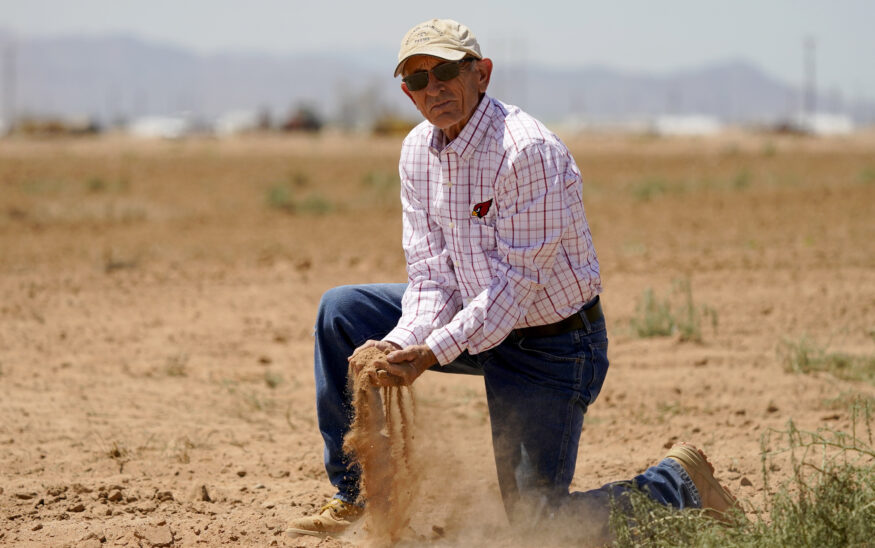
Kelly Anderson shows how dry one of his fields is, Thursday, Aug. 18, 2022, in Maricopa, Ariz. Anderson grows specialty crops for the flower industry and leases land to alfalfa farmers whose crops feed cattle at nearby dairy farms. (AP Photo/Matt York)
The odds are sinking for groundwater legislation
Jakob Thorington, Arizona Capitol Times//February 28, 2026//


Key Points:
-
Groundwater issues focus on rural needs
-
Rep. Gail Griffin is considered key opponent of reform
-
Attempting a ballot measure is believed to be too expensive
As crossover week at the Arizona Legislature concludes, it appears lawmakers will go yet another year without passing significant groundwater reform.
Gov. Katie Hobbs and rural stakeholders have been seeking reform for years, and one Democrat who has been involved in recent negotiations said he believes a deal could soon be struck at the Legislature — depending on which way the Governor’s Office swings after the 2026 general election in November.
“There is a deal there to be had,” said Rep. Chris Mathis, D-Tucson. “I think there’s a compromise there. There’s no question in my mind about that.”
If a Republican is elected to the Ninth Floor, it would be much more difficult for legislative Democrats to get a deal done if they remain the minority party.
Democrats did get close in 2024. A groundwater bill failed late in that session, but Mathis said lawmakers continued to negotiate over the summer before the 2024 election. At the time, there were some predictions that one of the legislative chambers could flip to Democrats, but when Republicans instead expanded their majorities, negotiations stalled.
“The impetus, for at least some on the Republican side, to come up with a workable deal just lessened,” Mathis said. “After that happened last year, we tried to go back to the negotiating table and just basically didn’t get anywhere.”

One of the main players in any water policy at the Legislature is Rep. Gail Griffin, R-Hereford. Griffin did not respond to an interview request, but lobbyists and rural stakeholders have blamed her for years for blocking any rural groundwater policy from advancing in the Legislature.
“As long as she is chairing the committee through which any of these bills would have to go through, I don’t think it’s possible,” said Sandy Bahr, director of the Sierra Club’s Arizona chapter.
Griffin, the chairwoman of the House Natural Resources, Energy and Water Committee, will be termed out of the House in 2026, but she is running for the state Senate in the conservative-leaning Legislative District 19.
“She’s a loyal vote to the speaker or the president if she happens to be in the Senate,” said HighGround Consulting CEO Chuck Coughlin. “I just don’t think it’s possible. You can’t get around her.”
Republicans in rural areas have also grown frustrated with Griffin. Mohave County Supervisor Travis Lingenfelter has been one of Griffin’s most outspoken critics. Last week, he and other Republican supervisors Holly Irwin, Patrice Hortsman and Nikki Check from La Paz, Coconino and Yavapai counties wrote an opinion article published by The Arizona Republic accusing Griffin of leaving rural Arizona “out to dry” with House Bill 2758. That measure would allow “eligible entities” to withdraw groundwater from the McMullen Valley Active Management Area that’s mostly located in La Paz County.
Active management areas are a tool that has predominantly been used by the Hobbs administration to impose restrictions on water pumping to aggressively manage the state’s groundwater resources. There are currently eight AMAs in the state, with the most recent one being deployed in January for the Ranegras Plain Groundwater Basin in La Paz and Yuma counties to slow annual withdrawal levels that are outpacing natural recharge by nearly 900%, according to the Department of Water Resources.
“They need to be called out on their assertions that they’re looking out for rural Arizona because they are doing anything but,” Bahr said of bills like HB2758.
Griffin has previously said the Groundwater Management Act of 1980 and its companion laws are sufficient in giving Arizona the tools it needs to manage groundwater. She’s called on residents to petition the water department to form active management areas or petition their county supervisors for local management options.
In a 2025 opinion column submitted to the Arizona Capitol Times, Griffin said the Legislature’s focus should be to improve existing groundwater management tools.
If a groundwater deal is not reached at the Legislature, Coughlin said another path that voters could take would be to get a measure on the ballot in the form of a citizen’s initiative.
But a citizen’s initiative is expensive, and Coughlin said he’s not sure who would be willing to fund a signature gathering campaign that could exceed $5 million and the subsequent campaign for the election.
“Voter initiatives take a long time and a lot of money and they tend to fail,” Mathis said. “That would be fine by me. I’m sort of all of the above on this stuff whether it’s pursuing the governor’s authority under the groundwater management act, whether it’s a negotiated deal, whether it’s a voter initiative. It’s really just about producing an outcome where we’re able to protect these basins that are at risk.”