Sign In



 Free Newsletter


Water settlement would be game-changer for northeastern Arizona tribes, experts argue
Carsten Oyer//October 28, 2026//
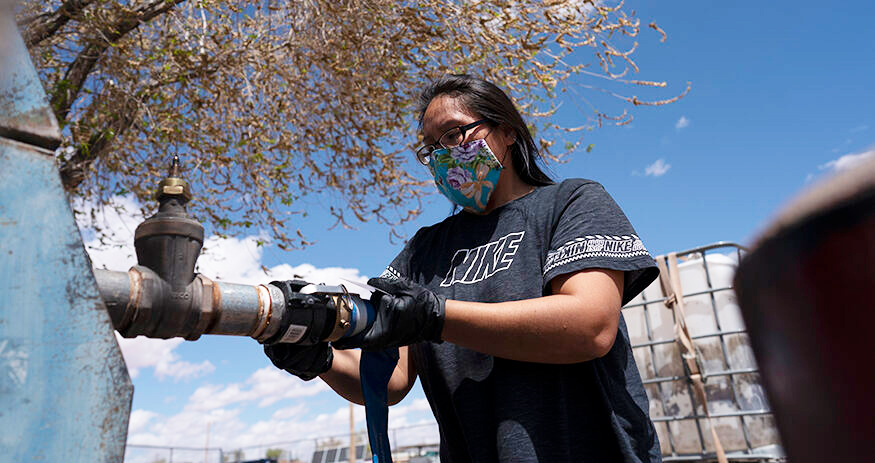
Raynelle Hoskie attaches a hose to a water pump to fill tanks in her truck outside a tribal office on the Navajo reservation, April 20, 2020, in Tuba City, Ariz. (AP Photo/Carolyn Kaster, File)
Water settlement would be game-changer for northeastern Arizona tribes, experts argue
Carsten Oyer//October 28, 2026//


Key points:
-
Tribal leaders said passage of the Northeastern Arizona Indian Water Rights Settlement Act would give their communities access to a secure source of clean water
-
The agreement matters especially to the San Juan Southern Paiute Tribe, which would gain the exclusive reservation it has pursued for decades under the legislation
-
The bill would benefit the entire Colorado River basin by providing certainty and increasing water levels at Lake Powell, tribal and water experts said
Leaders from three tribes in northeastern Arizona urged Congress on Wednesday to pass legislation settling their water rights, saying the agreement would ensure their access to the vital resource and provide greater certainty for water users across the Colorado River basin.
The legislation, known as the Northeastern Arizona Indian Water Rights Settlement Act, was the focus of a panel discussion, part of the Arizona Capitol Times’ Morning Scoop series. It featured leaders from the Hopi Tribe, San Juan Southern Paiute Tribe and Navajo Nation.
A settlement would resolve the tribes’ outstanding water claims, fund a pipeline from Lake Powell to deliver water and create trust funds for the three tribes. It would also establish a reservation for the San Juan Southern Paiute Tribe and allow the Navajo Nation and Hopi Tribe to lease their Upper Basin Colorado River water to other Arizona users — a provision that Upper Basin states oppose.
“If we’re able to get this settlement through, it’ll mean a lot of opportunity for our people, the region,” said Lamar Keevama, chairman of the Hopi Tribe. “It’ll mean safe, clean, reliable water for our people and the younger generation and the ones that are still coming.”
In 2025, Arizona Rep. Juan Ciscomani introduced the act in the House following a 2024 agreement among the tribes and other stakeholders. Sen. Mark Kelly introduced it in the Senate, where the Indian Affairs Committee held a hearing in March.
The infrastructure funding is critical, Keevama said, because it would let the tribes use their water rights rather than leave them on paper.
Meanwhile, the San Juan Southern Paiute Tribe has been waiting for a reservation for more than a quarter century. The Navajo Nation agreed to transfer two tracts of land to the tribe in 2020, but Congress has yet to ratify the treaty.
“We’re still waiting for this ratification. It’s been 26 years and ongoing now,” said Johnny Lehi Jr., vice president of the San Juan Southern Paiute Tribe. “With the settlement, it’s going to be completed. We have elders and other tribal council who fought for this tirelessly years before, and a majority of them are not here with us today.”
The San Juan Southern Paiute is the only federally recognized tribe in Arizona without its own reservation, which denies the tribe legal authority to build and maintain infrastructure.
“This is a foundation for our people,” Lehi said. “Water settlement is great, because what is the land without water?”
For Keevama and Lehi, the settlement would end the need for tribal members to haul water or buy it in neighboring towns and cities.
The settlement agreement has already achieved significant stakeholder consensus, said Crystal Tulley-Cordova, a principal hydrologist for the Navajo Nation’s Department of Water Resources.
While it would benefit the tribes by resolving their outstanding water claims, she said a settlement would also provide basin-wide certainty and increase water levels in Lake Powell.
More Colorado River surface water would allow the Navajo Nation to rely less on groundwater, which can be brackish or contaminated with dangerous pollutants, she said.
“Having the settlement provides that opportunity for us to close that clean water access gap and be able to be at the level that most Americans are with their water rights,” Tulley-Cordova said.
The agreement would protect both the three tribes and Arizonans across the state, said Brenda Burman, general manager of the Central Arizona Project.
The leasing provision would provide a vital water source to communities in central and southern Arizona facing potentially drastic cuts to their Colorado River water supplies, she said, while protecting existing water uses in the area.
“I think we all know it’s time,” she said. “The people, the members of these three nations, aren’t going anywhere. They live there. They deserve this infrastructure.”
Andy Mueller, general manager for the Colorado River Water Conservation District in Colorado, said the agreement is about social justice for Arizona’s Native American communities.
“Our nation owes this to these tribes to get this across the finish line to help the communities and the people actually have drinking water,” he said.
He said ongoing litigation over appropriation of the Colorado River should not hold up the agreement’s passage, though he added that some of his colleagues disagree.
He argued Congress ought to pass the bill after the election, during its lame-duck session.