Sign In


 Free Newsletter

Data centers dominated 2026 session – lawmakers answered with 3-year tax incentive pause
Reagan Priest, Arizona Capitol Times//July 9, 2026//
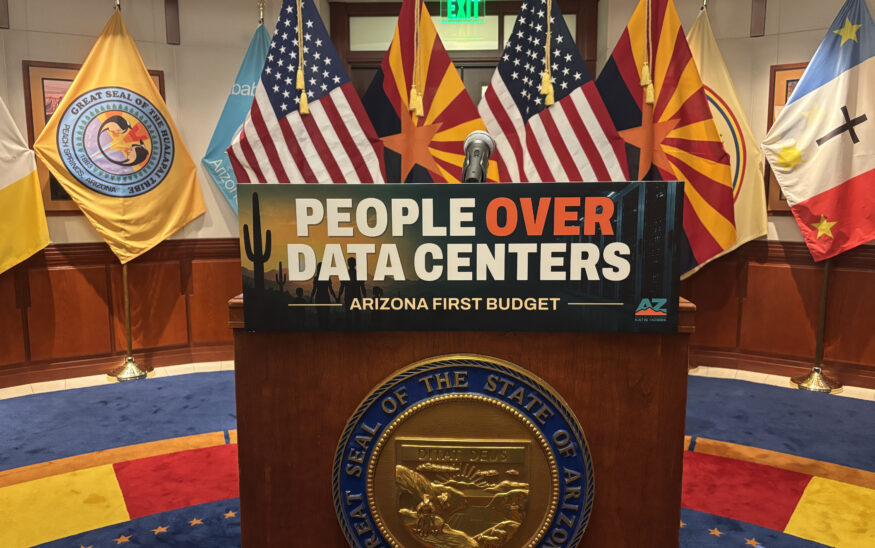
“People over data centers” sign sits atop Gov. Katie Hobbs’ official podium in the Ninth Floor rotunda of the state capitol Executive Tower on July 7, 2026. (Reagan Priest / Arizona Capitol Times)
Data centers dominated 2026 session – lawmakers answered with 3-year tax incentive pause
Reagan Priest, Arizona Capitol Times//July 9, 2026//


Key Points
-
The state budget freezes Arizona’s sales tax exemption for data center operators through 2029
-
After public pushback against proposed projects, data centers become the dominant topic of 2026
-
Gov. Katie Hobbs and Democrats say the fight isn’t over just yet
When Arizona lawmakers descend on the state Capitol at the start of each year to consider the most pressing issues facing the Grand Canyon State, one issue inevitably emerges as that session’s defining topic.
In 2026, the topic that captivated lawmakers, the governor, lobbyists, reporters and constituents was Arizona’s booming data center industry.
According to keyword data generated by the Arizona Capitol Times’ bill tracking service, State Affairs Pro, data centers were mentioned at least once throughout 84 committee hearings, caucus meetings and floor sessions from January to June. Lawmakers introduced more than 50 bills related to energy policy, six of which dealt specifically with the state’s data center tax incentives.
A new committee was even created this year to examine one of the biggest drivers of data centers: artificial intelligence. The House Artificial Intelligence and Innovation Committee heard presentations from utility companies, think tanks, universities and technology groups about the future of AI and how data centers will power it.
All of that discussion — covering both the upsides and downsides of increased data center development — culminated in Arizona’s first major policy shift on data centers in over a decade. The state budget, negotiated by Gov. Katie Hobbs and Republican legislative leaders, instituted a three-year moratorium on the state’s data center tax incentives.
“Arizona ranks in the top 10 for data centers nationwide, with nearly 98 facilities currently operating, and 86 planned or under construction,” Hobbs told reporters at a press conference on July 7. “… There is no question that Arizona’s data center tax exemption has achieved what it sought to do.”
According to the Pew Research Center, Arizona ranks seventh in the nation for the number of data centers currently operating or under development. Hobbs attributes that to the tax incentives that she and other state lawmakers voted for in 2013 when she served in the state Senate.
For the past 13 years, data center operators could submit an application to the Arizona Commerce Authority to exempt their operations from transaction privilege and use taxes on purchases like software and technology upgrades. The Legislature renewed the exemption for an additional 10 years in 2021.
Dan Diorio, vice president of state policy for the Data Center Coalition, said the tax incentives help keep costs low on expensive equipment and frequent server upgrades required to maintain a data center facility.
“The idea there is kind of two fold, one is that you defray some of the cost of the inputs to then get the outputs and the economic activity,” Diorio said. “And the second part is because you want to foster continuous reinvestment in the facility.”
After intense backlash in 2025 against proposed data center projects in Tucson, Chandler and Marana, Hobbs advocated eliminating the tax incentives entirely in her executive budget proposal. Republicans were vehemently opposed to the idea, arguing it would slow economic growth and send the wrong signal to potential investors.
Ultimately, a compromise resulted in the temporary moratorium set to lift in 2029 if the incentives aren’t completely eliminated in a future session.
Diorio said the outcome was a letdown for data center operators and developers, who rushed to file applications for the tax incentives before the window closed at the end of June.
“We are just very disappointed because now folks are going to question (Arizona’s) long-term commitment to the program,” Diorio said. “They’re going to look on it with uncertainty, and I think it’s going to push development elsewhere.”
Hobbs disputed that idea when taking questions from reporters on July 7.
“I think that this pause in the exemption gives us a chance to really examine the policies,” Hobbs said. “Nobody’s talking about a moratorium on data centers themselves. There are places where they make sense, where they provide economic opportunity and where they’re not sucking the groundwater and overtaxing the utilities.”
While the tax moratorium was the star of the legislative show this session, Hobbs also signed a bill imposing new reporting requirements for utility companies helping connect data centers to Arizona’s electrical grid. And she vetoed a bill specifically inspired by an attempt to refer a Marana data center proposal to the ballot after the referral’s petitions were rejected by the county and then withdrawn by a group helping collect them.
Democratic leaders in the Legislature agree that more work needs to be done in future sessions, specifically to rein in data center water usage and to prevent residential utility ratepayers from bearing any costs to provide data centers with electricity.
But the Legislature and the Governor’s Office are limited in the actions they can take against data centers, because the Arizona Corporation Commission has the exclusive constitutional authority to set utility rates. While other state legislatures have floated requiring data centers to pay large load tariffs, demanding they build their own energy infrastructure or even outright banning their development, only the Corporation Commission can make those decisions in Arizona.
The five-member commission, which currently has an all-Republican supermajority, has publicly supported data centers and while it has approved large load tariffs and expressed interest in “bring-your-own-capacity” programs, it cannot legally prohibit the monopoly utilities it regulates from providing power to customers.
Not that commissioners would want to do so anyway.
“I don’t think it’s realistic to bury our heads in the sand and simply say no to new data centers,” Commissioner Kevin Thompson said during an April commission workshop on large load users.
Hobbs pointed to the report generated by her Arizona Energy Promise Taskforce, which made several data center recommendations related to “bring-your-own-capacity” initiatives, tax incentives and energy efficiency technologies, as a road map for future work. But even that report notes that the implementation of its recommendations are “solely within the jurisdiction of the relevant ratemaking body.”
Nonetheless, Senate Minority Leader Priya Sundareshan, an environmental attorney by trade, says there is just enough wiggle room for the Legislature to set the tone for data center regulation.
“There are some areas in which the Corporation Commission has sole plenary authority, but the Legislature also has a very important role to play,” Sundareshan said. “And I think neither body has really been demonstrating any activity in that regard in the last couple of years.”
She plans to keep pushing a bill she introduced this session aimed at preventing cost shifts from data centers to residential customers, though the bill was not granted a hearing by Republican leadership in the Senate. It would require the commission to ensure large load customers pay for energy, fuel, generation and transmission costs.
Commissioners and their staff are content that data centers are currently paying their fair share, but they are exploring updates to existing large load tariffs and other policies to ensure residential ratepayers are protected. Sundareshan isn’t so sure.
“I am not confident that data ratepayers are being protected from those increased costs and I think data will be coming out shortly to show that,” Sundareshan said.
Whether data centers will continue to be the topic du jour heading into the 2027 legislative session remains to be seen, but Arizona leaders are clearly not done with the conversation.