Sign In


 Free Newsletter

Judge allows comprehensive election measure to proceed
By Howard Fischer, Capitol Media Services//July 27, 2026//
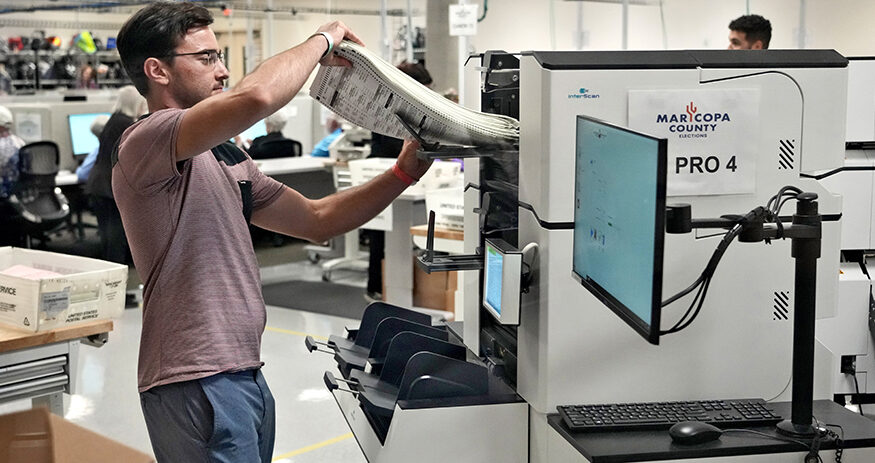
An elections official counts mail-in ballots on the first day of tabulation, Wednesday, Oct. 23, 2024, at the Maricopa County Recorder's Office in Phoenix. (AP Photo/Matt York)
Judge allows comprehensive election measure to proceed
By Howard Fischer, Capitol Media Services//July 27, 2026//


Key points:
- Judge has ruled that an array of election changes can be lumped into one ballot measure
- Opponents had argued that the items are unrelated, and shouldn’t be connected
- Ruling said items shared a topic, so Proposition 144 can move forward
PHOENIX — Arizona voters can be asked to decide on sweeping proposed changes in state election laws in a single take-it-or-leave-it ballot measure, a Maricopa County Superior Court judge has ruled.
In a decision issued last week, Judge Adele Ponce rejected a legal challenge to Proposition 144, a constitutional amendment Republican lawmakers put on the November ballot. The measure would:
- Require all voters, including those voting by mail, to present identification before casting a ballot
- Enshrine in the Arizona Constitution that only U.S. citizens may vote, a requirement already established in state law
- Restrict foreign nationals from spending money to influence Arizona elections
- Allow ballots to be counted at individual polling places rather than transported to centralized tabulation centers
- Affirm lawmakers’ authority to pass future election laws aimed at ensuring timely, accurate and secure elections
Tempe City Councilman Randy Keating argued the proposal violates the Arizona Constitution because it combines unrelated issues into a single ballot measure, preventing voters from considering each proposal individually.
He pointed to court precedents requiring constitutional amendments to be “sufficiently related to a common purpose or principle” to form “a consistent and workable whole.”
Instead, Keating argued, Proposition 144 bundles together “far-flung areas of the law,” including voter qualifications, voter identification, ballot tabulation, legislative authority over elections and, “perhaps most perplexingly,” campaign finance.
But Ponce concluded that the measures are “topically related” and “sufficiently interrelated.”
“Each aims to improve election integrity,” the judge said. “The fact that the proposed amendment’s
provisions address different aspects of election security does not prevent them from being topically related.”
An appeal to the Arizona Supreme Court already has been filed.
Keating said the issue is about more than just the number of different election law changes that Prop 144 would make. He said the package is designed to deceive.
For example, he said the provision requiring all state election voters to be citizens already is state law, which voters approved in 2004.
“These are things that are very clearly made to bait people into voting for a referendum in which they will then be taking away the rights and privileges that they’ve enjoyed,” he said.
One of those, he said, is the right to vote by mail.
Before 1991, voting by mail was restricted to only those who had special reasons to do so, such as disabilities or being away from home on Election Day. That year lawmakers approved “no excuse” early voting. And it has proven popular, with more than 80% of the ballots cast that way.
Strictly speaking, the measure would not outlaw early voting. But it would require such voters to provide identification. And nothing in the proposed changes indicates how someone voting by mail could do that.
That has led some to question whether that proposal, crafted by Rep. Alexander Kolodin, is designed to end the practice. Kolodin, the Republican nominee for secretary of state, filed suit four years ago on behalf of the Arizona Republican Party to ban voting by mail.
In legal arguments, he cited a provision in the state constitution which says that ballot measures have to be approved or rejected by voters “at the polls.”
“At the time Arizona’s Constitution was ratified, it was obvious to the Arizona Supreme Court that the plain meaning of ‘the polls’ did not include people’s homes but rather means designated polling places with the voting booths and the like,” Kolodin argued.
The Arizona Supreme Court later rejected that argument.
Keating said if the Supreme Court refuses to toss the measure off the November ballot, “there will be a robust ‘no’ campaign” to convince voters to defeat it.