Sign In
Upcoming Event
 Free Newsletter

Arizona governor’s race kicks off with battle over affordability, bipartisanship
Reagan Priest, Arizona Capitol Times//July 22, 2026//
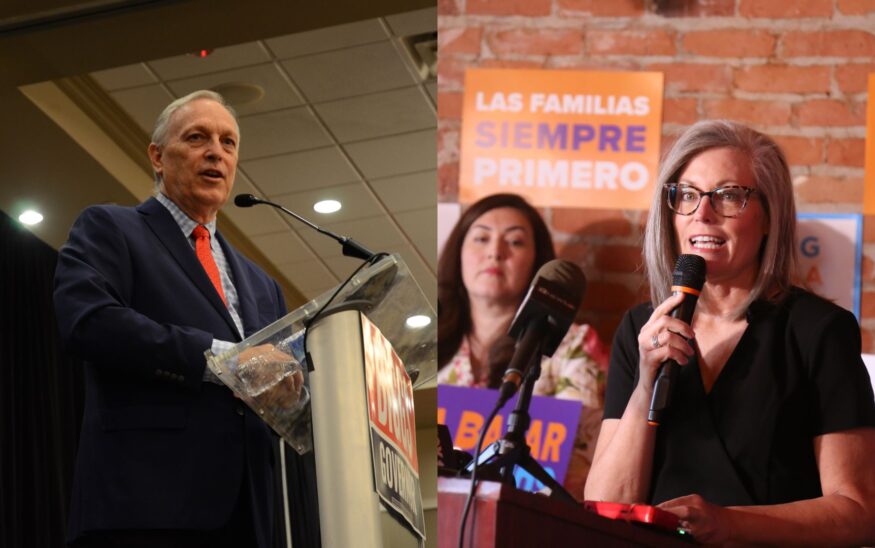
Congressman Andy Biggs to take on Gov. Katie Hobbs in November after he sailed through the Republican primary on July 21. (Jordan Gerard and Reagan Priest/Arizona Capitol Times)
Arizona governor’s race kicks off with battle over affordability, bipartisanship
Reagan Priest, Arizona Capitol Times//July 22, 2026//


Key Points:
-
Congressman Andy Biggs will face Gov. Katie Hobbs on Nov. 3
-
Affordability remains the key issue in Arizona’s governor race
-
Both candidates are already courting independent voters with 104 days to go
The stage is finally set for Congressman Andy Biggs to take on Gov. Katie Hobbs in November after he sailed through the Republican primary on July 21.
Now, the candidates will spend the next 104 days courting independent voters in Arizona, one of the country’s newest battleground states. The race will help determine whether the state returns to a familiar Republican trifecta or continues to chart a course through divided government.
Both campaigns recognize that their success on Nov. 3 hinges on their ability to convince voters that their candidate is best poised to improve economic conditions for Arizonans. And with the state’s electorate skewing independent in recent years, many voters will also be grading the candidates on whether or not they can work across the aisle to deliver meaningful relief.
Politicos who read election results like tea leaves say the primary offers a few hints as to who will be more successful in that endeavor.
Chad Heywood, a former executive director of the Arizona Republican Party, said he imagines the general election playing out as it did in 2014. That year, GOP candidates swept nearly every contest on the ballot.
“Everyone keeps comparing it to 2022, and to me, it looks a lot more like 2014,” Heywood said, referencing four years ago when Democrats swept all but two statewide offices. “We had a really historically low turnout in the primary, and in the general, Republicans won every single statewide office.”
As of Wednesday, voter turnout in the primary was significantly lower than the previous three primary elections. Between 1.2 million and 1.4 million voters cast ballots in the 2020, 2022 and 2024 primaries, while the 2026 primary hasn’t managed to crack 1 million.
However, Democratic consultant Stacy Pearson argues the voter turnout numbers show more motivation from left-leaning voters.
“Democrats overperformed in a low-turnout across-the-board election in a way that I’ve never seen,” Pearson said. “Democrats typically sit out when there’s nothing exciting on the ballot.”
In certain races, like the two uncontested primaries for Congressional District 6, Democrats cast more ballots than their Republican counterparts.
Heywood, Pearson and most other consultants agree that the candidate with the best messaging around the cost-of-living issues affecting Arizonans will come out on top — even if they can’t agree who that candidate is.
Affordability messaging
At a July 17 campaign rally, Biggs blamed Hobbs’ administration for Arizona’s economic downturn, citing flagging job growth and wage growth over the past few years.
“Arizona, which has been perennially at the top of the top for job growth and economic growth and affordability, we’re now in the basement,” Biggs told supporters during his speech. “And that’s happened in about three and a half years. What’s coincident to that is about three and a half years ago, Katie Hobbs became the governor.”
At her own July 20 campaign event, Hobbs countered that President Donald Trump’s tariffs, federal fund disruptions and Iran War are causing the state’s cost-of-living crisis.
“When I talk to Arizonans across the state, they well and fully understand that the cost hikes we’re seeing are a result of Washington’s agenda…,” Hobbs told reporters. “And Andy Biggs, every chance he had to not support that agenda, he has taken the opposite approach, supported that agenda and put that agenda above Arizona.”
Her campaign also released two ads attacking Biggs’ record on affordability. One came out minutes after the primary was called in his favor Tuesday night. A second was released early on Wednesday.
Both candidates have diverging views on how to address economic anxieties, each aligning with typical Democratic or Republican fiscal agendas.
Biggs has proposed eliminating Arizona’s 2.5% flat income tax, while Hobbs spent most of her first term directing state and federal funding toward utility bill assistance, rental and down payment assistance, and food assistance programs.
Both approaches come with unanswered questions.
The congressman has yet to say how he would replace the revenue lost by eliminating the income tax, which accounted for nearly a third of Arizona’s revenue in fiscal year 2026.
In interviews with reporters and on the debate stage, Biggs has suggested that the state could make up the difference by allowing more mining and mineral extraction on state land or by rooting out Medicaid fraud — neither of which generates a clear revenue picture.
Meanwhile, many of the Hobbs administration’s assistance programs relied on federal COVID-19 relief funds, which are set to dry up by the end of this year.
Other federal funding sources have been wiped out or held in limbo as the Trump administration attempts to cut Biden-era programs bolstering environmental and social priorities.
Working across the aisle
Both candidates say they have the bipartisan chops to help cut through the Legislature’s partisan noise and get work done for Arizonans.
Biggs began making his case to the state’s independent voters at a June 17 primary debate, rattling off a laundry list of Democrats he has successfully worked with during his decade in Congress. Speaking to reporters after his victory on July 21, he continued that refrain.
“I am a conservative and a principled conservative, but I work with people that don’t necessarily agree with me on every issue because you’re not going to find somebody who agrees with you on every issue,” Biggs said.
The congressman may need that messaging to win over independents and disaffected Democrats, but he would likely be working with a GOP-led House and Senate if he wins — eliminating the need to work across the aisle on budget or policy priorities.
Meanwhile, Hobbs has spent the last four years working with a Republican-controlled Legislature out of necessity, advancing bipartisan state budget packages and nearly 1,000 pieces of legislation.
While lawmakers like Senate President Warren Petersen have attempted to paint the governor as an extremist liberal, Hobbs has made a habit of bucking her own party on issues like immigration and the environment.
As of Wednesday, both candidates are already out of the gate with political ads making their case to general election voters. And from now until November, the race is anyone’s game.