Sign In


 Free Newsletter

Policy analysis: Biggs and Schweikert talk GOP primary platforms
Reagan Priest, Arizona Capitol Times//June 24, 2026//
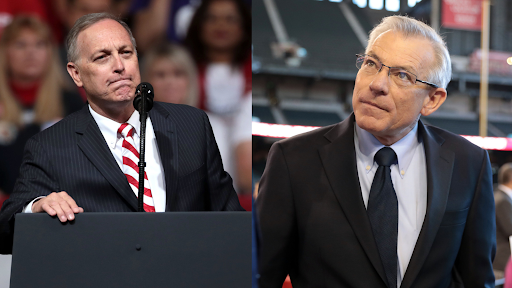
This combination photo features Congressmen and gubernatorial candidates Andy Biggs, left, and David Schweikert. (Gage Skidmore / Flickr)
Policy analysis: Biggs and Schweikert talk GOP primary platforms
Reagan Priest, Arizona Capitol Times//June 24, 2026//


Key Points:
-
Two Republican congressmen with near-identical records will go head-to-head in the July 21 gubernatorial primary
-
Biggs wants to eliminate income taxes, Schweikert prefers business recruitment
-
Schweikert breaks with Biggs on water resources, mail-in voting and DACA deportations
With early ballots already making their way to mailboxes ahead of the July 21 primary, Republicans and independents will soon have a choice to make between two GOP candidates aiming to be Arizona’s next governor.
Congressman Andy Biggs, the frontrunner, and Congressman David Schweikert, the underdog, have nearly identical voting records from their overlapping time in the U.S. House of Representatives. Yet while the two boast similar conservative bona fides, they have begun to show some differences in their plans for their would-be administrations and their paths to victory.
Biggs seems to have almost unanimous backing from the state’s conservative flank, but Schweikert maintains that he will be more palatable to the independent voters who truly decide the outcome of elections in Arizona. While Biggs attempted to demonstrate his ability to work across the aisle during a Republican gubernatorial debate, he continues to tout his close relationships with President Donald Trump and Turning Point USA — something Schweikert argues is a liability.
The differences become slightly sharper when comparing the two candidates’ plans to address the issues most pressing to Arizona voters.
Affordability and the economy
Republicans and Democrats alike agree that Arizonans are struggling to make ends meet. But Biggs and Schweikert have diverging opinions about how to ease those cost of living pains.
Biggs has proposed eliminating Arizona’s income tax, a 2.5% flat tax that already ranks as one of the lowest in the nation. In fiscal year 2026, income tax revenue made up 31% of the state’s $17.6 billion budget.
Biggs said he plans to incrementally lower the tax until it is eliminated, arguing that it will attract more businesses to Arizona.
“If you don’t do that, those businesses don’t get incentivized to come here,” Biggs said during a June 17 primary debate. “If you don’t deal with the tax structure that we have in Arizona … they’re going to Texas, they’re going to Tennessee, they’re going to Florida, they’re going to places that don’t have that income tax.”
In interviews with reporters, Biggs has also pledged to find new fuel sources for the state to offset the skyrocketing costs for gasoline and electricity. He has suggested building new natural gas pipelines or constructing new oil refineries since Arizona currently relies on fuel from nearby states.
“We will get this economy rolling and rocking,” Biggs said during the primary debate
Schweikert is not on board with eliminating the state’s income tax. Instead, he argues that Gov. Katie Hobbs’ administration has not been aggressive enough in its efforts to woo business owners who could move their operations to Arizona.
“Recruit every great business you can so there’s competition for your willingness to work,” Schweikert said. “That competition raises wages.”
He also proposed using state trust land to build more housing, which he argues will lower home prices by increasing their supply. Schweikert said state trust land in urban areas is being overlooked for housing developments, though that land is required by law to generate the highest amount of revenue possible for the state land trust’s beneficiaries.
Balancing the state budget
Biggs is a former state Senate president who has crafted state budgets alongside a Republican governor. Schweikert is a self-proclaimed math nerd who delivered 11 hours worth of floor speeches on the national debt in 2025 alone. The two have diverging plans for keeping the state budget balanced.
Biggs wants to allow for more mining and mineral extraction on state trust land to generate new revenue streams from the state. He also pledged to root out the “fraud, waste and abuse” that he argues is plaguing Arizona’s Medicaid system, which he claims could amount to about $8 to $10 billion in lost funding.
And Biggs took a page out of Hobbs’ book, promising to eliminate tax incentives for data centers, which cost the state around $38 million per year in revenue. It’s unclear whether legislative Republicans will back that proposal.
Schweikert argues that the state of the economy necessitates a dip into Arizona’s budget stabilization fund, more commonly known as the rainy day fund, as wages remain stagnant and inflation rises. He said lawmakers could have pulled around $300 million to $400 million from the over $1 billion fund to reinvest in government services.
Schweikert has also pledged to cut funding for pet projects from the state budget, specifically highlighting funding for “flying cars,” an innovation pushed by Sen. David Farnsworth, R-Mesa. And he wants to fight “fraud, waste and abuse” in Medicaid with data and artificial intelligence systems that he promises will catch fraudulent payments before they are sent out by state agencies.
Education
Both congressmen fully support Arizona’s Empowerment Scholarship Accounts program, a school voucher system that allows any student in the state to receive funding to attend the private or parochial school of their choice.
Biggs has argued the already-universal program should be expanded. He later told reporters that ESAs could be used to support alternative education programs like trade schools and apprenticeships, though it’s unclear whether there is any barrier to doing so currently.
Schweikert, in turn, has pledged to provide more resources and a new data system to the state Department of Education to reduce the improper payments and spending that have plagued the $1 billion program.
The two have different ideas about how to fund public schools in the state.
Biggs wants to use revenue generated state trust land to provide money to schools, but stopped short of pledging to renew Proposition 123, an expired funding measure that withdrew 6.9% annually from the state land trust for public schools. Schweikert argues the state needs to rebuild its school financing structure after a Superior Court judge found the Legislature has been chronically underfunding school facilities.
Water resources
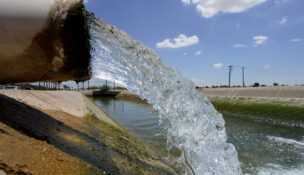
Biggs and Schweikert agree on one thing when it comes to water: Arizona is not running out anytime soon. The state just needs to better manage its resources.
And to do that, Biggs wants to reinvigorate a dormant desalination plant in Yuma that was abandoned after it became too costly and impractical. He also proposed building more dams and reservoirs to better manage Arizona’s portion of the Colorado River’s dwindling flows.
Schweikert argues that desalination would make water too costly for Arizonans and said the issue is more about how the state allocates water. He noted in the debate that most of the state’s water supply goes to feeding cattle rather than supporting home development.
Elections
Biggs has already pledged to sign a piece of legislation dubbed the “Florida-style elections” bill introduced by Republicans in the state Legislature, designed to speed up the ballot counting process to get results quicker. But Schweikert is far more cautious when it comes to mail-in voting.
“We have to deal with the reality (that) voters like the mail-in voting system,” Schweikert said.
Under the “Florida-style” proposal, early voting would end the Friday before an election, though many Arizona voters prefer to cast “late earlies” and drop their mail-in ballots off on Election Day. Schweikert says he isn’t sure voters are ready for that change.
Immigration and border security
Though it was a bellwether issue for voters in 2024, immigration has largely fallen by the wayside in Arizona’s gubernatorial race, in part due to record low border crossing numbers under the second Trump administration.
Both congressmen have been largely supportive of Trump’s immigration agenda, but Schweikert drew the line on mass deportations of recipients of the Deferred Action for Childhood Arrivals program — an idea pitched by Senate President Warren Petersen, a Republican candidate for attorney general.
Biggs quibbled with the definition of DACA recipients when speaking to reporters on the issue, but Schweikert said those mass deportations do not work mathematically or economically.