Sign In
Upcoming Event
 Free Newsletter

Can state leaders lower gas prices?
Reagan Priest & Jakob Thorington, Arizona Capitol Times//April 3, 2026//

A gas station display reads $4.98 per gallon of unleaded fuel in the heart of Phoenix on April 2, 2026. (Kiera Riley / Arizona Capitol Times)
Can state leaders lower gas prices?
Reagan Priest & Jakob Thorington, Arizona Capitol Times//April 3, 2026//


Key Points:
-
State leaders debate whether the governor or Legislature can lower gas prices
-
Gov. Katie Hobbs open to temporary suspension of state gas tax
-
One Republican says Arizona is “a victim of our geography”
The perennial quest to lower gas prices in Arizona is sparking debate at the Legislature and in the governor’s race as pain at the pump impacts consumers nationwide.
Gas prices in Arizona fluctuate at the whims of a dizzying array of factors. Everything from state and federal regulations governed by the Clean Air Act to reliance on out-of-state fuel suppliers and unforeseen supply shortages caused by severe weather or conflict in the Middle East can raise costs.
And while some Republican lawmakers have introduced bills this session aiming to clawback some of those regulations, one is arguing there’s nothing he or his colleagues at the Legislature can do to make fuel cheaper.
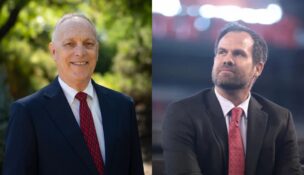
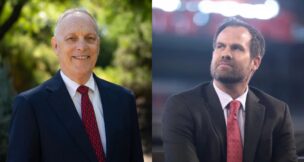
Just the same, the debate has spilled over into Arizona’s upcoming gubernatorial race, with Gov. Katie Hobbs and her potential Republican challenger Congressman Andy Biggs sparring over the state’s role in controlling gas prices.
“I, as I have been all year, am focused on lowering costs for Arizonans,” Hobbs told reporters on March 27. “They are continuing to be pinched by higher prices on everything, and now we’re seeing big increases in gas. I think we can’t take anything off the table.”
That includes reconsidering the state’s 18-cent-per-gallon gas tax, which generates revenue for the Highway User Revenue Fund that in turn bankrolls road improvement projects throughout Arizona. Hobbs noted that the HURF is already seeing declining revenues as electric vehicles become more popular, so a federal gas tax holiday may be more beneficial for the state.
There are currently several Republican proposals at the Legislature that would create an annual fuel tax holiday, or a temporary suspension of state taxes, between May 1 to Oct 1. Hobbs said she would prefer to address a gas tax holiday through budget negotiations, which are currently on hold, in order to mitigate impacts to the HURF.
Maricopa County and parts of Pinal County also tend to see higher gas prices in the summer months due to the Clean Air Act, which requires certain areas to use a cleaner-burning gasoline blend to reduce emissions. The state can request a waiver to use an alternative fuel in the event of shortages or supply chain issues, which Hobbs did on March 18 and has done twice before.
The EPA issued a nationwide fuel waiver on March 25 in response to rising fuel prices as a result of the war in Iran. The waiver will be in effect from May 1 to May 20, which won’t help Arizonans at the pump today, but will prevent prices from increasing further once summer hits.
While the waiver will provide temporary relief for Arizonans, Republican lawmakers have long been eager to eliminate the EPA’s cleaner-burning gasoline requirements to provide a more permanent solution.

With a Trump administration EPA, Rep. Julie Willoughby and other Republican lawmakers are urging Hobbs and local county governments in Maricopa County to take steps to secure approval for less expensive fuel blends in the state. Willoughby met with officials from the Maricopa Association of Governments on March 30 to discuss a revised plan that would meet the EPA’s environmental standards while using less expensive blends of fuel.
“The modeling is favorable. The facts are lining up in Arizona’s favor. We should seize this opportunity and make the case for lasting gas affordability now,” Willoughby said in a statement.
Biggs has criticized the governor for not doing enough during her tenure to push for EPA approval of a less expensive fuel blend and for supporting a proposed increase in the state’s gas tax while serving in the state Senate.
But not every Republican is convinced state leaders have sway over gas prices. Rep. Justin Wilmeth, R-Phoenix, said most of the incremental actions the state can take would only lead to a minimal reduction in prices.
“There’s nothing out there that we as a Legislature, or Governor Hobbs, or (former Governor Doug) Ducey or governor anybody could do to bring down gas prices by less than $2, which is what everybody wants,” Wilmeth said. “We’re a victim of our geography.”
Biggs also told reporters on March 13 that if elected governor he would pursue opportunities to bring more fuel to the state, like building new pipelines, adding more fuel storage facilities or even constructing an oil refinery.
“One of our problems is, because we don’t have any resources inherent in Arizona for oil and gas, everything’s piped in,” Biggs said. “But when you go to a refinery … you’re actually able to bring in the crude (oil), refine it, and then you can store it to offset what is a natural scarcity.”
Wilmeth has been speaking about the need for nearby oil refineries for years. He traveled to the California state Senate in 2024 to urge lawmakers to consider how legislation designed to prevent gas price spikes by regulating refinery inventory supplies would affect neighboring states, including Arizona and Nevada.
While Wilmeth said he’d love to have another refinery in Arizona, the state doesn’t have the petroleum reserves like Texas or California does to warrant building one.
“Nobody in their right mind is going to invest billions in a refinery in Arizona to truck crude oil to Arizona to be refined,” Wilmeth said.
What could help bring down gas prices in the future is a planned Texas gas pipeline from energy companies Phillips 66 and Kinder Morgan, which aims to address California’s refinery capacity, but that project isn’t expected to be complete until 2029.
Democratic legislative leaders told the Arizona Capitol Times that higher gas prices are ultimately a direct result of the war with Iran and are unlikely to come down without a resolution to the conflict.
“These are ideas that might impact gas prices by a couple of cents here or there, but nowhere near the amount of gas prices that are squarely due to Trump taking us to war with Iran,” said Senate Minority Leader Priya Sundareshan, D-Tucson. “If Andy Biggs is trying to message around it, he is deflecting from his own responsibility and failing to hold Trump accountable for having taken us to war without Congress’s authorization.”