Sign In




 Free Newsletter
Arizona Senate looks to sidestep rural zoning codes for new nuclear generation
Howard Fischer, Capitol Media Services//June 8, 2026//
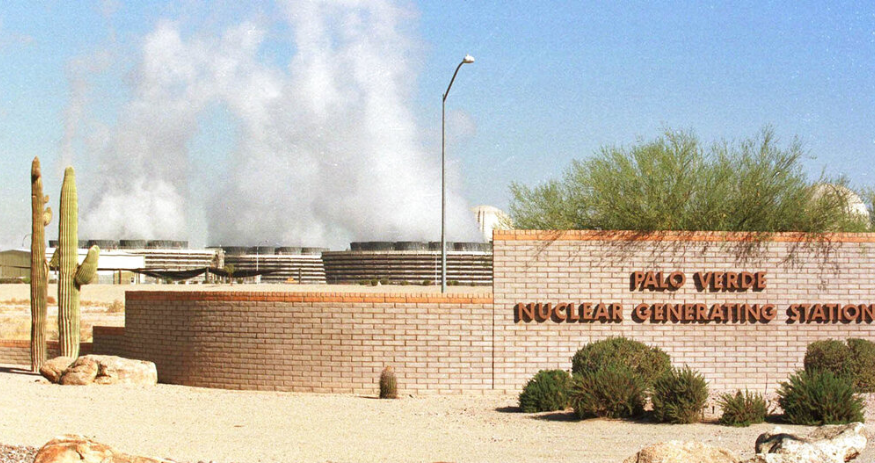
Water vapors rise from cooling towers at Palo Verde Nuclear Generating Station, the nation's largest nuclear plant near Wintersburg, Ariz. (AP Photo/Jason Wise, File)
Arizona Senate looks to sidestep rural zoning codes for new nuclear generation
Howard Fischer, Capitol Media Services//June 8, 2026//


Key Points:
-
Arizona may soon have small nuclear reactors in rural areas
-
Legislation would allow reactors to be placed near data centers without local oversight
-
Opponents argue that the state should prioritize renewable energy sources instead
Rural Arizona counties could soon lose their zoning authority over nuclear power plants under legislation that would fast-track placement of small “modular” reactors near data centers and former coal sites.
Legislation approved by the Senate and awaiting a House vote would strip supervisors in 13 rural counties of their authority — everywhere but Maricopa and Pima — from being able to use zoning or other land use regulations to prohibit new nuclear construction.
The measure is aimed at allowing these reactors to be placed where there used to be coal-fired power plants without additional review. The idea is that there already is the infrastructure, mainly in high-voltage power lines, to distribute the power generated.
But an even-bigger piece of the proposal is wrapped up in the debate about data centers.
That’s because the measure is specifically worded to say that one of those plants can go in right next door — again, without county oversight — to a business with an “extra high load energy factor.” That means a lot of 24/7 electricity demand, which aligns with the power draw of a data center.
The measure, Senate Bill 1418, has so far advanced solely with Republican votes.
Democratic lawmakers are raising questions about safety, dealing with nuclear waste, and why the state isn’t instead promoting renewable forms of energy like solar, wind and geothermal.
But there could be a crack in that partisan divide.
“As Republicans, we are supposed to be for local control,” Rep. Walt Blackman told GOP colleagues during a caucus to discuss the pending House floor vote. The Snowflake Republican represents a sprawling district which includes parts of Coconino, Gila, Navajo and Pinal counties.
“I’ve been seeing a lot of bills from so-called Republicans that do the opposite,” he said. And Blackman said if the net effect of this bill is to override local decisions he will vote against it when it reaches the House floor.
House Majority Leader Michael Carbone, by contrast, said he has no problem with such an override.
“We do it all the time,” acknowledged the Buckeye Republican.
In fact, Carbone was a prime mover behind a 2025 law that allows homeowners to build “accessory dwelling units” on their own property, regardless of local zoning — and over the objections from cities who said this should be a local issue.
To Carbone, the bottom line is that cities and counties are subdivisions of the state. And that, he argued, means state legislators need to occasionally preempt local control for what they believe are worthy causes.
In this case, he said, that worthy cause is rural economic development. Carbone said one data center under development, once completed, would generate between $70 million and $90 million a year in just property taxes.
“That fire, police, infrastructure,” he said. “That’s water, sewer, roads,” Carbone continued. “They’re your schools. That’s where that money goes.”
And Carbone said that building more data centers is necessary to ensure that Arizona — and the United States — have enough computing power to compete with China. And that, he said, can occur only if there is the “juice” to power them.
These reactors differ sharply from the nuclear plants most people know.
The legislation limits them to a capacity of generating 300 megawatts. By comparison, the three units at the Palo Verde Nuclear Generating Station west of Phoenix can generate more than 3,900 megawatts.
And David Morris, a lobbyist for Americans for Prosperity which lobbies for free-market policies and deregulation, told lawmakers they are physically smaller, perhaps no taller than 30 feet, versus the 200-foot towers of traditional reactors.
All that, however, still leaves the question of whether these reactors are a good idea and, more to the point of SB 1418, whether there is desire to make it easier to place them in rural areas despite objections of local supervisors.
“Supervisors and county residents understand the importance of economic development and the infrastructure necessary for energy,” testified Jacob Emnet on behalf of the County Supervisors Association. But he told lawmakers this has historically been established “in collaboration with residents and the elected residents.”
“And while we appreciate the excitement around small modular reactors, we are still in the early stages of the development of the technology,” Emnet said.
That’s one of the issues for Senate Minority Leader Priya Sundareshan. The environmental attorney said she supports nuclear energy, particularly as providing an alternative to other methods that can affect the climate.
But the Tucson Democrat pointed out that there are currently no such “modular” reactors actually operating commercially in this country.
That did not bother Sen. Frank Carroll, the Sun City West Republican who is the sponsor of SB 1418.
“This technology has come a long way,” he said, saying there are 11 companies involved in building such reactors right now.
“There are a lot of lessons that were learned along the way,” he said. “And all of those are being applied. I don’t buy in to being overly cautious because that’s not necessary here.”
Cost has been the main prohibitive force working against commercial operation of the small nuclear units.
Take a plan by NuScale Power to work with Utah Associated Municipal Power Systems. The project was canceled after costs ballooned from $5.3 billion to $9.3 billion.
“We think while billions are being invested to prop up this technology we could be investing in clean, renewable solar with storage,” said Sandy Bahr, director of the Arizona chapter of the Sierra Club. And that, she said, is just part of the problem.
“They will increase the volume of waste,” Bahr said. “And we still have no — zero — long-term storage for nuclear waste, which is dangerous and harmful to human health.”
Carbone, however, said too much is being made of the waste issue, saying that places like Palo Verde are doing just fine storing the spent fuel rods at the plant. He also said that, with current technology, the danger is being overstated.
“They’re getting to the point where they’ve taken everything out of it,” he said. “There’s nothing hazardous about it any more.”
Still, much of the discussion about overriding local control is the promise that having a source of power like a modular reactor would produce more local economic development, much like what already exists in the state’s two metro areas.
Carroll said, for example, that the Phoenix area has benefited from construction of the new Taiwan Semiconductor Manufacturing Co. plant.
“The city of Winslow, from every indication, wants to participate in that,” he told colleagues. But that, said Carroll, requires available energy, particularly with coal-fired plants being shuttered in northern Arizona.
“This bill is designed to support the rurals,” he said.
Sen. David Gowan echoed the sentiment, calling the modular plants “perfect for rural Arizona and building out smaller towns and cities and giving them the ability of competing, maybe in the future for, more economic boom with businesses.”
But one rural lawmaker said Arizona should have nothing to do with encouraging more nuclear power of any type.
Sen. Theresa Hatathlie said her objection comes down to a simple fact: These plants require uranium, something that has been mined for decades in northern Arizona. And she said that 27,000 square miles of Navajo Nation land, where she lives “is littered with what became the Cold War era.”
“In my family alone, I have nine siblings,” she told other lawmakers.
“Six of them have had cancers, various forms of cancer.” Hatathlie said she has become a caregiver, watching them suffer not only physically but emotionally about whether they will survive. “That’s what this technology does.”