Sign In
Upcoming Event
 Free Newsletter

Arizona’s Prop 145 voucher fight heads back to Supreme Court
Howard Fischer, Capitol Media Services//August 10, 2026//
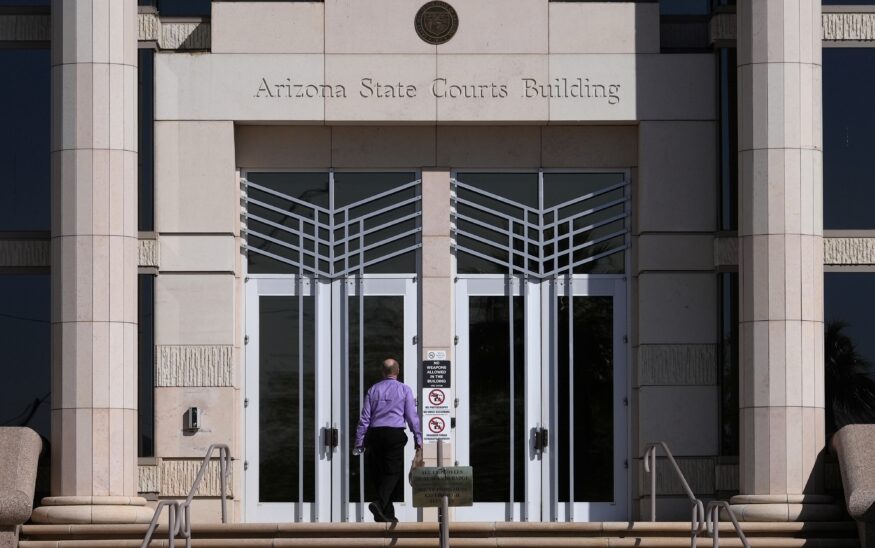
A man enters the Arizona Supreme Court building, Wednesday, April 10, 2024, in Phoenix. (AP Photo/Matt York)
Arizona’s Prop 145 voucher fight heads back to Supreme Court
Howard Fischer, Capitol Media Services//August 10, 2026//


Key points:
- Proposition 145 would enshrine school voucher money for military families, nullifying any laws going against it
- That would apply to Proposition 212, which proposes several reforms to the voucher system
- A judge had previously removed Prop. 145 from the ballot, but supporters are trying to get that overturned
PHOENIX — Voucher supporters are asking the Arizona Supreme Court to overturn the disqualification of a ballot measure that, if approved, would kill a separate initiative to reform the Empowerment Scholarship Account program.
Attorney Thomas Basile, who represents House Speaker Steve Montenegro and Senate President Warren Petersen, does not dispute that Proposition 145 contains two separate provisions that would amend the Arizona Constitution.
One would permanently protect the ability of children in military families to receive taxpayer-funded vouchers to attend private and parochial schools or to be homeschooled. It also would allow those families to save any unused voucher money each year for college.
The other provision would declare entirely void any law that undermines that right — not just laws dealing with military families.
That provision is aimed specifically at Proposition 212, which asks voters to make major changes to the voucher program, including ending the ability to bank unused voucher money. Those changes would apply to all voucher recipients, not just military families.
Basile is asking the justices to overturn Maricopa County Superior Court Judge Joseph Kreamer’s ruling that the measure is constitutionally flawed.
The trial judge ruled that GOP lawmakers cannot combine the two provisions into a single take-it-or-leave-it proposal, one specifically protecting military families and the other to permanently take out every other voucher measure that touches on the subject.
But Basile said the entire purpose behind Proposition 145 is to protect those scholarship accounts for military families.
He conceded that if lawmakers only included the protection for military families, it would have precluded any future attempts to change it. But he argued there is no legal reason why that can’t include Proposition 212 on the same ballot.
Basile said none of that precludes future efforts by groups like the Arizona Education Association and Save Our Schools to make changes to the voucher program. Instead, they would just have to avoid provisions that affect military families.
Prop. 212 seeks to further define what items serve an educational purpose and what items do not.
There even is a list of forbidden items, ranging from household furniture and motor vehicles to jewelry, lingerie and admission to amusement parks. It also would deny vouchers to children in families earning more than $150,000 a year.
Basile said the court should ignore any effect Prop. 145 would have on Prop. 212.
“So what?” Basile said.
“So even if HCR 2048 [the legislative designation before it was numbered Prop. 145] would effectively preempt all ESA regulations, HCR 2048 still would comprise a unified pronouncement on the state’s constitutional understanding of parents’ and students’ rights with respect to school choice funding,” he said. And that, Basile said, makes putting the two issues together legal.
But to win the appeal to the Supreme Court, Basile also needs to overcome some other flaws that Kreamer found with the ballot measure.
For example, the judge questioned the legality of any effort by lawmakers to preemptively kill future initiatives, requiring courts to void entire otherwise-legal measures approved by voters just because one section runs afoul of a constitutional provision.
Generally speaking, courts have the power of severability when dealing with a measure that has multiple provisions.
If a single provision of any law is determined unconstitutional, then judges void that section, and allow other, unrelated provisions to take effect. That is true whether the measure is enacted by the Legislature or voters.
But Kreamer said that’s not the case with how Prop. 145 is crafted.
“Instead of applying only to the bill being proposed, it would invalidate future legislation,” the judge continued. And he said it affects constitutional provisions dealing with the power of the court “because it would potentially force the judiciary to invalidate laws that do not violate a constitutional right.”
“It concerns key aspects of judicial review, legislative power, and the separation of power between those branches,” Kreamer wrote.
Basile, however, said courts do not have a freestanding power to decide whether to sever illegal portions of a law and leave the rest.
“Courts employ severability as an interpretive tool, not an exercise of autonomous will,” he said. And he said the fact that Prop. 145 includes language voiding all of Prop. 212 does not run afoul of the law.
No date has been set for the justices to take up the case.