Sign In
Upcoming Event
 Free Newsletter

Conservationists worry Trump may prematurely strip Mexican gray wolf protections
Ellis Preston, Cronkite News//September 21, 2026//

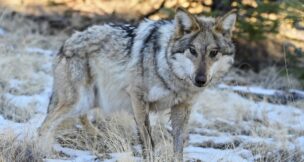
This Jan. 24, 2025, image provided by the Arizona Game and Fish Department shows a Mexican gray wolf in the wild that was monitored as part of a population survey in eastern Arizona. (Arizona Game and Fish Department via AP)
Conservationists worry Trump may prematurely strip Mexican gray wolf protections
Ellis Preston, Cronkite News//September 21, 2026//


WASHINGTON – President Donald Trump’s executive order reviewing the status of Mexican gray wolves on the Endangered Species List comes despite the species’ population count falling short of the minimum requirement.
It’s a move conservationists argue ignores science and threatens to remove protection of Mexican wolves in order to appease the ranching industry, which has advocated against the species for decades.
“The Trump executive order is just a more extreme example of openly putting politics above science,” said Carlos Carroll, an ecologist who studies the population growth of gray wolves.
According to Trump’s executive order, the Secretary of the Interior has 90 days from Sept. 4 to decide whether the Mexican gray wolf species is healthy enough to be downlisted to the “threatened” status or be removed off the Endangered Species list altogether.
“FWS will be evaluating all applicable science, existing laws and the ESA listing status of Gray and Mexican Wolves,” a spokesperson for the U.S. Fish and Wildlife service said in a written statement to Cronkite News. “The Executive Order does not change the current threatened or endangered status of any wolf populations.”
As of 2025, there are 319 Mexican gray wolves living in the United States, between Arizona and New Mexico. For the past 50 years, the gray wolf subspecies has been marked as “endangered” on the list, giving them federal protection, along with federally initiated programs which assist with reintroduction measures and population monitoring.
To be downlisted from “endangered” to the “threatened” tier, the wolves must maintain a U.S. population average of 320 or more over the course of four years, according to the U.S. Fish and Wildlife Service. To be removed off the list completely, the wolves must average a population of 320 in the U.S. and 200 in Mexico for at least eight years.
The FWS’s own data show the Mexican gray wolves have not reached the population stability required for their endangered status to be revised in any capacity. They have averaged an estimated population of 276 over four years and 222 over eight years in the U.S., falling short of the required averages.
“We still want to know the genetic health of the wild population before removing protections,”said Craig Miller, an Arizona senior representative at the Defenders of Wildlife
And based on their own population modeling, reaching a steady 320 population count in the United States is necessary for the species’ resiliency without federal intervention, according to the FWS Mexican Wolf Recovery Plan.
A research study commissioned by the FWS in 2013 found that a wolf population of 750 over an eight year period was more likely to facilitate a self-sustaining species.
Carroll, who was one of the ecologists who worked on that study, said the agency dismissed the findings and hired a new team of researchers who decided a wolf population of 320 was a sufficient measurement. In 2019, Carroll and a group of researchers questioned the scientific integrity of the new findings.
“The last iteration of the recovery group was dominated by the state game agencies,” Carroll said. “So it’s not surprising to me that they ended up with a lower number.”
Both Carroll and Miller said they expect the federal government’s sharp pivot was partially due to a pacifying attempt to appeal to the deer-hunter rancher community, which has been vocal against the reintroduction of the wolves.
Ginger Cheney is a rancher located along the Arizona-New Mexico border in Blue, Arizona, with 300 heads of cattle between her two ranches. She said this past year she had at least 16 cows killed by Mexican gray wolves.
Cheney wasn’t concerned that the federal government’s possible premature status revision would put the wolf population at risk, because she said she did not believe the official count of 319 Mexican gray wolves was correct. She said she believes the count is much higher and a portion of wolves were miscounted.
“There’s a lot of uncollared wolves out there, in unknown packs,” Cheney said. “I don’t think that they need to worry that we haven’t hit the 320, because we have.”
She said lethal measures are the most effective ways of securing her cattle’s safety.
In his executive order, Trump suggested that the Department of the Interior consider allowing lethal removal of Mexican gray wolves to assist ranchers in combating livestock predation.
“Illegal killing remains their greatest threat,” Miller said. “The president’s suggestion that, you know, people can shoot them now is blatantly wrong, and it demonstrates a disturbing disregard for both science and the law.”
Conservationists continue to fight for the protection of the animals.
“It doesn’t take much for one bad year and it can dip again,” said Hollie Colahan, the executive director of the Arizona-Sonora Desert Museum. “Just want to see that it’s at that level and then see that it can maintain that level.”
Colahan said if the wolf species is removed from the Endangered Species list now, it is likely the population will decline.
“That 320 over four years was a decision that was based on science,” Colahan said. “It was based on the biology of the wolves and the population.”
This article first appeared on Cronkite News and is republished here under a Creative Commons Attribution-NoDerivatives 4.0 International License.