Sign In




 Free Newsletter
Judge says Fontes can’t call ESAs ‘vouchers’ on ballots
Howard Fischer, Capitol Media Services//August 12, 2026//
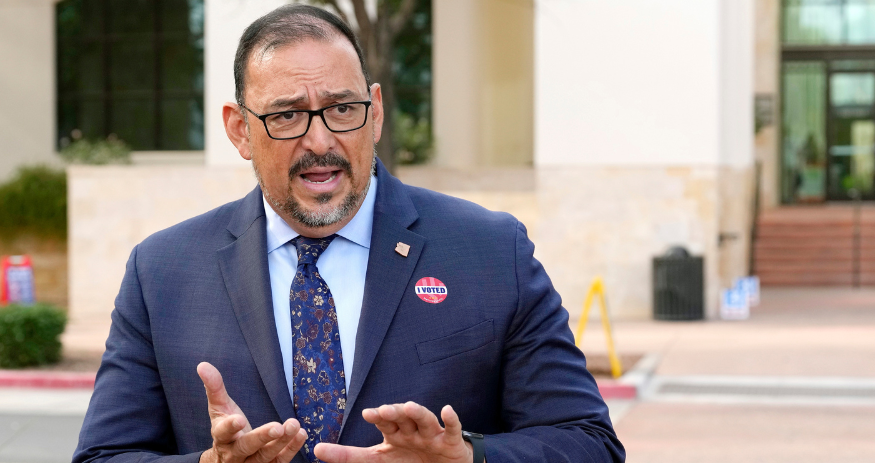
Adrian Fontes, Arizona Secretary of State, speaks at Surprise City Hall, Wednesday, Oct. 9, 2024, in Surprise, Ariz. (AP Photo/Ross D. Franklin)
Judge says Fontes can’t call ESAs ‘vouchers’ on ballots
Howard Fischer, Capitol Media Services//August 12, 2026//


PHOENIX — Secretary of State Adrian Fontes acted illegally in using the word “vouchers” to describe the program that gives tax dollars to parents sending their children to private and parochial schools, a judge ruled.
Maricopa County Superior Court Judge Julie Ann Mata acknowledged that Fontes’ use of the word in describing Proposition 212 was based on a common understanding of the Empowerment Scholarship Account program and how funds are distributed.
But Mata said that the word “voucher” itself does not actually appear in the Arizona law governing ESAs. And, she noted, the Arizona Supreme Court ruled more than a decade ago that vouchers are unconstitutional, but the current ESA system is not.
Mata’s ruling does not deal with the merits of the ballot measure itself. Instead, the ruling focused on Fontes’ incorrect use of the word in this case, despite the common understanding of it.
“Because the phrase may cause voters to treat legally distinct programs as the same, the court concludes that the use of ‘school voucher programs’ is misleading,” the judge wrote.
Fontes’ office on Wednesday did not comment on a possible appeal.
Arizona law requires the secretary of state to describe every measure that goes to voters, as well as an explanation of the effect of a “yes” or “no” vote. Both summaries go directly on the ballots that are mailed to individuals or received at polling places.
Fontes described approving Prop. 212 as an amendment to “Arizona’s Empowerment Scholarship (ESA) school voucher program,” and listed various changes the initiative would make. These include everything from limits on how the funds can be spent to placing a $150,000 family income cap to receive the benefit.
But the Arizona Free Enterprise Club, which has advocated to both protect and expand the program, said the ESA program is “definitely not” a voucher program.
Arizona lawmakers first established a self-described voucher program in 2006. But the state high court voided it three years later after ruling the Arizona Constitution bans appropriating public funds in aid to private and parochial schools.
In 2011, however, lawmakers came up with “empowerment scholarships.”
A key difference between that later program and the voucher system is the special, state-established account parents can tap to pay tuition and fees for private or parochial schools, or other educational arrangements.
The state Court of Appeals determined these accounts do not amount to tax dollars being used to subsidize private schools. The judges said that’s because parents are the ones deciding where the money goes, and not the state.
The Arizona Supreme Court upheld that ruling in 2014.
Since its inception, the new program expanded from one that simply provides funds for students with special needs to also include students in schools rated D or F, foster children, children in military families, and children living on reservations.
And, in 2022, lawmakers removed all limits. That ballooned the program from about 12,000 students to more than 100,000, with the annual cost now surpassing $1 billion.
Backers of Prop. 212, including the Arizona Education Association and Save Our Schools, said what’s in Prop. 212 will curb the costs of the universal program without affecting students who were considered eligible prior to 2022.