Sign In


 Free Newsletter

$75 buys you 300 words — and an audience of 4 million Arizona voters
Howard Fischer, Capitol Media Services//June 8, 2026//
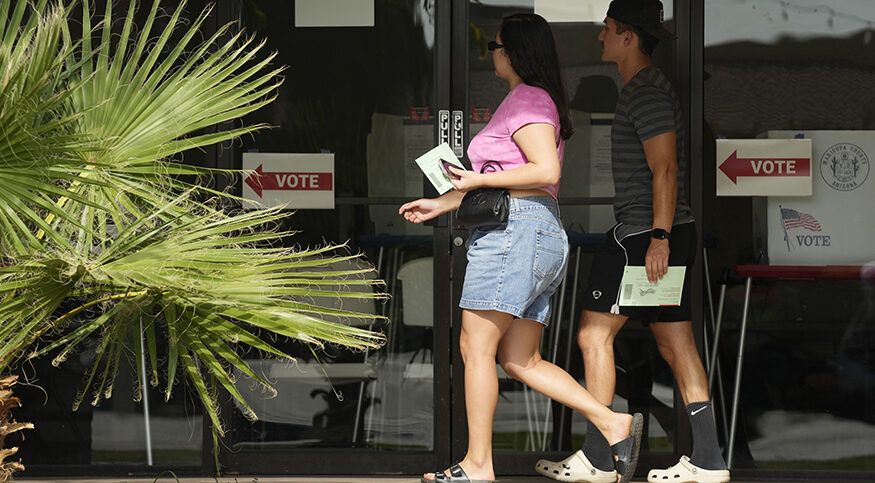
Voters walk to a voting precinct prior to dropping of their ballots Tuesday, July 30, 2024, in Guadalupe, Ariz. (AP Photo/Ross D. Franklin)
$75 buys you 300 words — and an audience of 4 million Arizona voters
Howard Fischer, Capitol Media Services//June 8, 2026//


Key Points:
-
Arizona voters can share opinions on ballot measures for $75
-
Arguments must be submitted by June 24 to be included in the widely-spread ballot pamphlet
-
The Secretary of State’s Office may seek legal advice on offensive arguments
Got an opinion about photo radar?
Empowerment scholarship accounts?
The firing squad as an acceptable method of execution?
All these and more may be on the November ballot.
And for $75, you can share your thoughts about them with nearly everyone registered to vote.
That’s all it takes to get a 300-word argument in a ballot pamphlet that’s going to be mailed to about four million registered Arizona voters ahead of the Nov. 5 election.
Those interested have until 5 p.m. on June 24 to submit their entry and file payment to the Secretary of State’s Office.
The idea of a ballot pamphlet is part of a long-standing state law that allows individuals, organizations and political committees to make their own pitch to voters about ballot issues. The Secretary of State’s Office then mails these out, one to each head of household with at least one registered voter.
It all starts from a website which will go live next week: “https://ballotarguments.az.gov”.
First, pick out the issues on which you would like to opine.
For all the rest, it’s straight forward. Just follow the instructions, type in what you want to say — up to 300 words — fill out the rest of the form and then, when prompted, make your $75 payment online with a credit card.
What you do with those 300 words is pretty much up to you.
The Secretary of State’s Office doesn’t edit for content. That means any typos you make will remain for everyone else to see. So proofread carefully.
But the agency said it might seek legal advice before actually printing an argument with some four-letter words not generally used in polite conversation.
Pretty much anything else, however, is in bounds — even if it doesn’t actually relate to the ballot measure or not.
Don’t worry about filling in the ballot number, like “Proposition 100.” Leave a blank and that will be filled in by the office when it finally assigned the numbers.
There are constraints.
The web site won’t accept efforts to use bold or italics to make a point, though people are free to capitalize for emphasis.
Also, only online submissions will be accepted. Forget about typing or printing up something at home and showing up at the Secretary of State’s Office, paper and $75 in hand.
Still, if you have a lot to say about a lot of things — and money to burn — there’s no limit to the number of ballot arguments you can submit, either on one or multiple issues.
Here’s what’s currently confirmed for the ballot, plus what could be coming:
– Precluding lawmakers from taxing vehicles based on the mileage they drive, a bid to remove that as an option for dealing with the fact that owners of electric vehicles don’t buy gas and don’t pay a gas tax;
– Restricting the ability of cities to impose their sales taxes on food;
– Declaring drug cartels as “terrorist organizations,” requiring the state Department of Homeland Security to do “everything in its authority” to address the threat.
And more could be coming.
One proposal still awaiting final legislative action, for example, would say that cities can’t use photo enforcement for speed or red lights unless local voters give their approval. And any community that has that now would need to take it to the ballot.
Another seeks to prohibit anyone born as male from participating in intramural or interscholastic sports designed for females, women or girls.
There’s also a plan to raise the mandatory retirement age for judges from 70 to 75.
And then there’s a proposal to allow those facing the death penalty to choose among lethal injection, lethal gas or the firing squad.
In total, there are 25 measures pending at the Capitol that Republican leaders, who control both chambers, may or may not choose to try to put on the November ballot.
And that’s not all.
There also are efforts by various groups to put their own initiatives on the ballot.
Several appear to have already been abandoned, like one to cap the salaries of hospital executives and another to repeal a voter-approved law that legalized marijuana for recreational use.
Those still apparently active are:
– Two separate measures that seek changes in Empowerment Scholarship Accounts. They have some similar provisions like limiting what can be purchased with the funds. But there are key differences, with one putting a cap on eligibility based on family income;
– A constitutional amendment that would guarantee the right to get an early ballot and vote by mail.
Initiative petitions aren’t due until July 2 – eight days after the ballot argument deadline – meaning anyone who submits early risks losing that $75 fee if a measure fails to qualify or is knocked off the ballot through litigation. There are no refunds.
And this year, there’s another complicating factor.
It’s unclear whether the Legislature will have finished its business — including deciding what to send to the ballot — by that June 24 deadline. So here, too, those who want to comment still have to meet that deadline and pay that $75 fee even if it turns out the measure is never actually referred.