Sign In


Upcoming Event
 Free Newsletter

Salt River horse protections die in the Senate, animal advocates stunned
Jordan Gerard, Arizona Capitol Times//June 26, 2026//
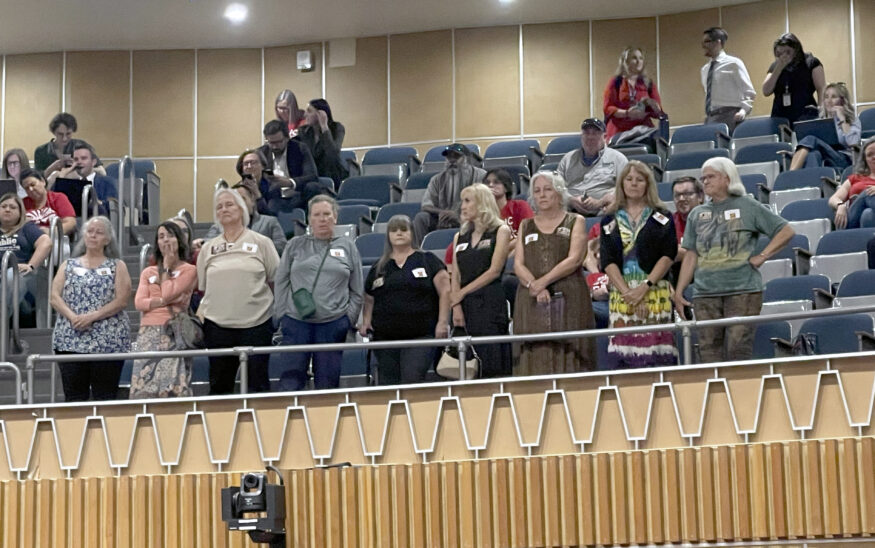
A coalition of local Salt River horse advocates in the gallery of the Arizona Senate on the final day of the 2026 legislative session wait for an update on SB 1199. (Jordan Gerard / Arizona Capitol Times)
Salt River horse protections die in the Senate, animal advocates stunned
Jordan Gerard, Arizona Capitol Times//June 26, 2026//


Key Points:
-
A bill that would have offered more protections for the Salt River horses died without a vote in the Senate
-
It would have directed genetic studies on the herd, the first of its kind in Arizona
-
Advocates say the governor could direct those studies at any time instead of waiting for legislation
Arizona’s environmental advocates are mourning the recent death of a striker amendment that would have allocated more protections and scientific study for the state’s beloved Salt River horses.
Senate Bill 1199 would have put a three-year moratorium on the removal of any Salt River horses from wild herds unless absolutely necessary to prevent or alleviate suffering of a horse. Rep. Cody Reim, R-Scottsdale, who replaced Joseph Chaplik in Legislative District 3, filed the bill as a strike-everything amendment in March, right as the last regular committee meetings took place.
The House gave it bipartisan support in a third reading on June 9, but it died in the Senate on the final day of session with advocates lining the gallery in support.
Reim said it’s a little unclear as to why the bill wasn’t heard in the Senate, but said a senator did not concur with it coming to the floor for a vote. That didn’t happen, despite other senators helping him whip votes, he said.
But even if the bill had passed the Senate, there’s a chance it still could have been vetoed because negotiations with the Governor’s Office and the Arizona Department of Agriculture fell apart, he said.
“There was a lot of pressure to hold the bill from a lot of different stakeholders and those stakeholders were successful, but next year I’ll have a bill in my name and it’ll have enhanced protections for the herd and we’ll get it through the House,” he said. “I have some friends from the House that are likely to be in the Senate next year, so I’ll have a little bit more help over there than I did this time.”
Reim said he and the stakeholders have come a long way since the idea’s inception. Initially, they didn’t want any horses removed from the herd for any reason other than humane purposes such as ailments or injuries. They negotiated a three-year moratorium on removals and genetic diversity study to determine a proper herd size, he said.
The Governor’s Office did not respond to requests for comment. The Arizona Department of Agriculture Deputy Director of Programs Sheldon Jones said the management contract and plan explicitly state that all adopted horses must be relocated to department-approved sanctuaries and the sale, donation, trade or slaughter of any horse is expressly prohibited, he said.
Horses that are adopted are branded to identify them as former members of the herd, which helps identify unauthorized movement, he said. Adopters who can no longer care for the horse are required to return the horse to the vendor managing the herd, Jones added.
The bill would have also required the Arizona Department of Agriculture to maintain a genetically viable Salt River horse herd consistent with genetic viability standards and peer reviewed studies as they evolve and become available. Genetic assessment data and all corresponding scientific studies would need to be published on the department’s website.
The department would have been required to contract for an independent genetic assessment of the herd. The genetic testing would have to include generally accepted genetic analysis methodologies that include measures of effective population size, allelic diversity and inbreeding coefficients. The contracting company would need to have a demonstrated expertise in equine genetics.
They are steps that Salt River horse advocates say need to be taken. Susie Bell, who manages the Friends of the Salt River Wild Horses advocate group, said Hobbs could do all of them without legislation.
“She’s always talking about science, truth, facts,” Bell said. “She just took the word of the adversaries of wild horses and went with it, refusing to meet with any wild horse advocates, despite our countless pleas to do so. She could stand up for these horses like her predecessor did, and she has chosen not to.”
Bell said they’ve asked for meetings for over a year and added she’s not voting for Hobbs again this fall. Hobbs’ office did not respond to a request for comment. Bell and many other advocates waited all day and all night up “in the rafters” for the Senate to hear the bill before the session ended, she said.
It’s not just Hobbs that has horse advocates fed up. It’s also lawmakers who spent hours voting on bills that would likely be vetoed by the governor, Bell added.
“It was extremely disappointing that, given the overwhelming majority of votes that were obtained in the House, and the large number of Arizonans who were pleading for action on this bill, that the Senate chose to ignore it and not let it go to a vote, instead spending 13 hours of the last day of the session passing laws they knew the governor was going to veto rather than take up a bill that all the majority of Arizonans care about,” she added.
Bell said they’re not giving up, but unfortunately, by the time January rolls around, some horses will be removed from the herd, per the agreement signed in February between the Arizona Department of Agriculture and the Salt River Wild Horse Management Group. The goal is a herd size of 120 after five years, per a news release from the department.
Patricia Miller, executive director of American Wild Horse Conservation, said they sent a letter to Hobbs’ office in April, asking her to intervene and stop the removal of Salt River horses because they believe the most recent management contract failed to comply with the Salt River Horse Act. The letter said the authority to remove the horses from their home range is very narrow, permitting removal “only for humane purposes.”
“Once again, this legislation unambiguously demonstrates that its intent was to allow this population of horses to remain in their habitat, creating this narrow exception only to protect them from inhumane management. Missing from both the Management Contract and Management Plan is any valid reference to how these removals are being planned for humane purposes,” the letter stated.
Miller said they did not receive a response from Hobbs’ office. The group has taken legal action before and they will if needed, but they’re hopeful they can work with the governor, she added.
“Arizona Salt River horses are so popular and have been such a love for Arizonans,” Miller said. “We’ve worked with Arizona and the Salt River Wild Horse Management Group, as well as advocate for other wild horses in Arizona and burros. This year in particular, we’ve been focused on Salt River and the Heber horses, but are grateful and think that that program in Salt River shows success when doing field management.”
It’s a delicate balance between allowing the horses to live wild and other concerns for the environment and ranchers, she said.
“What we mostly see is that competition of resources driving the decision-making, but what we also sometimes hear is there’s a lack of forage or an environmental implication, which is not the case for the Salt River or Heber (horses),” Miller said.
Can there be coexistence? Miller said she thinks so, adding people shouldn’t have to make the choice between conservation and development. Putting two groups against each other isn’t worth it.
“I think the choice has to be figuring out how all can coexist in a healthy, diverse ecology. That’s why we have seen fertility control programs and field management when implemented well, there can be healthy coexistence,” she said. “I think it’s more just ensuring that all have a voice and a seat at the table and wild horses need to get a fair shake in that.”
Miller said they’ve worked with state and congressional lawmakers and highlighted the bipartisan support for wild horses.
On Arizona’s congressional side, U.S. Reps. Juan Ciscomani and David Schweikert – who is running for governor – are members of the Wild Horse Congressional Caucus.
Recently, they sent a letter to the U.S. Department of Agriculture urging the U.S. Forest Service to ensure the management of the Salt River herd and the Heber wild horse herd reflects their “historic, cultural and economic significance to the state while fully complying with all applicable federal and state protections.”
In the letter, both lawmakers said they remain committed to protecting Arizona’s wild horses and ensuring future management decisions are guided by transparency, science and the law.
Schweikert’s campaign did not respond to a request for comment on how he would protect the horses if he was elected governor.