Sign In


 Free Newsletter

Lower Basin states brace for Colorado River cuts
Humberto Sanchez, Pluribus News//August 7, 2026//
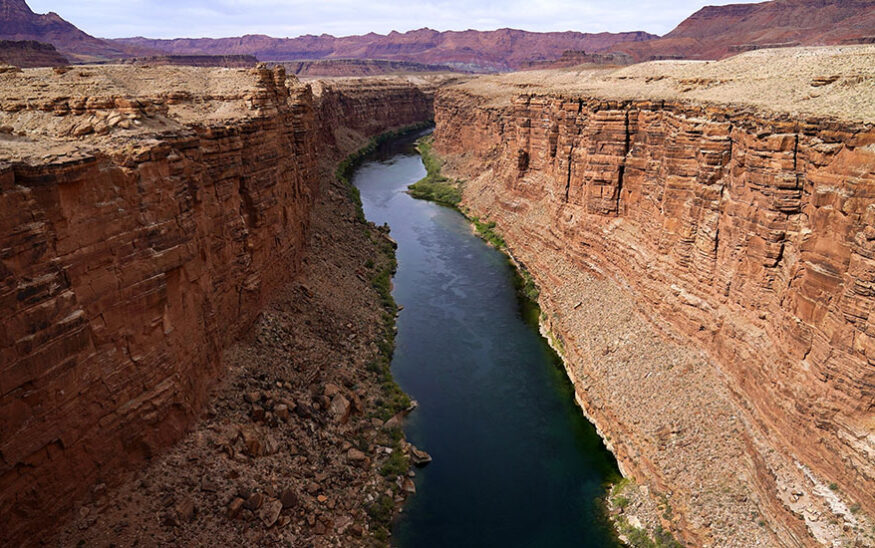
The Colorado River in the upper River Basin is pictured on May 29, 2021. (AP Photo/Ross D. Franklin)
Lower Basin states brace for Colorado River cuts
Humberto Sanchez, Pluribus News//August 7, 2026//


Lawmakers and water officials in Arizona, California and Nevada pushed back against proposed reductions to withdrawal allowances from the drought-stricken Colorado River.
The U.S. Bureau of Reclamation’s “adaptive decision framework” included in the recently released final environmental impact statement would reduce the three states’ share by up to 3 million acre-feet a year through 2036, roughly the same amount Nevada and Arizona receive combined.
The Colorado River provides water to 40 million people in seven states, several tribes and Mexico. The allocation cuts would start next year, be revisited every two years, and be adjusted based on conditions throughout the basin.
Arizona Gov. Katie Hobbs, a Democrat, said this week she hopes the bureau implements the plan crafted by the Lower Basin states for the first two years, which includes cuts far less drastic through 2028.
“I’m not going to lie, the cuts will be painful, but certainly not as painful as what was proposed in the federal government’s draft,” Hobbs said.
Read more: The Legislature may need to call a special session after all
The framework is needed to manage the river’s water, which has been depleted by a decades-long drought, rising temperatures and decreasing snowpack.
“The flow of the river now is 20% less than it was at the start of the century,” said Doug Kenney, director of the water policy program at the University of Colorado. “It’s just dropping quickly. … This is one of the best and clearest examples of what climate change looks like that you’ll find anywhere in the world.”
The framework is also needed to replace a previous framework implemented in 2007 that expires at the end of the year. The states have been trying to negotiate their own framework, but talks have stalled, requiring the federal government to step in.
A California water official underscored that the proposal is only a guideline and not the final word, while Hobbs, Arizona Senate Republican leaders and Nevada Gov. Joe Lombardo, a Republican, all issued statements in opposition.
The plan “could have devastating economic and environmental impacts on Nevada,” Lombardo said.
The water would be divided under the priority water-rights system, with Arizona having the lowest claim. Cuts are expected to come from those that get their water from the Central Arizona Project, a 336-mile canal system that delivers Colorado River water to Maricopa, Pinal and Pima counties, experts said.
“This would place Arizona at risk of shouldering a disproportionate share of the cuts while requiring no reductions from the Upper Basin,” Arizona Senate President Warren Petersen and President Pro Tem T.J. Shope, both Republicans, said in a joint statement.
Experts say it’s unlikely the river water allocation cuts will ultimately be the maximum level proposed, 3 million acre-feet annually.
“I don’t expect them to impose a cut that deep in the next two years,” said Sarah Porter, director of the Kyl Center for Water Policy at Arizona State University.
The bureau also called for limiting releases from Lake Powell, which stores river water on the Arizona-Utah border, to as little as 5 million acre-feet. That is less than the 7.5 million acre-feet that Lower Basin states typically get.
All the Lower Basin states urged the bureau to adopt a deal struck by the three states in May to cut 3.2 million acre-feet over two years, including 1.25 million acre-feet of binding reductions in both 2027 and 2028 and at least 700,000 acre-feet of additional conservation.
Experts say the bureau’s plan for the first two years will reflect the Lower Basin agreement.
“The cut that we expect is along the lines of the Lower Basin proposal,” Porter said.
Experts are also waiting to see what the specifics of the Bureau of Reclamation’s plan for the next two years and whether any states will sue. Lawsuits could take issue with the process, under the National Environmental Policy Act, and whether it violated the law in some way.
States could also sue each other over broader river water use and the application of the 1922 Colorado River Compact and subsequent regulations used to make water policy. That lawsuit would go straight to the U.S. Supreme Court but take years to resolve.
Celene Hawkins, director of the Nature Conservancy’s Colorado River program, agrees that a lawsuit is possible, but warned that a long, protracted legal fight could have negative impacts on the river.
“Lawsuits — particularly litigation about water at this scale — can take a lot of time, and litigation can’t actually create more water or solve problems in the short term for the basin,” Hawkins said. “The crisis is here, and yes, litigation is possible. But litigation can’t actually solve the problems that we’re facing today.”