Sign In


Upcoming Event
 Free Newsletter

Independents to be a deciding factor in CD1 race
Jakob Thorington, Arizona Capitol Times//October 7, 2026//
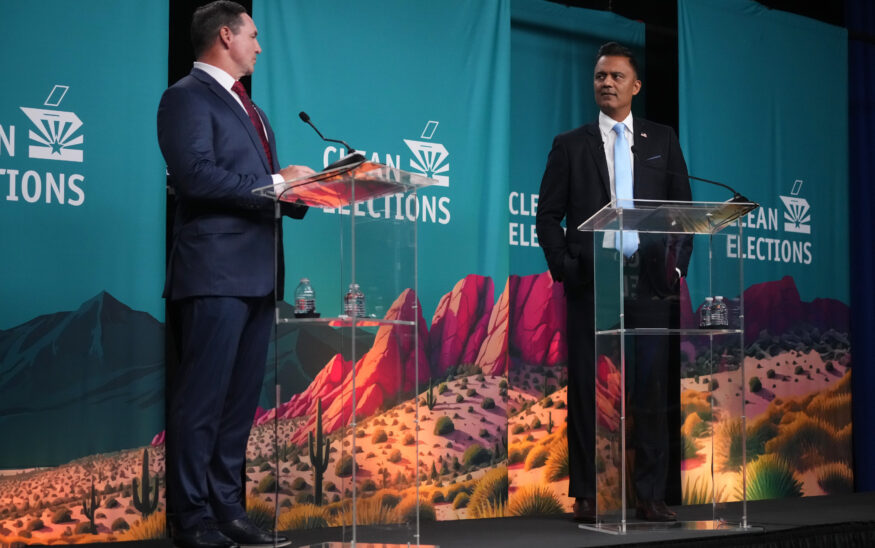
Congressional District 1 candidates Democrat Amish Shah and Republican Jay Feely participate in a Clean Elections debate at Sneaky Big Studios in Scottsdale on Oct. 7, 2026.
Congressional District 1 candidates Democrat Amish Shah and Republican Jay Feely participate in a Clean Elections debate at Sneaky Big Studios in Scottsdale on Oct. 7, 2026.
Independents to be a deciding factor in CD1 race
Jakob Thorington, Arizona Capitol Times//October 7, 2026//


Key Points:
-
Republican Jay Feely and Democrat Amish Shah both made appeals to independent voters during an Oct. 7 debate
-
A local pollster has described their race as “statistically tied” and will depend heavily by independents
-
The winner could help determine which party controls the U.S. House in one of the most competitive swing districts in the country
With Congressman David Schweikert stepping away from Congress in an unsuccessful bid to be Arizona’s next governor, Arizona’s competitive 1st Congressional District will elect a new representative for the first time since 2011.
Candidates Jay Feely, a Republican former NFL kicker, and Democrat Amish Shah, who served in the state House of Representatives for five years, faced off Wednesday night in the Arizona Citizens Clean Elections Commission’s final debate for statewide and congressional offices.
Independent voters, who make up a sizable portion of the district, could decide this race, making it unclear whether Feely’s alignment with President Donald Trump helps or hurts him. A FirstStrategic poll conducted Oct. 1 showed Shah leading Feely 44% to 41%, with 14% undecided. Shah held a 22-point advantage among independent voters, while 62% of independents said they disapproved of Trump’s job performance.
Shah said he’s not beholden to any party, including his own, and touted his endorsement from the No Labels Party and former Republican Arizona House Speaker Rusty Bowers.
He also noted Feely originally planned to run in the Republican-friendly Congressional District 5, but later decided to run in CD1 with President Donald Trump’s endorsement, in contrast to his own primary where he received no support from congressional Democrats.
“He owes that nomination to Donald Trump,” Shah told reporters after the debate. “I don’t owe any such nomination to my own party.”
This is Shah’s second attempt at running for Congress in CD1. He resigned from the state Legislature in 2024 to pursue a congressional campaign, leading to his victory in the Democratic primary. Schweikert defeated Shah by just under four points in the general election during that cycle.
Feely backed many of the Trump administration’s policies during the debate, including its handling of the Iran War, “the One Big Beautiful Bill” from 2025 and the president’s immigration enforcement.
“If Democrats get back in control, they will open the borders again,” Feely said.
Shah said that he doesn’t support illegal immigration, arguing that former President Joe Biden had failed policies, but criticized the Trump administration’s enforcement and said many actions taken with U.S. Immigration and Customs Enforcement are “unconstitutional.”
CD1 covers parts of northeastern Maricopa County, including Scottsdale, Paradise Valley, Cave Creek, Fountain Hills and northeast Phoenix. The district leans Republican with 194,000 registered voters compared to 135,000 Democrats, according to the most recent voter registration report from the Secretary of State’s Office.
FirstStrategic described the race as a “statistical dead heat” that independents will decide.
“It is the age-old question whether independents will show up this election,” FirstStrategic partner Marcus Dell’Artino said in a statement. “If independents show up in big numbers, it favors Shah. If they don’t, it favors Feely.”
Political consultant Barrett Marson said he believes Feely is a strong candidate for the district, but thought that Feely’s endorsement from President Donald Trump could hurt him in a general election.
“If [Feely] can localize the race a bit, that’ll help him,” Marson said. “If it’s all about gas prices and national issues. That’s going to hurt him.”
Affordability was the top issue for 44% of voters in FirstStrategic’s poll. Another 54% of voters, including 62% of independents, said they disapprove of Trump’s performance in office.
Feely said he “vehemently disagrees” with the Trump administration over the announced cut to Arizona’s Colorado River allocation because the state has led water conservation efforts relative to Upper Basin states.
Another area of disagreement between the two candidates was on data centers. Shah said he does not support them in the district after he’s heard a consensus from voters. He said he was fine with data centers in more rural areas that have access to electricity and water.
Feely said he believes the issue is a local control issue and didn’t rule them out of CD1 if voters decide they want them.