Sign In




 Free Newsletter
Mayes taking wait-and-see approach to Prop 314 lawsuits
Howard Fischer, Capitol Media Services//August 4, 2026//
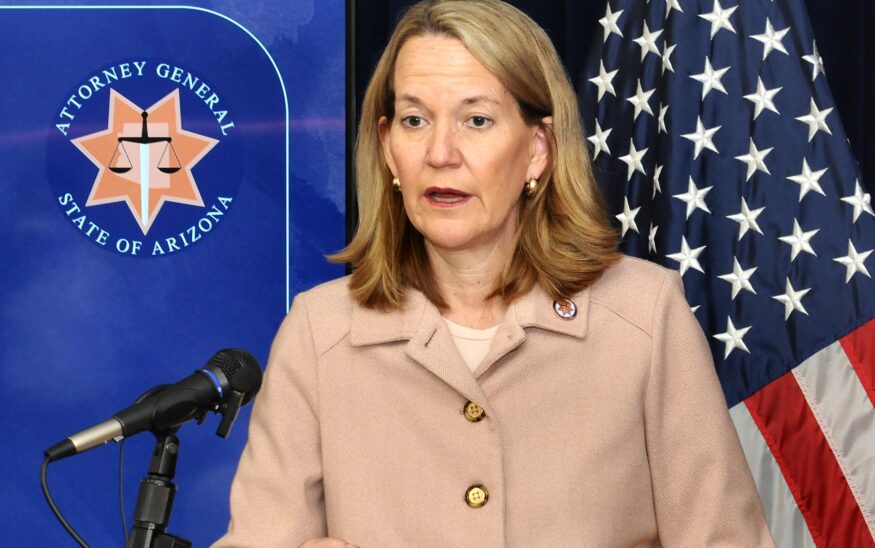
Attorney General Kris Mayes answers questions Aug. 3 over whether she will argue that what is in Proposition 314 is constitutional. (Capitol Media Services photo by Howard Fischer)
Mayes taking wait-and-see approach to Prop 314 lawsuits
Howard Fischer, Capitol Media Services//August 4, 2026//


PHOENIX — Attorney General Kris Mayes won’t say whether she will defend the constitutionality of Proposition 314, a voter-approved measure allowing state and local police to arrest people entering Arizona illegally between ports of entry.
At a news conference Monday, Mayes acknowledged that defending state laws is part of her job and noted that her office already persuaded a federal judge not to temporarily block the law while a legal challenge proceeds.
U.S. District Judge Michael Liburdi has yet to decide whether the measure conflicts with a 2012 U.S. Supreme Court ruling striking down key provisions of Arizona’s controversial SB 1070 immigration law. That leaves unresolved not only the fate of Prop. 314 but also whether Mayes ultimately will defend it on the merits.
“What I will say is, we haven’t gotten there yet,” she said. The attorney general added that her job is to defend laws “when I think there is a good-faith argument to be made, and a constitutional and lawful argument to be made to defend the will of the voters.”
Mayes has previously declined to defend laws she believes are unconstitutional. Those include Arizona’s 1864 near-total abortion ban, a 24-hour waiting period for abortions, and an ongoing Maricopa County case over whether lawmakers can prohibit certain advanced practice nurses from performing abortions.
Mayes also refused to defend a 2022 law barring transgender girls — defined in the statute as students born biologically male — from participating in girls’ sports, saying she believed the measure violated the Constitution. That led state schools chief Tom Horne to defend the law instead, though challengers ultimately dismissed the case.
Whether she views Prop. 314 the same way remains an open question.
“As you know, I was not a fan of it,” Mayes said. “I thought it was an unfunded mandate.” Beyond cost, Mayes said the 2024 ballot measure “could very well lead to racial profiling.”
When opponents sued to keep Prop. 314 off the 2024 ballot, Mayes’ office took no position, leaving Republican legislative leaders to defend the measure. They prevailed, and voters approved it by nearly a 2-to-1 margin.
What is Prop. 314?
Prop. 314 makes it a crime to submit false information to obtain employment or government benefits and increases penalties for selling fentanyl imported from another country when the drug causes a death.
Its most controversial provision, however, authorizes state and local police to arrest noncitizens who enter Arizona anywhere other than a legal port of entry. The offense is a misdemeanor, but judges may dismiss the charge if the defendant agrees to return to the border for removal.
Though the law was approved in 2024, it was written not to take effect until 60 days after final resolution of litigation over a similar Texas law. That happened on July 14.
Constitutionality challenged
The Florence Immigrant & Refugee Rights Project filed suit last month, arguing that Prop. 314 unconstitutionally usurps federal immigration enforcement powers.
The lawsuit relies heavily on the U.S. Supreme Court’s 2012 decision striking down major portions of SB 1070, including provisions that made it a state crime for undocumented immigrants to seek work and required immigrants to carry federal registration documents.
Liburdi declined to block enforcement of Prop. 314, ruling that the Florence Project lacked standing because it could not show it had suffered a legal injury. He also noted that no one has yet been arrested under the law.
The judge, however, reserved judgment on the law’s constitutionality, an issue expected to be litigated in the coming months.
‘Up to a judge to decide’
Mayes sidestepped the question of whether she believes the new law has the same constitutional flaws as SB 1070.
“That’s going to be up to a judge to decide,” she said. “There are arguments that are going to be made on both sides of this issue, and I don’t think there’s harm in having a court make those decisions.”
Mayes, who is seeking reelection in November after winning her first term by just 280 votes, said her opposition to Prop. 314 was based on policy, not necessarily on its legality.
“I came out against it from a policy angle,” Mayes said. “And I came out against it after talking to sheriffs and local law enforcement who told me, ‘Kris, we don’t have the funding to do this.’”
She also said going after individual border crossers “takes our eye off the ball of fighting the Mexican drug cartels.”
“That is where the state’s efforts should be,” Mayes said.
Liburdi has scheduled a hearing next week to discuss the next phase of the litigation.