Sign In
Upcoming Event
 Free Newsletter

Republicans bring back Florida-style election measure
Jakob Thorington, Arizona Capitol Times//February 13, 2026//

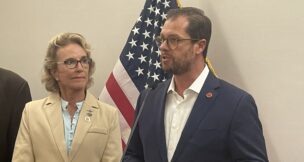
Rep. Alexander Kolodin, R-Scottsdale, speaking with attendees at a campaign rally for Andy Biggs for Governor at the Arizona Biltmore in Phoenix, Arizona, in May 2025. Kolodin is the sponsor of the Arizona Secure Elections Act, which seeks to place Florida-style elections on the 2026 ballot. (Gage Skidmore / Flickr)
Republicans bring back Florida-style election measure
Jakob Thorington, Arizona Capitol Times//February 13, 2026//


Key Points:
-
House sponsor says measure would speed up election results
-
It includes a voter ID provision
-
Governor vetoed a similar proposal last year
House Republicans have approved a returning measure intended to reshape Arizona’s election process in the form of Florida’s.
The Arizona Secure Elections Act, known formally as House Concurrent Resolution 2001, passed Feb. 9, with the express purpose of speeding up the ballot counting process by moving the state’s early voting deadline to 7 p.m. on the Friday before an election.
Arizona’s Republican officials have wanted to speed up election results for years, and this isn’t their first attempt at moving up the early voting deadline. Their reason? Election results across the state, most prominently in Maricopa County, have come in late — sometimes nearly two weeks after Election Day — for years.
In 2020, the county needed 10 days to complete its election count. In 2022, it needed 13 days. Now, Republicans are proposing their solution to a problem they claim has frustrated the many voters and politicians whose parties, livelihoods and policy measures depend on speedy results.
“Arizona voters deserve elections that are free, fair, and transparent. It shouldn’t take weeks to count ballots,” said House Speaker Steve Montenegro, R-Goodyear.
Election officials such as former Maricopa County Recorder Stephen Richer have cited “late early ballots,” or early ballots that are turned in at a voting location on Election Day, as the most significant factor causing the delayed results.
By moving the deadline to return an early ballot to the Friday before an election, proponents seek to eliminate the problem of late early ballots by giving election workers more time to process and verify signatures. The move would effectively align Arizona’s election system more closely with Florida’s, and that isn’t a coincidence.
The sponsor of HCR2001, Rep. Alexander Kolodin, R-Scottsdale, has credited Florida’s election system for the idea and has made its adoption a personal goal for the last two years.
On the House floor, Kolodin blamed “bad faith” negotiations from some Senate Republicans for blocking his measure in the past. This year’s version of the measure includes a requirement for an individual to show a government-issued identification card in order to return a mail ballot, which Kolodin said some Senate GOP members weren’t happy with.
“Voter ID aligns with President Trump’s agenda for securing our elections. And to the Republicans in this body, it is nonnegotiable,” Kolodin said. “For two years, certain Republicans in the Senate have played a game of cat and mouse in bad faith, requesting ever-changing lists of demands and begging us to chase the ball.”
Two other House Republicans on the House Federalism, Military Affairs and Elections Committee also publicly said they wouldn’t budge on a voter ID requirement. The committee’s chairman, Rep. John Gillette, R-Kingman, said any bill he receives from the Senate in his committee that doesn’t include voter ID is “dead on arrival.”
“In regards to voter ID, this is not something that we should even be discussing, especially with our friends over in the Senate,” said Rep. Rachel Keshel, R-Tucson.
In a text to the Arizona Capitol Times, Senate President Warren Petersen, R-Queen Creek, wrote that he wasn’t sure why some Republicans were critical of the Senate and reaffirmed his caucus’ support for voter ID.
“I believe we have the support to get it on the ballot,” Peterson wrote.
In the 2025 legislative session, the Senate failed to pass the predecessor of this year’s measure, HCR2013, after a marathon session abruptly ended following the Senate’s attempt to adjourn without consent of the House. The final result? A failed 11-18 vote at nearly 1 a.m. on June 20.
Sen. Shawnna Bolick, R-Phoenix, said during that vote that a floor amendment added that night which removed all provisions relating to the new Friday early ballot deadline from the measure, was made without her agreement, so she voted against it. Sens. Janae Shamp, R-Surprise; David Gowan, R-Sierra Vista; and Hildy Anguis, R-Bullhead City, also voted against it.
In addition to moving the early voting deadline, this year’s measure would require voters to confirm their address with their county recorder each biennial general election if they want to stay on the Active Early Voting List.
No Democrat in the House voted for the measure.
In context, about 80% of Arizonans vote by mail, according to the Arizona Clean Elections Commission, and Democrats did not want to implement a policy that would make it more difficult for that population of voters.
“This should be called the bill to kill vote by mail,” said House Minority Leader Oscar De Los Santos, D-Laveen.
De Los Santos also said he believes the measure is unnecessary as a constitutional amendment because the Arizona Constitution already requires citizenship to vote.
Kolodin disagrees with the idea that he’s trying to end voting by mail.
“It doesn’t change really anything about vote by mail other than making sure that there’s some form of government issue ID provided with it,” he said.
If the Florida-style election system were adopted as a constitutional amendment, it would make the law much more difficult to change or update in the future. That’s because Arizona law requires a supermajority vote from the Legislature to change constitutional measures that are placed on the ballot and approved by voters.
The first bill that Hobbs vetoed in the 2025 session was a version of a Florida-style elections measure – House Bill 2703. The governor wrote in her veto letter that she believed the measure would disenfranchise voters, and she would not support a bill that makes it less convenient for people to vote.