Sign In


 Free Newsletter

Confirmation firestorm: National Guard nominee battles GOP over Kelly, Iran War
Howard Fischer, Capitol Media Services//May 12, 2026//
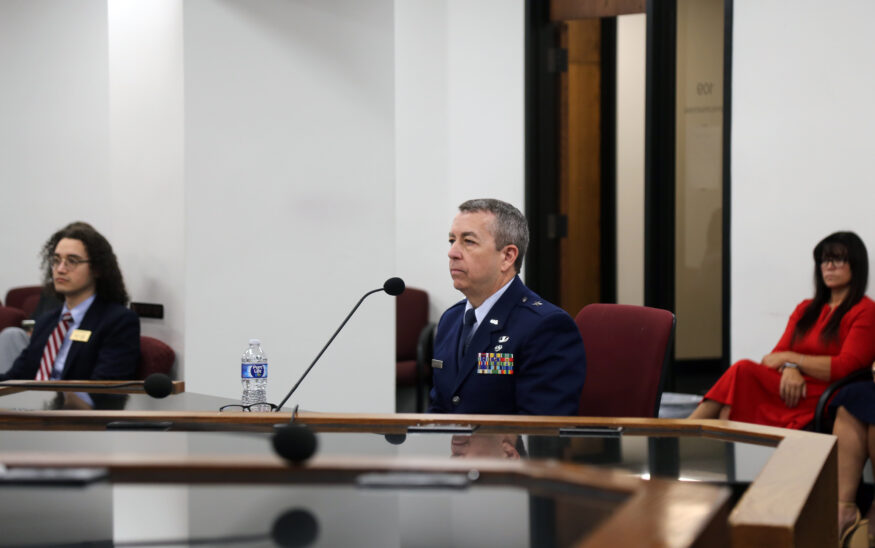
Adjutant General John Conley awaits questions from the Senate Director Nominations Committee during a confirmation hearing on May 11, 2026. (Reagan Priest / Arizona Capitol Times)
Confirmation firestorm: National Guard nominee battles GOP over Kelly, Iran War
Howard Fischer, Capitol Media Services//May 12, 2026//


Key Points:
-
High-profile fight over Sen. Mark Kelly’s comments on munitions stockpiles may affect Arizona National Guard nominee
-
Gov. Katie Hobbs’ nominee, John Conley, distanced himself from the national spat between Kelly and Defense Secretary Pete Hegseth
-
Conley’s nomination faces a one-year confirmation deadline from last June
A high profile fight in Washington over comments by Democratic U.S. Sen. Mark Kelly about dwindling stockpiles of munitions spilled over Monday into efforts by state Republicans to derail Gov. Katie Hobbs’ nomination to head the Arizona National Guard.
But John Conley, seeking to survive the nomination process, sought to distance himself from the national spat between Kelly and Defense Secretary Pete Hegseth.
“I don’t know any of the facts and circumstances regarding it,” he said.
The fight concerns claims by the Pentagon chief that Kelly, while appearing on a Sunday talk show, released what Hegseth said was classified information.
Kelly has countered that he didn’t say anything on TV that Hegseth himself has not said publicly about the depletion of arsenal due to the war in Iran.
Conley, a brigadier general, made it clear to members of the Senate Committee on Director Nominations that he was not about to get in the middle — even if he knew more. He said it would violate both state and federal law for him, as a soldier, “to speak critically about any sitting member of Congress.”
Still, he said, speaking strictly academically, Conley said that such an action would be prohibited absent prior authorization.
“I don’t believe it’s appropriate for anybody to release classified information in violation of the law,” said Conley.
What makes Conley’s viewpoints relevant is that he was being screened by nominating committee members, the first step in deciding whether he will get the required Senate confirmation to lead the state’s National Guard. And two of the Republicans on the five-member panel — Jake Hoffman and Wendy Rogers — were trying to get the governor’s nominee to weigh in on what has become a high-profile political fight between the Trump administration and the Democratic senator.
But the two senators weren’t just interested in the propriety and legality of Kelly’s comments on “Face the Nation” about the stockpiles of weapons.
Rogers also wanted to know what Conley thought about a video released by Kelly and five others — she called them “the seditious six” — telling service members that they should ignore “illegal orders” and instead follow the Constitution.
In response to those comments, Hegseth demoted Kelly’s rank as a retired Navy captain — he is the only one of the six who is retired military, a move that would reduce his retirement pension — and issued a letter of censure. So far, federal courts have blocked those actions.
Conley, for his part, sidestepped the efforts by the GOP lawmakers to drag him into that fight.
“I believe that the folks who made those comments, because they’re not actively serving, they have a little more leeway to say those things,” he said.
“But I also understand the perspective of the current administration (that) wanted to put a test whether or not those statements were outside the bounds,” Conley said. “And I think that that is going through a court process and the court will decide.”
Still, Conley who served in the office of judge advocate general — an attorney in uniform — said that one of his duties was to “teach the law of war and the code of conduct.”
“And part of teaching of the law of war is to discuss lawful versus unlawful orders,” he said. “And you don’t follow unlawful orders is the crux of the teaching.”
But whether Conley ultimately gets confirmed by the Republican-controlled Senate could more likely depend on the contention, particularly by Rogers, that while he may be a good administrator, he doesn’t have the skills or experience to lead soldiers into war if it ultimately comes to that.
Rogers said that Conley, trained as a lawyer and having been an attorney within the military, appears to have the background and credentials to become the director of the state Department of Military Affairs. It works with local governments to provide help in emergency situations, like fires and floods,
But the Flagstaff Republican, a military veteran herself, pointed out that position, by definition, also includes being the adjutant general of the Guard, responsible for more than 8,000 Army and Air Force personnel.
Conley told committee members that it isn’t necessary to have combat experience to hold the job.
In fact, he said, it was Gen. George Washington who appointed the first adjutant general with the specific assignment to prepare troops to be ready to fight. Conley said that’s what he has been doing for close to a year already since being tapped by Gov. Katie Hobbs.
Rogers was unconvinced.
“You would be a provider and assessor of what is needed to complete the mission,” she said. “But if you became the adjutant general you would be the commanding officer.”
And that, said Rogers, means being a role model.
“But you have not led and had your life threatened constantly,” she said.
Rogers also pointed out that there has been a change at the national level, with Hegseth saying he is pushing a “warrior ethos” and wants to restore a “warrior culture” in the military.
“How do you, as a career judge advocate, with no operational command, no combat deployments or experience leading troops in high-risk environments plan to personally model and instill that ethos in the Arizona National Guard among the aviators, infantrymen … and other operators who routinely fly in dangerous conditions or are deployed into harm’s way?” she asked.
Conley said he has been in dangerous situations — even as a JAG — including time in Korea where U.S. troops died in combat operations
“Have I been an infantryman on the front lines in a battle?” he said.
“No I have not,” Conley continued. “But I can take care of those infantrymen because I have been doing this job for nearly 40 years all over the world in all kinds of different situations.”
And he said there’s something else that makes the question of whether he can lead soldiers in the field irrelevant.
“You don’t want the 58-year-old out on the front lines,” Conley said.
“We want the young folks out there,” he said. “My job is to make sure that they have the training, the equipment, the resources that they need.”
Rogers also sought to pin Conley down on the question of whether the United States is at war with Iran. He said it’s not that simple.
“If we use the term ‘war’ colloquially, we are engaged in hostilities in Iran,” Conley said. And he said the United States also is engaged in a “cold war” with China.
Rogers said that doesn’t answer her question.
“If the definition of ‘war’ is something that we’re going to glean from the War Powers Act, I don’t think there’s been a declaration of war by the Congress,” Conley responded.
Rogers said his inability to come up with a clear answer, coupled with his lack of combat experience, is one of the reasons she believes he’s not ready to lead the Arizona National Guard.
“We are at war,” she said. “And you would be asked to command forces that would be at war.”
Hoffman had his own problems with what he heard from Conley on this question and others is that “legalistic quibble mentality.”
“These are all kind of filibustering responses,” said the Queen Creek Republican.
Republican Sen. T.J. Shope of Coolidge joined with the two Democrats on the panel to advance the nomination to the full Senate.
Time also is running out for Conley. He has been serving since he was nominated last June 10 to the job. And if he is not confirmed within one year, he can no longer hold office.