Sign In


Upcoming Event
 Free Newsletter

US judge rules federal futures law negates Arizona gaming statutes
Howard Fischer, Capitol Media Services//May 7, 2026//
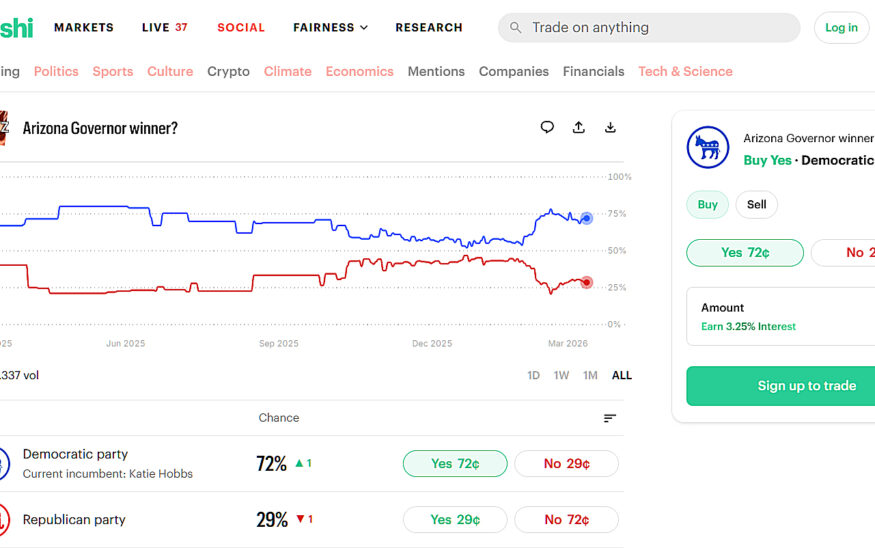
A Kalshi prediction on the 2026 Arizona gubernatorial race. (Howard Fischer / Capitol Media Services)
US judge rules federal futures law negates Arizona gaming statutes
Howard Fischer, Capitol Media Services//May 7, 2026//


Key Point:
-
Decision allows betting on future events, such as elections
-
Lawsuit by Arizona AG is rejected
-
Arizona wants to continue allowing sports wagering only through state-licensed operators
A federal judge has blocked the state from prosecuting an online gambling site for violating state gaming laws.
In an extensive ruling, U.S. District Court Judge Michael Liburdi ruled that Congress gave the federal Commodity Futures Trading Commission exclusive jurisdiction over what it calls the trading of “swaps.”
More to the point, the judge said that wagering money on future events — including gambling on the outcome of elections — fits the legal definition of swaps. And that, Liburdi said, preempts state laws which specifically restrict such wagering.
A spokesman for Attorney General Kris Mayes, who wants to enforce those state laws, said the decision is being reviewed and an appeal is possible.
But, at least for the moment, Arizonans remain free to go online to sites like Kalshi and Polymarket and see if they can predict — and win money — on everything from whether Democrat Katie Hobbs will win another term as governor to who will win next week’s face-off between the Texas Rangers and the Arizona Diamondbacks, all of which Mayes says violate state laws.
What the ruling also means is that, unless overturned, Mayes cannot pursue the 20 separate criminal charges she filed in Maricopa County Superior Court against Kalshi.
Liburdi acknowledged that there are competing interests to be considered.
“Gambling remains a traditional field of state concern,” the judge wrote.
In this case, Arizona has three specific restrictions that it wants to enforce.
One strictly forbids gambling on the outcome of elections.
A second allows adults to wager on sporting events, but only through state-licensed operations. Neither Kalshi nor Polymarket have such a license.
Finally there are generic laws against games of chance where there is money involved.
In that last category falls pretty much everything else on which Arizonans can now place bets through these online sites, like what will be the highest grossing movie in 2026, whether Congress will approve a federal law requiring proof of citizenship to vote, and even whether Jesus Christ will return before 2027.
The amount someone could win on any of the offers is based on the odds at any one moment, all of which is determined by the number of people who bet on one side or the other.
So, for example, this week there was a 76% chance that “Spider-Man Brand New Day” would make the most money this year. That meant someone would have to put up 76 cents to win a dollar.
By contrast, just 4% said the top spot would go to “The Super Mario Galaxy Movie.” So it would take putting up just 4 cents to win a dollar.
Liburdi said that, in general, the “historic police powers of the states,” like regulation of gaming, are not superseded by federal law absent a “clear and manifest purpose of Congress.”
But here, however, the judge said the evidence is that Congress, in enacting the Commodity Exchange Act, did intend that the regulation of “swaps” — what this kind of wagering is labeled — be handled at the federal level.
“Congress built a comprehensive regulatory structure to oversee the volatile and esoteric futures trading complex,” Liburdi said. That includes the regulation of what federal law considers “designated contract markets,” or DCMs, meaning companies like Kalshi and Polymarket.
“These provisions regulate every aspect of DCMs, including what contracts may be listed and how trading may be conducted, leaving no room for state regulations,” the judge wrote. “That comprehensive framework is so pervasive that it forecloses parallel state regulation of DCM trading.”
Liburdi said there’s a good reason behind the intent of Congress to preempt state regulation.
“If states could prosecute DCM operators for offering event contracts, the operators would face the prospect of 50 different regulators, each capable of restricting which contracts may be listed on each exchange,” he said.
“The result would be the inconsistent regulatory patchwork that Congress intended to avoid,” the judge continued. “Because Arizona’s gambling laws stand as an obstacle to federal regulation, those laws are preempted.”
Liburdi’s ruling is unlikely to be the last word — even if the state does not appeal.
Last month the 9th Circuit Court of Appeals heard arguments in a similar dispute, this one between Kalshi and the Nevada Gaming Control Board over whether that state can regulate prediction markets.
What makes that important is that Arizona also is in the area over which decisions of the 9th Circuit set precedent. So any ruling in the favor of Nevada could change Liburdi’s conclusion.