Sign In
Upcoming Event
 Free Newsletter

Development projects, tax credits and agency budgets face hard cuts in new GOP proposal
Howard Fischer, Capitol Media Services//April 28, 2026//
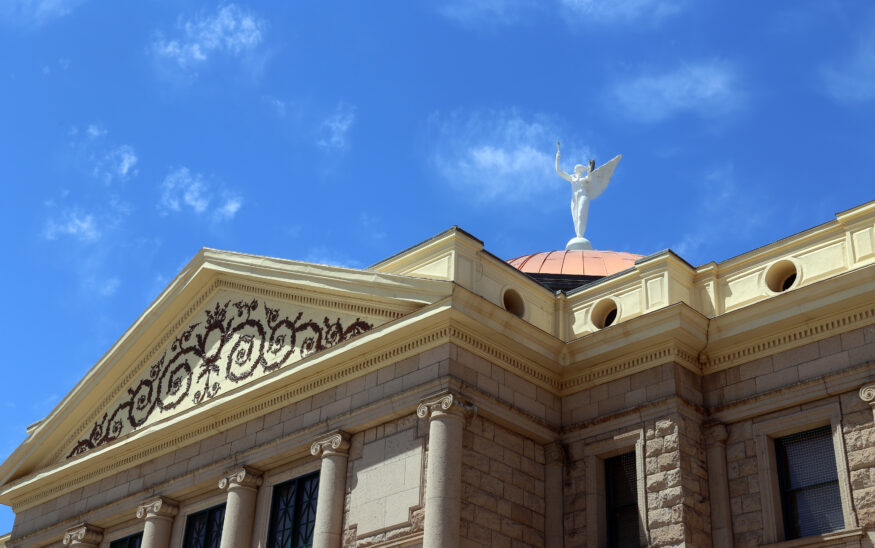
The dome of the Arizona State Capitol. (Brock Blasdell / Arizona Capitol Times)
Development projects, tax credits and agency budgets face hard cuts in new GOP proposal
Howard Fischer, Capitol Media Services//April 28, 2026//


Key Points:
-
Republican lawmakers unveil plan to balance state budget amid tight financial forecast
-
Nearly $100 million in economic development funding is cut
-
They also propose a 5% reduction in agency operating budgets
Republican lawmakers on Monday unveiled their plan to balance the state budget and finance the tax breaks they want by eliminating others they don’t.
Gone would be nearly $100 million for economic development projects — including $19 million of diverted state sales taxes now used by the Tucson Rio Nuevo project to spur business and residential growth in the southern Arizona community.
The proposed budget — $800 million less than Gov. Katie Hobbs’ initial January proposal — would also do away with the Arizona Commerce Authority Compete Fund, which provides grants to attract, retain and support new business in the state. According to the plan, that would not only save $4 million going forward, but also drain approximately $63 million already in the account.
GOP legislative leaders defended those cuts, along with another $8 million reduction to the state Office of Tourism, by dubbing the programs “crony capitalism.”
And they aren’t the only state programs on the GOP’s chopping block.
Also eliminated would be several policies lawmakers believe to be part of the “Green New Deal,” those state and national policies aimed at creating renewable energy, reducing greenhouse gas emissions and creating what proponents say would be high-wage jobs.
That includes the elimination of tax credits — an actual reduction in what is owed — when individuals and businesses purchase solar energy devices and pollution control equipment. That cut is predicted to save $32 million a year.
And another $44 million would be saved by repealing the exemption from state sales taxes when people buy certain other energy savings devices.
What all this does is ensure that Arizona tax policy is aligned with what the Republican-controlled Congress approved last year as part of President Donald Trump’s One Big Beautiful Bill Act, H.R. 1.
And that includes certain items already in the governor’s budget, like increasing the standard deduction, eliminating income taxes on tips and overtime, and providing an additional $6,000 income tax deduction for seniors.
But what’s new, and what Hobbs questions whether the state can afford — are tax breaks for businesses and a state income tax deduction for payments on state and local taxes — a measure designed to benefit those whose income or wealth is high enough to itemize tax deductions rather than taking what is standard.
That’s important because the GOP plan estimates its tax savings — meaning cuts to state revenue — at $1.45 billion over the next four years. By contrast, the Hobbs proposal has a price tag closer to $1 billion.
The two proposals differ elsewhere too. For example, Hobbs wants a $3.50-a-night tax on short-term rentals. She also proposed increasing the fees that some sports gaming operations pay to the state.
Neither idea is in the GOP plan.
Also missing is the governor’s plan to link eligibility for vouchers — tax dollars to send children to private and parochial schools and for home schooling — to parental income. That would have freed up nearly $90 million.
Republicans also won’t ask voters — at least not this year — to renew a program that provides an extra $300 million for K-12 schools by increasing withdrawals from a special state land trust account.
Hobbs also built her spending plan on the yet-to-be-delivered promise by the federal government to reimburse the state $760 million for border security costs.
Sen. John Kavanagh, R-Fountain Hills, acknowledged that Republicans also considered the promised funds as a potential revenue source, but said that idea was dropped after the party determined it was “only wishful thinking.”
Republicans, meanwhile, largely aren’t looking for new revenue sources — they’re looking for cuts that can save money.
And that’s not just for policies like renewable tax credits.
GOP lawmakers also believe they can save $42 million a year by requiring participants in the Arizona Health Care Cost Containment System, the state’s Medicaid program, to more frequently prove their eligibility. There’s also another $139 million in predicted savings from new work requirements for food stamp recipients.
And the rest?
The Republican plan calls for a 5% reduction in agency operating budgets — about $99 million — excluding corrections, public safety and child safety, none of which is in the governor’s proposal.
And there’s something else in the GOP plan that actually has no financial cost, at least for the state.
Last year’s federal budget allows individuals to claim a dollar-for-dollar tax credit of up to $1,700 for donations to approved organizations that provide scholarships and tuition assistance for children attending private schools. Scholarships also could be provided to eligible public school students for things like tutoring and after-school programs.
Because those credits are against federal income taxes, there is no cost to the state. But federal law requires states to opt in for their residents to get the credit.
Hobbs vetoed a freestanding bill to have the state join, saying she wanted to first see what kind of accountability, transparency and oversight are included — things she says are missing from the state’s own voucher plan.
Now, however, this opt-in is part of the budget, meaning Hobbs could get rid of it only by vetoing the entire plan.
In a prepared statement, gubernatorial press aide Christian Slater said Hobbs was “disappointed” by some of what is in the GOP plan, including the refusal to consider renewal of that program to put another $300 million into K-12 education.
But Slater sidestepped a question of whether his boss will veto the bill if it gets to her in this form, saying only that Hobbs “looks forward to working across the aisle” to deliver a “bipartisan, balanced budget that addresses the big challenges Arizonans face.”