Sign In


Upcoming Event
 Free Newsletter

William Auther: Aiming to retain high performing judges
Kiera Riley, Arizona Capitol Times//April 26, 2026//

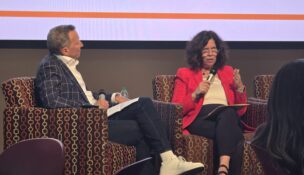
William Auther, chair of the Arizona Commission on Judicial Performance Review and product liability attorney, sits down for a conversation with the Arizona Capitol Times at his office, Bowman and Brooke, in downtown Phoenix. Auther spoke about his 14 year and counting term as a commissioner. (Kiera Riley / Arizona Capitol Times)
William Auther: Aiming to retain high performing judges
Kiera Riley, Arizona Capitol Times//April 26, 2026//


William Auther, a product liability attorney by trade, did not plan for a near-decade and a half run on the Commission for Judicial Performance Review. But when an open spot granted him a front row seat to how the state grades its judges, he came to know just how vital the system is to keeping a high-caliber bench.
Now chair, Auther will lean on his experience as a commissioner to provide a steady hand to voters ahead of the 2026 judicial retention elections.
Questions and answers have been lightly edited for style and clarity.
What called you to JPR?
My experiences in courts in Arizona and my experience in other states — where they have every other manner of system that exists — I think proved to me that the Arizona system is the best.
I was down in a very tiny rural county in Mississippi for a hearing. I had a local lawyer who I was working with. It was a very contentious hearing. There was a lot riding on it. It was a big motion. I went down there and met with the lawyer. We go to court the next morning. We’re there at 8:45 for our 9:00 a.m. hearing; 9:15 a.m. rolls around, no one’s there; 9:30 a.m. rolls around, no one’s there; 9:45 a.m. rolls around, and all of a sudden, the judge walks out of chambers with the opposing lawyer following him. The judge takes the bench. The opposing lawyer stands next to the bench. I’m at the council table with my local counsel. Like, what’s going on here?
The judge says, ‘I’ve been talking about this motion with Mr. So and So, the plaintiff’s lawyer here, and we decided that you’re going to do this, and that’s going to be my ruling.’ And I said, ‘Judge, may I be heard on it?’ He goes, ‘Well, you can.’ But we — he and the other lawyer — have already decided this. I made the little argument he would let me make, and he didn’t change his ruling. And that was that. And I remember, thinking about it on the plane coming home, thinking, God I’m glad to be getting back to Arizona, because that just would just never happen here. It would never happen, and no one would even contemplate something like that.
What was the application process like?
I put in my application for something else, maybe rules committee or civil rules or something. And I got a call and they said, ‘Well, we don’t have any appointments there, but they’re looking for someone to be on JPR.’
That was 2012. I had to look that up today, refresh my memory. It’s been 14 years now since my first appointment, and we’ve had a lot of elections in that time, and we’ve had a lot of improvements. I’ve been on three separate task forces, maybe four, to review the rules and update them and make improvements to the process and and then that brings us to now.
What do you remember about your start as a commissioner?
It’s a learning curve, like everything else. It took me one full cycle to see the whole process from start to finish. I knew about it. JPR is nothing new. All through my career, I’ve received the forms, and in the old days, it was hard copy paper, and you had to go get one, and they would distribute them by hand, and it was a big process. I knew about the surveys, I knew about the data. I knew that there was a website you could go to to try to read some of the data. It wasn’t always in the most user friendly format. I knew all of those things, but I didn’t really know the nuts and bolts about — how much data do you get? What are the commissioners actually given? How do you evaluate? Is this good, bad or otherwise? Should we call this judge in or not, ask this judge for an explanation or not? So it took a while to get the feel from the other commissioners and the chair, and get your feet under you.
How would you describe the decision-making process?
Everybody’s got to look at it independently. We’re all independent commissioners. One of my early legal mentors used to remind me, don’t underestimate the ability of someone else to see the same thing differently, and that has never been more true. In JPR, everybody has their own perspective on these things, on the data, and what the data means, and how important this aspect is versus that aspect. And everybody’s got to have a right to express their views of it, say what they need to say.
What do you think makes a good judge?
Everybody in your life is going to encounter a court, whether they like it or not. It’s just a matter of fact. Virtually everybody is going to have some encounter, whether it’s personally, a friend, a family member, the company they work for, whatever it is. And it could be anything from a probate matter to trying to get a title changed on a car for someone who’s deceased to a juvenile issue with a kid or a nephew or a niece, or a divorce, a fender bender. You might sue someone, or you might be sued. It’s going to happen, right? And the courts aren’t just for big companies who can afford it, they are for everybody. And so you have to have a system that is fair. The judges are the people in the middle of the system. They are the forward facing aspect, the public facing aspect of it.
Judicial temperament is incredibly important. Making people feel like they’ve been heard. People can understand losing when they understand why they lost. When they feel like they were able to tell their story and participate and they were heard in the process, it makes losing a lot more palatable.
We have to ensure that the public feels like they are being heard and have a forum to actually have a meaningful resolution of whatever issue it is that they’re in the courts for. And how judges do that really depends on the judge’s personality in a lot of ways. You can’t do it if you don’t have the legal ability. You’ve got to be smart, you’ve got to be hard working. But our selection process vets the judges, so we start out with good judges.
How have you worked to evolve the judicial review process?
We’ve expanded our rules to allow us to do a lot more. We’ve improved the data collection. The public hearings are always important to hear what people are saying. Our meetings are public, and anybody can show up to those and say anything they want. We’ve expanded the scope of things we can look at. We can go and look at the hearing videos, if we think that’s important, we can review court data on timeliness of things. We can review orders, written orders, written opinions, especially when it comes to the state Court of Appeals and Supreme Court justices. Those have been improvements that have come out of prior task forces and the courts readily adopted those recommendations when we’ve made them. We have a more robust dataset now than we did in 2012 for sure, and a stronger ability to to really look behind the numbers.
What do you make of the increased focus on retention elections and recent campaigns to sway judicial results?
It’s debatable whether people really are trying to educate themselves, or whether they just have decided it’s a political issue. They’re going to call it by party lines. I can’t tell you how many calls we get every year, what’s this person’s political affiliation? That’s not part of the calculus. We don’t look at it. We don’t care, because there can be good judges and bad judges from any political affiliation, so we don’t tip the scales based on that. But more and more we’re getting those kinds of inquiries, like I want to know what governor appointed this person. That’s not fair, standing alone. That is not a fair criteria, to be making a decision about whether a judge should stay, should keep his or her job.
We do need more voter education. I think that people, once they are directed to the website, once they realize what’s there, I think they’re very responsive to it, and I do think they understand it. I do think they make their decisions based on it.
What’s your sense as we head into this election cycle?
I don’t see any highly political issues this year coming up. We haven’t had a lot of headline grabbing opinions that have been making their circulation in the newspapers. So I’m not anticipating any problems this year, but I don’t know. I don’t know what people are going to make of these things, right?
All the judges are high performing, and that does not change from one year to the next and one election to the next. Virtually all of them are high performers.
Why is this work important? And why is this work important to you?
We’ve got to have a system where we have high performing judges in courts so that people can feel like they’re getting their disputes resolved in a fair way. And that’s hugely important. It’s incredibly important that we have a high performing judiciary at every level and it’s not just for me and my clients, but it’s for everybody out there.
It’s got to be a high functioning system that’s fair for everybody, and it’s the only way the system works.