Sign In




 Free Newsletter
Maren Mahoney: Creating a more resilient Arizona
Reagan Priest, Arizona Capitol Times//May 3, 2026//
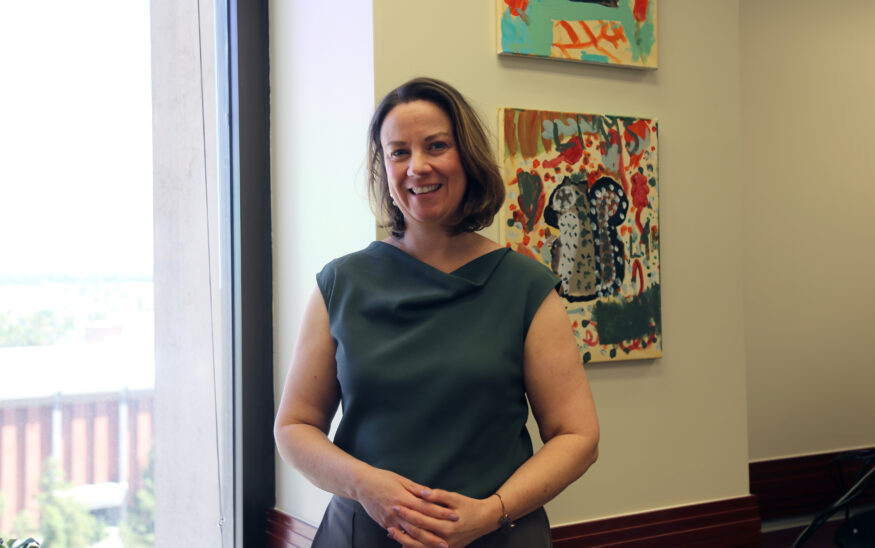
Maren Mahoney poses for a photo in her office at the Executive Tower in Phoenix on April 28. (Reagan Priest / Arizona Capitol Times)
Maren Mahoney: Creating a more resilient Arizona
Reagan Priest, Arizona Capitol Times//May 3, 2026//


Maren Mahoney is the director of Gov. Katie Hobbs’ Office of Resiliency, a climate-focused reimagining of the state’s energy office. Since taking the helm in 2023, Mahoney has guided the state’s first extreme heat preparedness plan and its first state energy plan in over a decade, while also demonstrating her own resilience in face of personal struggles.
Questions and answers have been lightly edited for style and clarity.
Can you tell me a bit about your career trajectory?
I went to Arizona State University. That’s where I started my bachelor’s degree. And at that time I had an opportunity to spend one of my semesters at the Biosphere 2 in Oracle, Arizona. That was a really pivotal experience for me. I got to really know the desert, I got to love the desert and see the beauty in it, the fragility, but also the hardiness and the resilience of it. While I was there, I also got to do a lot of camping, which was not something that I had grown up doing. I grew up on the East Coast. Then I went to law school, (and) I practiced law in New York for a while, and then I wanted to go back to school, because I really felt this pull toward environmental work. I found out about this school that was just getting started at ASU, so I went back there and I got my master’s degree in sustainability. After that, I got to work at ASU for a few more years, developing and managing an energy policy think tank. I worked under our now-Attorney General (Kris Mayes), and I learned a lot about regulation (and) about energy policy in different states. I had a few other positions through the years, one of which was as a policy adviser at the Corporation Commission. All of those tools and all those experiences have really helped me in this position.
What has it been like building this office from the ground up?
Under Governor (Jan) Brewer, the State Energy Office was thriving. I actually had the opportunity, when I worked at ASU, to help with the energy plan under the then-director Lisa Brugg. Under the previous administration, the Energy Office got put into the Department of Administration and did a lot of capital improvement projects, but not policy or programs. When Governor Hobbs got into office and announced that she was standing up the Office of Resiliency, I was very excited. I said, “I’ll throw my hat in the ring, what the heck?” And I am just grateful every day that I get to be part of this administration and that I get to be a part of this really, really cool Office of Resiliency. We are the State Energy Office, but we also do broader things. The policy advisers for water and transportation and land and energy sit in my office as well. All of those policy areas are intertwined, and I think it makes our office that much more impactful when we work together — and we work together quite well. When I first came into this position, that was when the Bipartisan Infrastructure Law and the Inflation Reduction Act were in full (force), and there was a lot of funding for state energy offices. This was an opportunity for us to bring in hundreds of millions of dollars for Arizonans to make their lives better, to improve our energy grid, to increase our energy security. Being able to get into this position at that time was also a really historic opportunity that we knew we had a very short period of time to take advantage of, and I think we did a really good job of making sure we made the most of it.
How have recent changes in federal funding impacted how your office operates?
The change in administration had a significant impact on our operations. In years past, there would be a little bit more of a continuity of operations, but because this administration and the previous one had such divergent visions and priorities, it definitely made it a bit of a challenge for us to make that pivot. In the initial six to eight weeks of this federal administration, they froze our funds. So not only was I not sure how we were going to pay my staff, some of whom I had just hired on, but also we had some program administration that we were doing. We were starting to really build out the networks of stakeholders to ensure long-term success, and unfortunately we had to put a pause on some of those grant programs, which set us back a little bit. But I also think that we handled it as prudently and responsibly as we knew we needed to, because of the uncertainty. Ultimately, several of (those programs) restarted, and we have been able to pick up that momentum and push it forward and continue and building upon the earlier successes, specifically with Efficiency Arizona. I’m just very glad that we were able to continue that program in particular, because it’s making a marked improvement in people’s lives.
What has been your biggest accomplishment and challenge in this role?
So the summer of 2023 was the hottest summer on record in the state. We had just gotten into the groove a little bit, I was still in the middle of hiring, we were still trying to get a lot of those federal funds for Arizonans. That first summer, the governor signed an emergency declaration to unlock additional funding for that emergency response, and then directed me to lead interagency planning so that we could have a more coordinated, focused state response. I worked with various state agencies (and) we also brought in stakeholders, the organizations who had already been out there on the ground doing a lot of the emergency response and a lot of the preparation. We had a very short period of time to get that plan completed. Two months before the plan was due, my husband had a stroke. He is fine now, he’s doing great. That was a very scary time for me. It felt very precarious. I was only able to meet that deliverable because of the people in this office, because of the governor, because of all of the people who have been working on this issue. Everyone was incredibly supportive, and that is a core part of resilience, because nobody can really do things alone. The fact that we were able to deliver (the Extreme Heat Preparedness Plan) that has been impactful, that has actually been effective — I think that is one of the biggest accomplishments.
What helps you stay grounded in a difficult role like this one?
I’m a parent. I have two kids who are in elementary school, and they keep me very grounded. I think about the history that we are all living through, or that we all have in our past. Our ancestors went through a lot of challenges, but our people have also been incredibly resilient and have made amazing advancements. I think we’re all also looking at the kids who are coming up and how do we make their lives better? The decisions we make today are going to determine how good their lives are. So that’s something that keeps me grounded and keeps me going.
What do you wish people knew about energy and climate issues, especially in an era of climate despair?
First of all, climate and energy are both things that impact all of our lives every day. I wish people knew more about the specifics of those issues and how their lives are impacted. I also want people to think about what they can do, because there’s a lot we can all do. It’s easy to get into a despairing state of mind, but there’s also a lot of things to be hopeful for that are happening. And there’s a lot of people working on these issues right now, really smart, really dedicated people. So I see hope in the people, and I see hope in the successes that we’ve already achieved.