Sign In
Upcoming Event
 Free Newsletter

Debate rages over state land designated for solar industry
Howard Fischer, Capitol Media Services//May 27, 2026//
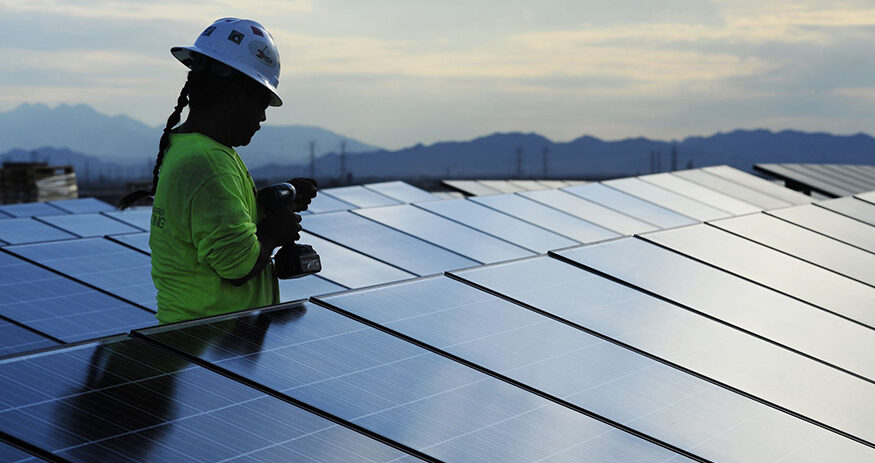
Daniel Baldonado, a contract worker for a steel fabrication company, Ironco Enterprises, installs a series of solar panels on the roof of Wells Fargo Arena on Arizona State University's Tempe campus. (Photo by Brandon Quester/Cronkite News Service)
Debate rages over state land designated for solar industry
Howard Fischer, Capitol Media Services//May 27, 2026//


Key Points
-
Gov. Katie Hobbs favors Land Department map designating areas for solar projects
-
GOP bill blocks state agency from creating solar-only areas
-
Both side differ over best use for state land
The Hobbs administration has unjustly prioritized renewable energy projects over new housing projects, legislative Republicans contend.
Led by Rep. Ralph Heap, R-Mesa, lawmakers are one step away from approving legislation that would override a practice by the Arizona Land Department to study and make available a map where the agency believes its extensive holdings make the most sense for large-scale solar projects.
The caveat, said the Mesa Republican, is that the agency is not preparing similar maps for others who might want to buy or lease state lands. And that, he told Capitol Media Services, amounts to the agency “putting its thumb” on the scale in a way that gives solar projects more priority than housing.
“By designating a map for solar, but not for other industries, the Hobbs administration is effectively declaring solar the preferred use of the land,” he said in a separate statement in support of his legislation.
“For many residents, these parcels are among the worst possible locations for utility-scale solar: near established residential neighborhoods, directly in the path of growth, and on land that could otherwise support new housing,” Heap said. “At a time when housing affordability is a top concern for Arizonans – and when communities are increasingly frustrated with large wind and solar projects being placed in their backyards – Hobbs placing new renewable energy development in the heart of urban and suburban cores makes zero sense.”
The governor says she remains convinced that Arizona needs an “all of the above” approach for energy. And she said all she’s looking for is balance.
“I think that it is essential that we’re not picking winners and losers in the energy equation,” Hobbs said in response to questions by Capitol Media Services.
Hobbs says that the agency’s policies have only one guiding star: What raises the most money for the state. But that raises the question of whether the department could be skewing that evaluation.
For Heap, Exhibit No. 1 is that solar map.
But there is other evidence that there are decisions being made which are designed to encourage renewable energy projects on state lands.
“When the federal government acted to limit what they were going to approve on federal lands, we took the opposite action and said we’re going to expedite approvals on state land,” she said.
“And we’re doing that,” Hobbs said. “We have to ensure that we’re not limiting what we can use to power Arizona.”
The governor has said, however, that none of that puts the Land Department out of compliance with state requirements and guidelines for how to lease and sell state land.
“The number one responsibility of State Land, and the constitutional obligation, is to get the highest value of land for the trust,” Hobbs said.
When Arizona became a state in 1912 it was given about 10 million acres of land by the federal government to be held in trust.
Some of it has been sold off for development, leaving about 9.2 million acres, with about 8 million acres remaining for K-12 education. While there are outright sales, something pretty much required for new residential developments, the trust also can make money by leasing that property, including for grazing, some long-term commercial development as well as for mining.
It can also develop solar and wind energy.
All that gets figured into that constitutional requirement that state lands must be managed for its “highest and best use” and to maximize financial returns.
But Heap told colleagues during legislative hearings that the action of the Land Department, under Hobbs, to create the “solar scores map” skews all that.
“This map singles out solar development, often near growing communities in places like the greater Phoenix area while offering no comparable scoring and mapping for other critical uses like home building or mining,” he said. “This tilts the playing field towards one industry, risks lower value uses, and short-changes the funding our schools need.”
That’s where Heap’s HB 2975 comes in. It has a two-step approach: kill the ability of the Land Department to have a solar map and instead direct the agency to prepare similar maps, this time for residential and mining.
“This ensures neutral, data-driven decisions that prioritize the highest return for Arizona,” he said.
Hobbs, for her part, insists that’s what’s already happening with the actions of the Land Department when it decides who gets to lease or buy state lands.
“If the highest and best value of the land is renewable energy, that will be the case,” she said.
“If the highest and best use is housing, that will be the case,” the governor continued. “We’re not sacrificing one for the other.”
But Spencer Kamps, vice president of the Home Builders Association of Central Arizona, said it’s not that simple. He said that the decision of the Land Department to create a map for best places for solar – and only for solar – can affect who gets access to state land.
Kamps pointed to large areas on the map of available state lands which are color-coded as being the most suitable for solar. Many of these parcels are in lands on the edge of existing urban development, not just around the Phoenix area but also in Pinal County and both northwest and southeast of Tucson.
“In the absence of a similar map for other industries, some might say the solar map is serving functionally as a ‘presumptive highest and best use map,’ which gives solar a ‘rebuttable presumption’ of highest and best used in each part indicated in green,” he said in prepared comments.
HB 2975, which has been approved on a party-line vote by the Republican-controlled House and now awaits a Senate vote, has its detractors.
“It does single out solar in a punitive way,” said Sandy Bahr, director of the Grand Canyon Chapter of the Sierra Club, of the proposal to eliminate the solar map.
“It does not negate that very high responsibility of the state Land Department to determine what is the highest and best use and to maximize dollars for the trust,” Bahr said. “So I don’t know why you would want to get rid of that.”
Rep. Chris Lopez, R-Casa Grande, wanted to know whether it was appropriate to have things like large solar farms near residential development.
Bahr responded that there are multiple factors that go into such placement. But she said that proximity is not necessarily a bad thing.
“Generally, having that solar generation closer to where that electricity is being used is good,” Bahr said.
The measure also drew opposition from Chispa Arizona, a program of the League of Conservation Voters.
“We feel HB 2975 moves Arizona in the wrong direction and removes a useful planning tool,” said lobbyist Jodi Liggett.
Heap, a Republican candidate for the Arizona Corporation Commission, which regulates utilities, said his legislation he’s not trying to kill utility-scale solar.
“In fact, I don’t mind some solar,” he said. “You want some solar fields? I don’t have a problem with that.” But Heap said he wants to ensure that other uses, including residential and mining, also get a fair chance to buy or lease state lands.
There’s also the question of whether solar leases can impair residential development.
“They want to put all these solar fields out in Pinal County,” Heap said, referencing a plan to put in an 8,100-acre project on state land near Florence Junction.
“That’s definitely in the line of housing development,” he said.
“We say we want more housing,” Heap said. “But definitely the solar would negatively impact a lot of growth in that area.”
Heap was not alone in his concern about the project. It was unanimously rejected by the Pinal County Board of Supervisors.
The fight over the solar map at the Capitol doesn’t address parallel findings raised in a report last year by the Auditor General’s Office which said the agency has failed to properly plan for its land sales, including for residential development.
“For years, the department has failed to keep land and housing development moving with consistent long-term disposition planning and predictable decisions,” said Rep. Gail Griffin. The Hereford Republican chairs the House Committee on Natural Resources, Energy and Water.
“That means less trust revenue for classrooms and fewer lots available for homes,” she said. “The department can improve housing supply and education funding today by selling more land and ending the internal practices that keep projects stalled.”