Sign In


Upcoming Event
 Free Newsletter

Educator-legislator pipeline highlights shortfalls of state education
Jordan Gerard, Arizona Capitol Times//May 22, 2026//
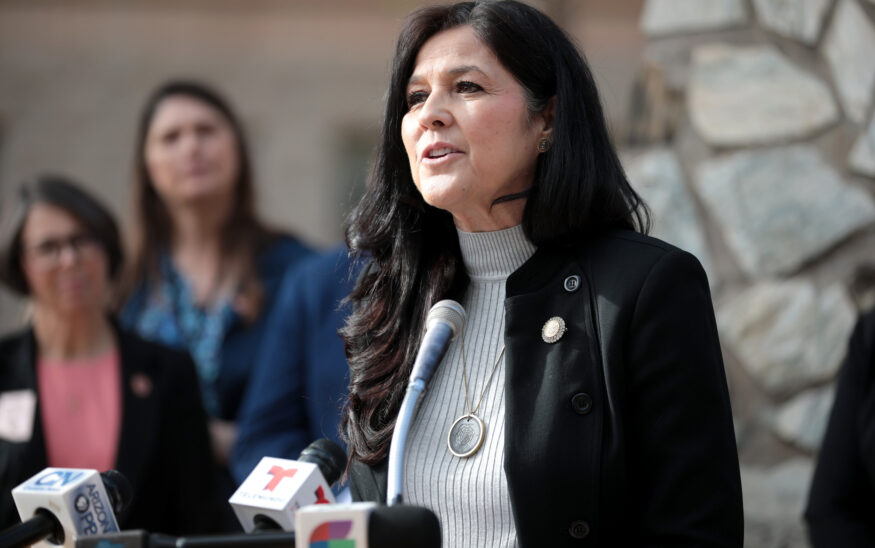
State Senator Catherine Miranda speaking with the media at a February 2023 press conference for the Arizona Latino Legislative Caucus at the Arizona State Capitol building in Phoenix. (Gage Skidmore / Flickr)
Educator-legislator pipeline highlights shortfalls of state education
Jordan Gerard, Arizona Capitol Times//May 22, 2026//


Key Points:
-
About 52% of Arizona lawmakers have one or more ties to education, according to their biographies
-
Despite that, Arizona ranks below the national average for per-pupil spending
-
Lawmakers, candidates and union leaders remain hopeful for improvement in spite of politics
The majority of Arizona’s lawmakers have ties to education, yet the state still struggles to find education solutions that work for everyone.
Collectively, 47 lawmakers have experience in the education field, the Arizona Capitol Times found.
Some are current or former K-12 teachers, others have served or currently serve on school district governing boards, and others still teach or have formerly taught at colleges. Even more have served on education foundations, hold education degrees, have an immediate family member who is an educator or have done education-related work at some point in their career.
The party representation among legislators who fit one or more of these categories is an almost-even split, with 26 Democrats and 23 Republicans having some tie to education.
Approximately 52% of total state lawmakers have some form of education experience they are bringing into the Legislature, yet despite that fact, Arizona still ranks 49th in the nation in per-pupil spending. The state currently sits at $11,987 per student, according to a National Education Association report, with the national average being $17,250. Arizona also has the highest student-to-teacher ratio of any state, the report found.
All of that means Arizona’s classrooms are both underfunded and overcrowded when compared to the national average.
The educator-legislator pipeline
Sen. Catherine Miranda, D-Laveen, has taught kindergarten, first grade, second grade, third grade and a little bit of seventh and eighth grades over her 10 years in education. Her inspiration for wanting to teach came from her own experiences as a student, she said.
“In kindergarten, it is just amazing how slow you have to teach and repeat and repeat, so you have to be a really patient kindergarten teacher, right? If you taught kindergarten, that would be a qualification on a résumé for any job,” Miranda said.
Running for office wasn’t in her plans, but her late husband, Ben Miranda, who served in the House of Representatives, encouraged her to run.
“I thought it was the most ridiculous thing for him to ask me to run for the House, and I basically said, ‘No, you’re the politician. I’m the educator,’” she recalled. Long story short, she ran for school board and got elected, giving Miranda her first experience in politics she likened to a “little legislature.”
Now a senator, her priorities have shifted from improving the lesson plan to advancing education more broadly — an issue she says boils down to who has majority control.
“At the end of the day in politics, in this Legislature, it depends on who the majority is, and whoever the majority is. The results of where we’re at in our state is a reflection of that,” Miranda said. “The majority of us are educators, but it comes down to what we believe is right for education, and I can’t imagine any of us not thinking that the child should come first, so we’d have to find more like-minds in that area.”
Miranda isn’t alone. Even teachers who are not yet elected officials want the opportunity to contribute to education policy. Democratic candidate Ben Koehler, for example, is running for a House seat in Legislative District 20 while currently teaching math at a public high school in Tucson.
“I’ve had a handful of students for two years now, and getting to develop those relationships and build upon what we did in their first year on algebra one, and keep growing their math skills. Just watching them grow as people and mature and develop has been incredibly rewarding,” he said.
Koehler emphasized addressing the many road blocks and barriers that are put in the way of education — everything from broken air conditioners to well-intentioned but disruptive government mandates.
Koehler also pointed to elections, teacher pay and the voucher program as sore spots for Arizona’s public education system.
“It’s a real struggle for public schools to see that money being siphoned away and sent towards, frankly, wealthy families that don’t need that money as much as other communities may,” he said.
Those at the cross-section of education and politics don’t always become politicians. Sometimes they become advocates. That was the case for Arizona Education Association President Marisol Garcia, who taught eighth grade social studies for 20 years, and now leads the association’s advocacy efforts using her firsthand experience.
“It was a place where I understood the power of having experience and potentially offering a firsthand account of what’s happening right now, and how we could come to a solution,” she said. “I think it is quite common for people who are interested in public service and running for office that they see going to being a full school board member as a stepping stone to understand policies to then move to the Legislature.”
The experience differs slightly for teachers and school board members, Garcia said, but classroom experience, working with parents, understanding standards and testing and even setting up classrooms can all give valuable insight into political life.
School board members, she added, often have the advantage of having worked with the district office and have a deeper understanding of the budgets and statewide policies or directives that impact the day-to-day running of a school district.
Both are important to the Legislature, Garcia said.
So why are Arizona’s rankings so low?
Garcia said she thinks the state’s subpar education funding and test scores come down to dueling priorities, especially for those who have other jobs outside of the Legislature.
Another factor is how long those who represent Arizona have been in the classroom. Veteran educators have a unique experience and see year after year that high quality education needs better funding, she said. A classroom 12 years ago is very different from a classroom just five or six years ago, during the pandemic, and it’s even different now, she added.
She also pointed to the ESA program and tax cuts for corporations as her two top picks for why state education is so poorly funded.
“(The Legislature’s) focus on cutting taxes and giving tax credits to people has a direct impact on funding of public schools. The pie keeps getting smaller and smaller, so they can say we’re giving a larger percentage, but it’s a mini pie,” she said.
Garcia pointed to elections as one force that could change the tide, but added that any real progress was going to take nonpartisan effort from the Legislature.
“I would love to see a nonpartisan solution come from not just business and parents, but also educators and children who are going to inherit these systems, to be able to say this is a priority for us. Let’s find a creative solution,” she said.
And despite the ongoing political chess matches, Garcia said those educator-legislators aren’t giving up. They’ll keep fighting for their districts and students well into their term.
“I need more educators. I don’t care their party affiliation. I want more educators in the Legislature who can tell their colleagues what is really happening in our schools because they, at least, can speak to firsthand experiences that are recent and the impacts that the decisions that are made at the Legislature have on them,” she said.
Reps. Matt Gress, R-Phoenix, and Rep. Alexander Kolodin, R-Scottsdale, who both worked as teachers according to their biographies, did not answer a request for comment.