Sign In


Upcoming Event
 Free Newsletter

Arizona classrooms see just .52 cents of every dollar spent on education
Howard Fischer, Capitol Media Services//March 3, 2026//
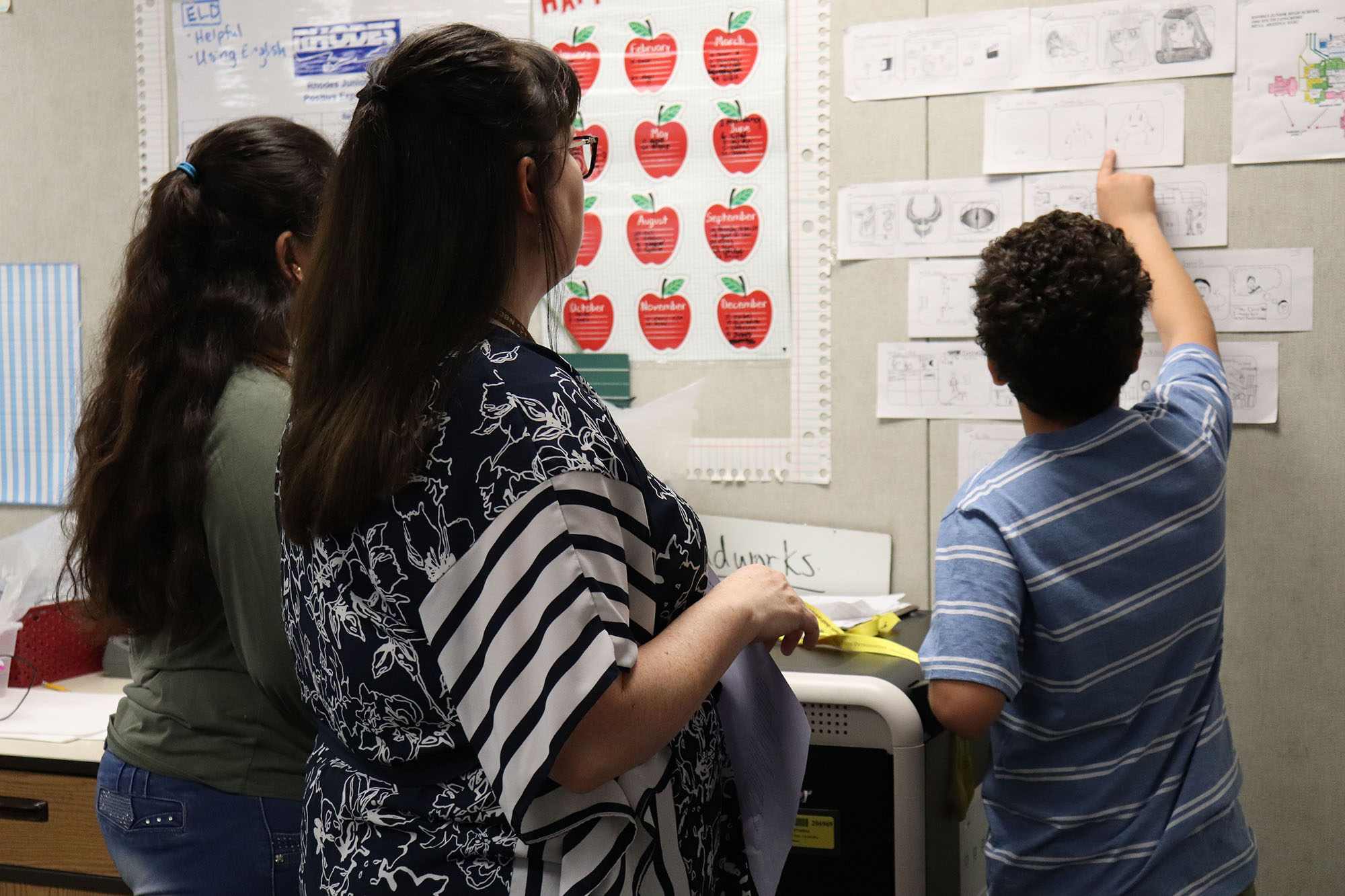
Amethyst Hinton Sainz, an English Learner educator, shows two of her students some of the posters on her classroom’s wall at Rhodes Junior High School in Mesa. (Kelsey Mo/Cronkite News).
Arizona classrooms see just .52 cents of every dollar spent on education
Howard Fischer, Capitol Media Services//March 3, 2026//


Key Points:
-
Only 52.1 cents of every education dollar reaches the classroom
-
Arizona’s instructional spending is the lowest in two decades
-
Arizona’s per-student spending is $4,503 less than the national average
The percentage of education dollars spent in Arizona classrooms has slipped once again.
New figures from the Auditor General’s Office show that just 52.1 cents of every dollar spent during the last school year was used for instruction. That mainly includes the salaries and benefits of teachers, aides, substitutes as well as general instruction supplies, field trips and athletics.
It is the lowest rate since the report’s inception following last year’s rate of 52.6 cents per dollar.
Significantly, the new figure comes amid a Republican push to require, via ballot initiative and voter approval, that schools increase the rate to 60 cents.
If approved, that mandate wouldn’t be instant. Institutions will be given some time to get there, with districts directed to increase the rate of spending by at least one nickel each year. Failure to meet the higher rate would amount to a loss of certain state funds.
Chuck Essigs, lobbyist for the Arizona Association of School Business Officials, said the numbers are not surprising given fiscal realities of not just fixed education costs but also a declining enrollment.
All of that is complicated further, Essigs said, by the fact that Arizona spends far less than the national average on education.
That’s not just his assessment. It’s backed by reports from the Education Data Initiative and Forbes.
A recent report puts per student spending in Arizona at $14,629 compared to the significantly higher national average of $19,132.
The new report shows actual instructional spending is about $30 higher per student than it was a year before, but plant services are up by $59 per student.
That includes utilities. And Essigs said electric companies in Arizona are not giving schools a break.
The situation, however, could be changing.
Enrollment in public schools, which peaked at nearly 932,000 in 2008, is now down by 92,000, resulting in a commensurate reduction in state aid which is based on attendance. That is forcing districts to close schools, which should reduce the need to heat and cool those buildings.
But Essigs said there are other factors — things that just cost a certain amount, regardless of how much schools are being given.
“Things like food service,” he said. “It doesn’t cost less to feed kids in Arizona.”
Ditto transportation costs.
Essigs said there are things that schools can do to deal with declining enrollment, whether it is closing buildings or by simply having one less third grade class.
“You still need to have buses,” he said.
“So instead of having 50 kids on that bus, you have 40 kids on that bus,” Essigs said. “It still uses the same amount of fuel, you still have to have the bus drivers.”
The new report also points out that, for whatever reason, while the overall number of students in public schools is declining, the number of students receiving special education services has increased, particularly for autism. And that can cause an increase in the category of instructional support — something that doesn’t count toward that 60% goal for instruction — because it includes counselors, audiologists, speech pathologists, nurses and social workers.
And such support costs increased by $33 per student last year.
Still, there were other costs that also increased, costs that some lawmakers say can be reduced.
Administration, on average, took up 10.4 cents of every dollar of state spending. That also is up by $33 per student.
The report also says that there were 59 students for every administrator. That’s down from 60 the prior year — and 62 the year before that.
All that is acknowledged in the report which says that looking at pure percentages of each dollar spent paints only a partial picture.
“For example, a district’s overall spending might increase, but its percentage spent on an operational area may decrease if the dollars per student spent on that area stay the same or even increase.”
Rep. Matt Gress, who is pushing the legislation to require schools to get to that 60% figure for instruction, said he isn’t buying the argument that there isn’t enough money to reach that goal.
He said the Edunomics Lab at Georgetown University has a report which looks at education spending in Arizona between 2014 and 2024.
“How is it that we increase K-12 spending by 57%, certainly higher than the rate of inflation, and yet instructional spending went down,” asked the Phoenix Republican. “It doesn’t make any sense to me.”
And Gress has his own views on the growth of the cost of support services — 2.7% in the past year versus 0.4% for instruction.
“Schools have spent money on everything but the classroom,” he said.
Nor is Gress buying arguments that transportation costs, up 2.7% year over year, really can’t be controlled. He instead looks at data not found in the auditor general’s report which says total ridership is down 44%.
“You lost nearly half your ridership,” Gress said.
“And you’re telling me that there were enough bus routes that were just fixed that not only did we maintain them, we actually increased the spending on them?” he continued. “I’m having a hard time wrapping my head around that concept.”
Essigs said all that ignores what the new report says about an increasing number of special needs students. He said these are the ones who ride on the smaller buses, which can transport only a few students at a time, but still require drivers and fuel.
That still leaves the data, including in the report, that finds Arizona near the bottom of all states in what it provides in aid.
“I’m not going to dispute the per-pupil costs,” Gress said. But he said that, in some ways, that’s irrelevant to academic performance.
“Mississippi was able to make not only gains but read third grade reading, compared to some states like Massachusetts and California, while spending drastically less per pupil,” Gress said.
Still, that Education Data Initiative report shows Mississippi spending more than Arizona on a per student basis.
Gress remains unconvinced, saying that the scores in standardized tests given to third and eighth graders in Arizona have fallen to a point that “suggests, to me, that monies are not being prioritized correctly,” going back to his central argument about putting more into the classroom.
What the report also shows is that the average teacher in Arizona earns $65,613, up less than 1% from the prior year. That also compares with $48,472 in 2017.
But it also notes that some of the difference in this average can come from districts where more experienced — and better paid — teachers have left the profession and were replaced by more recent graduates.