Sign In


 Free Newsletter

State treasurer hopefuls face off over land trusts, education funding in GOP primary
Howard Fischer, Capitol Media Services//May 20, 2026//
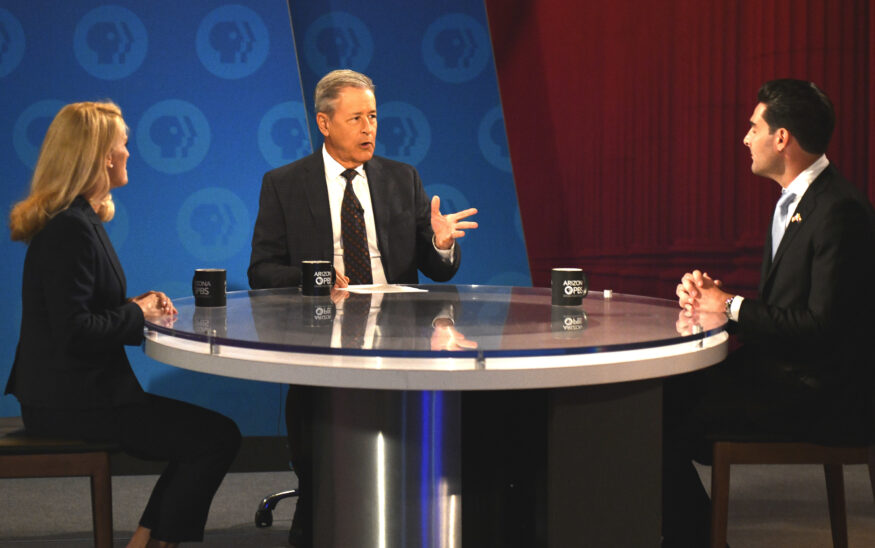
Candidates Katherine Haley, left, and Elijah Norton, right, debate ahead of the Republican primary for who should be the nominee for state treasurer. The debate was hosted by Ted Simons. (Capitol Media Services photo by Howard Fischer)
State treasurer hopefuls face off over land trusts, education funding in GOP primary
Howard Fischer, Capitol Media Services//May 20, 2026//


Key Points:
-
State treasurer manages Arizona’s $32B in investments
-
Outgoing Treasurer Kimberly Yere endorses Katherine Haley
-
Elijah Norton touts backing of Turning Point
State treasurer hopeful Elijah Norton is charging that his Republican primary foe is totally unqualified to manage the state’s $32 billion in investments.
During a televised debate May 19, Norton cited his experience as founder and CEO of what is now known as Veritas Global Protection, a company which sells extended warranties on vehicles. And that, he said, means he has to invest premiums in a way to ensure that the funds will be there when claims are made.
By contrast, Katherine Haley cites her experience as owner of Oak Rose Group, an investment advisory firm.
“We maintain balance sheets,” she said.
“We have to make sure we balance our checkbook every day,” Haley said. “We have to make sure we pay our bills.”
Norton sniffed at that.
“I think my opponent’s a lovely person,” he said.
“But this is about experience,” Norton said. “She’s not qualified frankly — and I mean this with all due respect — to be the bookkeeper at a pizza parlor.”
Haley responded that the job goes beyond deciding where to invest the dollars that come into the Treasurer’s Office. She said it also requires leadership and planning, both skills she says she has.
Beyond that, Haley said much of what treasurers can do with the dollars under their control is not on whim of the person heading the office but constrained by statutory restrictions as well as oversight by the State Board of Investment.
“At the end of the day, you are following state statute and also what is defined in the Constitution,” she said. And Haley chided Norton, saying he has said the state should manage its investments like Texas and Florida.
“They’re very different states,” she said.
What Haley said she does have is broader experience, including working as a policy adviser in Washington for Republicans John Boehner and Paul Ryan when they were speakers of the U.S. House. Norton dismissed both as “swamp rats,” a derisive term that had been used against both by some hardline conservatives to criticize more establishment politicians.
Haley’s view of the role of the office is also much closer to that of Republican Kimberly Yee, the current treasurer, who after serving two four-year terms, is now running for state superintendent of public instruction. And Yee told Capitol Media Services after the debate that whoever is in that office should not be making individual decisions on investments.
“The treasurer should be the manager of the agency and hire the best individuals qualified,” said Yee.
Haley made it a point during the debate to say she has been endorsed by Yee. Norton clapped back with his endorsements by the Free Enterprise Club, Turning Point and Senate President Warren Petersen.
Norton also dismissed the argument that it is the job of the treasurer to run the office and ensure it is staffed by the people who are the actual experts in their fields.
“We’re not trying to hire a glorified HR manager to manage unelected bureaucrats,” he said. “We’re electing the chief banking and investment officer of our state.”
Haley said all that is true, but that doesn’t mean Arizona should have a treasurer who has overly broad ideas of how to earn more money with the cash that the state needs to pay its bills.
“We cannot make risky bets,” she said. And Haley said what Norton wants is to “sell our portfolio to the highest bidder with the goal of, oh, perhaps, we’ll get higher yields.”
Norton makes no secret of his belief that the state could make more on the money it has invested.
He poked fun at Yee who, in press releases, said that the assets her office is managing nearly doubled from $15.4 billion in 2019 when she was first elected.
He said during that time there was growth in state population and property value, state lands were sold off and the proceeds put into the trust, and cities, who can invest through the Treasurer’s Office have gained the ability to tax internet sales.
“If you take our portfolio to somebody who actually understands investments, they’re going to say we should have about $3 billion to $5 billion more than we actually do,” Norton said.
“I’m not saying we should take risky bets,” he said. “I want to go to the office every day, do my job, and apply my experience to getting better returns for the taxpayers.”
One place where the treasurer has played a role — or at least has had some input — has been on the question of how much extra money can be withdrawn from the special education trust account.
Arizona received about 10 million acres of land from the federal government when it became a state in 1912, with the restriction that the land be held for the benefit of certain entities, primarily public schools. About 9.2 million acres remain, along with more than $10 billion the trust invested from sales and leases of the land.
A former formula in place for years gave schools 2.5% of the value of the trust annually, a figure that was designed to ensure level distributions without endangering the principal.
In 2016, however, voters narrowly approved Proposition 123, a measure to boost that annual distribution to 6.9%, generating an extra $300 million.
But that authorization has since expired. And lawmakers along with Gov. Katie Hobbs are now debating whether to ask voters to renew that rate — and at what level.
That’s where the views of the treasurer can come in.
The governor at one point proposed boosting the distribution to 8.9%, with GOP lawmakers proposing to keep it at 6.9%.
Yee has already weighed in, rejecting both proposals as unwise and saying the prudent figure would be more in the neighborhood of between 4% and 5%.
“We do have to protect the principal,” Haley said when asked her views on renewal. “It’s an endowment,” she said, having to last not just through today but well into the future.
“On average, an endowment distributes about 5%,” Haley said, saying she would consider that a safe figure going forward.
Norton blasted the numbers originally proposed by Hobbs as “absolutely ridiculous,” though the governor, in her proposed budget released in January, is not on the same page as the Republicans at 6.9%. But Norton refused to say, both during the TV appearance and when asked afterward, whether he agrees with that GOP figure — or what he believes would be the proper level of withdrawal going forward to both protect the trust and yet still provide more dollars for K-12 education.
What history has shown is the difficulty of making predictions of a return on investment on a long-term basis.
When Proposition 123 went to the ballot in 2016 it was opposed by Jeff DeWit, the state treasurer at the time. He predicted that the higher withdrawal would cut into the principal of the trust and ultimately leaves public schools with less money.
As it turned out, the economy — and the rate of return on investments — remained strong enough so that the principal actually increased even with the higher withdrawals.
Whoever wins the July 21 primary will face off against Democrat Nick Mansour.