Sign In


Upcoming Event
 Free Newsletter

Can state election officials still exercise their free speech rights?
Mary Jo Pitzl, Capitol Media Services//May 26, 2026//
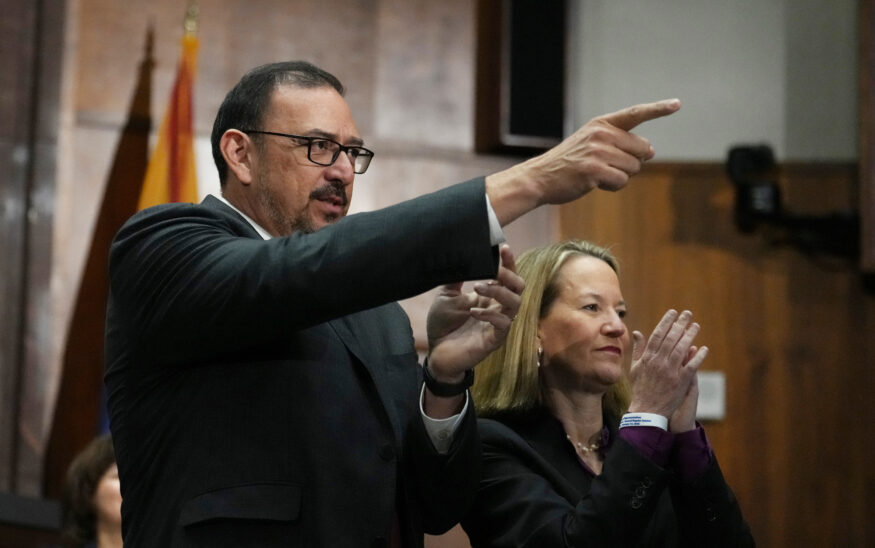
Arizona Secretary of State Adrian Fontes, left, and Arizona Attorney General Kris Mayes at the State of the State Address in the Arizona House of Representatives at the Capitol, Jan. 12, 2026, in Phoenix. (AP Photo/Ross D. Franklin)
Can state election officials still exercise their free speech rights?
Mary Jo Pitzl, Capitol Media Services//May 26, 2026//


Key Points:
-
Arizona election officials may face conflict of interest concerns
-
Secretary Adrian Fontes endorses candidate who filed campaign finance complaint
-
Arizona law does not bar election officials from endorsing candidates
A campaign finance complaint filed with the Arizona Secretary of State has unwittingly provoked a perennial election question in Arizona: Can state officials carry out their election duties while also exercising their free speech rights?
To Secretary of State Adrian Fontes, who has endorsed the candidate making the complaint, the answer is simple.
“I can chew gum and walk at the same time,” said Fontes, a Democrat who is backing fellow veteran Dan Toporek in a contested legislative district in north Phoenix. “I’m a voter, too, and I have a First Amendment right to express myself.”
There is no clear answer to the possible conflict of interest. Arizona law doesn’t bar endorsements or block an election official’s management and oversight of elections when they themselves are on the ballot.
The National Association of Secretaries of State had a similar assessment when looking at conflict of interest policies nationwide.
However, a recent Utah state law requires election officials to take steps to avoid potential conflicts, said John Milhofer, research director for the association. And, he noted, Michigan Secretary of State Jocelyn Benson, who is now running for governor, has said she would formally recuse herself from actions that would affect the gubernatorial race.
While there are guidelines and codes of conduct, in Arizona and elsewhere, it often comes down to the official’s own discretion, said Tammy Patrick, chief executive officer for programs with the Election Center, which is run by the National Association of Election Officials.
“These types of questions arise and surface when we start to talk about our election infrastructure,” Patrick said.
The questions are not new.
In 2000, the issue became a national hotpoint when then-Florida Secretary of State Katherine Harris oversaw the contentious recount of Florida’s presidential election results, and certified George W. Bush as the winner of that state’s votes. Harris also was co-chair of Bush’s campaign in Florida.
Four years ago, then-Arizona Secretary of State Katie Hobbs also faced questions about her ability to oversee the 2022 election, given she was running for governor. Hobbs did not recuse herself and said she would follow ethical guidelines to keep her political ambitions separate from her formal duties.
She followed in the footsteps of her predecessors in the secretary’s office, who continued their work as secretary of state even while their name was on the ballot. They include Jan Brewer, who was re-elected to the state’s top election office in 2006; Ken Bennett in 2010 and Michele Reagan in 2018, who lost in the primary election that year.
Fontes said he is tending to his secretary duties in the upcoming primary and general elections as he seeks a second term.
“No secretary has ever recused for that purpose and that won’t start now,” he said.
It’s similar to what he did in 2020, when he served as Maricopa County recorder.
He was on the 2020 ballot as a candidate, seeking re-election. He lost that race and stepped down, a point Fontes’ supporters say indicates he did not use his post for his own political benefit.
Gina Swoboda, who is running for the Republican nomination for secretary of state this year, said the public doesn’t grasp the fairly limited role the secretary of state plays in elections. The secretary does not run elections; that is done by each of the 15 county recorders. The secretary has an oversight role and is required to certify election results.
“I think there’s a perception these leadership roles have more power than they do,” she said.
That said, if elected, Swoboda said she would refrain from participating in the logic and accuracy tests that are done on ballot-counting machines, arguing it’s not a good look. And she would seek legislative scrutiny of any other “significant” changes to the state’s Elections Procedures Manual that could affect the secretary of state race.
Her Republican challenger, state Rep. Alexander Kolodin, R-Scottsdale, did not return requests for comment.
The focus on the secretary’s office often obscures scrutiny of conflict issues at the county and local levels, where the elected officials actually run elections.
“That can be a particular issue in rural counties, where there aren’t big staffs,” said Patrick, of the Election Center.
If the elected official running the office has a conflict, who handles the work, she asked. She cited a 2022 report from Reed College in Portland that found 34% of election offices nationwide have no full-time staff dedicated to elections.
The Election Center has suggested standards for dealing with conflict issues, encouraging election officials to create guardrails to guide situations where they are on the ballot. Recusal from decisions that directly impact their own race should be one of those guardrails, “to the extent feasible,” according to the center’s report.
Another organization that is working to reduce partisanship in elections has suggested that election officials take a cue from the judiciary when it comes to dealing with potential conflicts.
Federal law, as well as many state and local laws, require judges to recuse themselves in potential conflict situations.
“Election officials are enough like judges that recusal guidelines should at least exist for elections,” the Election Reformers Network stated in a 2024 report.
Patrick said the issue of endorsements is less clear cut than oversight of elections. Elected officials have a First Amendment right to support the candidates of their choosing, but it can create the perception of a conflict.
Fontes said his office is set up so that issues such as the campaign-finance complaint filed by the candidate he endorsed won’t even get to his desk. He had not even seen it, he said on May 15, as his staff is still reviewing it to determine if there is reasonable cause to forward it to the state attorney general for investigation.
“We’re operating under this basic understanding that if there is a political matter, I’m not involved,” Fontes said in an interview. Any decision, if needed, would fall to the assistant secretary of state, he said.