Sign In




 Free Newsletter
Trump administration backs state GOP proof of citizenship push
Howard Fischer, Capitol Media Services//May 28, 2026//
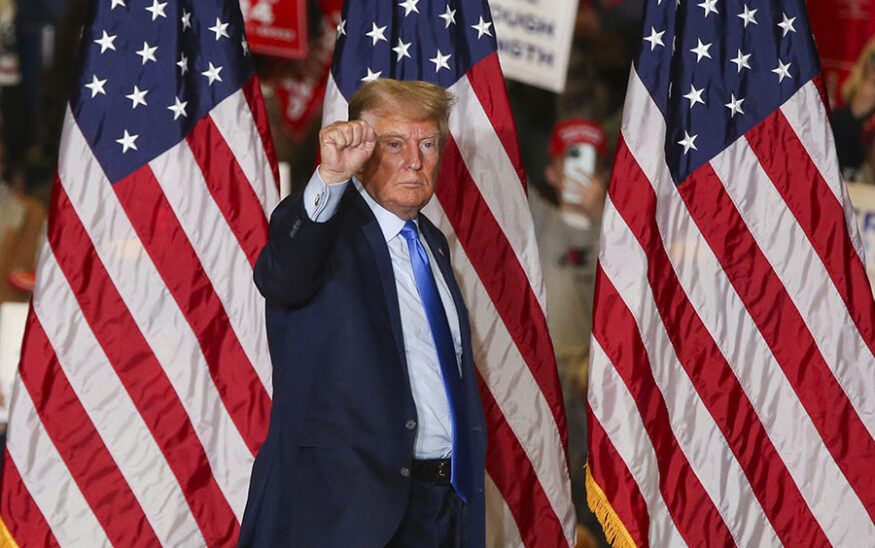
Former President Donald Trump leaves the stage at a campaign rally on Nov. 11, 2023, in Claremont, N.H. (AP Photo/Reba Saldanha)
Trump administration backs state GOP proof of citizenship push
Howard Fischer, Capitol Media Services//May 28, 2026//


Key Points:
-
Trump administration asks U.S. Supreme Court to let Arizona block voters without proof of citizenship
-
Arizona wants to regularly check voter rolls and purge non-citizens from registration
-
Arizona’s 2022 voter ID law was blocked by lower courts from taking effect
The Trump administration is asking the U.S. Supreme Court to allow Arizona to block people who do not provide “documented proof of citizenship” from registering to vote for president.
And it wants to clear the way for Arizona to be able to regularly check — and purge — voter rolls of those who other databases say are not citizens.
In a new filing, the Department of Justice is asking the high court to overturn lower court rulings which restricted the ability of the state to enforce certain requirements for citizenship and residency. The federal attorneys also want to pave the way for county election officials to purge voter registration rolls of those who they say “were never eligible to register in the first place.”
“When noncitizens, with no right to shape American government, vote in American elections, the ballot box no longer speaks for the people, because its tally no longer reflects their voice,” the agency argued.
At the heart of the multi-year battle is the 1993 National Voter Registration Act which requires states to provide “simplified systems for registering to vote in federal elections.” That, in turn, led the federal Election Assistance Commission to design a form for voters to use in those elections.
Crucially, the law requires states to “accept and use” the federal form to sign people up to vote in federal elections. And that form has no obligation to provide proof of citizenship, requiring only that applicants avow, under penalty of perjury, that they are citizens.
There also is language in the NVRA about how much a state can require on its own forms to vote in a federal election.
None of this affects Arizonans who have signed up to vote in all elections. They fall under a 2004 voter-approved law that requires proof of citizenship to vote in state and local elections.
But in 2022, the Republican-controlled Legislature enacted a series of provisions adding new requirements to those who sign up to vote in only federal elections, including proof of citizenship and proof of residency. Those were overturned the following year by U.S. District Court Judge Susan Bolton, a decision upheld by a majority of the 9th Circuit Court of Appeals.
Republican legislative leaders are asking the Supreme Court to intercede, saying the lower courts got it wrong. And now the Trump administration has weighed in on their side, making many of the same arguments.
The scope
There are only a relative handful of Arizonans — about 43,000 at last count — who have not provided what lawmakers demanded in 2022. And, armed with lower court decisions, election officials have signed them up as “federal only” voters.
But proponents of enforcing the law have argued the numbers are irrelevant.
They have pointed to the 2020 presidential election which showed Joe Biden outpolled Donald Trump in Arizona by just 10,457 votes. In fact, Trump’s loss by that margin was cited when Republicans in 2022 pushed through the change to expand the proof-of-citizenship requirements to all voters.
There were claims — never proven — that the 2020 race was affected by votes from noncitizens.
State election officials, however, have repeatedly said that most of those who fail to provide documented proof of citizenship are those who do not have easy or immediate access to their birth certificates, mainly college students and members of Native American tribes.
“Reality has proven that, as a general rule, those who are not citizens do not register to vote,” said Pima County Recorder Gabriella Cázares-Kelly in a previous response to queries by a Republican-aligned group. “In rare cases where someone who is not eligible actually attempts to register to vote, there are safeguards and laws to ensure that only eligible persons can vote.”
In prior orders, the Supreme Court has refused to disturb the lower court findings and barred the state from enforcing the 2022 law in the 2024 election.
But the high court has never actually ruled on the merits of the 9th Circuit decision. And the Department of Justice said that leaves the issues unsettled with “further review is warranted.”
The arguments now before the Supreme Court about what Arizona can do to determine if registrants are citizens are even more complex.
One related issue is another 2022 Arizona law which requires county election officials to regularly check their voter rolls against available databases to ensure that noncitizens are not registered to vote.
The 9th Circuit concluded that procedure runs afoul of another provision of the NVRA which restricts the ability of states to remove “ineligible voters.”
That, the Department of Justice is arguing, is wrong and should be overturned.
“The NVRA’s protections for registered voters do not apply to those who were ineligible and improperly registered to vote in the first place,” the government lawyers told the high court. Instead, they said, it protects only people who were eligible to vote but have since died, moved, been convicted of a crime or determined to be mentally incapacitated.
“Otherwise, the act would never allow for the removal of noncitizens once registered,” they said. “That absurd law is not the one Congress enacted.”
There is one related issue where the Department of Justice is not in lockstep with the Republican lawmakers.
In a ruling last year, the 9th Circuit concluded not only that the 2022 laws were unenforceable ,but that there was evidence that Arizona legislators acted with discriminatory intent when they initially approved the measures.
Appellate Court Judge Ronald Gould said the evidence shows that lawmakers knew there had been no voter fraud, the justification GOP legislators cited when passing the laws. That includes the results of a so-called “audit” of the 2020 election returns commissioned by the Republican-controlled Senate — with the findings showing that Biden had, in fact, received more votes.
“Yet the legislature proceeded to enact legislation aimed at remedying the voter fraud that was contradicted by its own findings,” Gould wrote. He also cited what he called the state’s “history of discriminating against minorities and of voter discrimination.”
The Republican legislative leaders want the Supreme Court to overturn that finding of discriminatory intent. But the Department of Justice is urging the justices to sidestep the issue, saying that it can be decided by Bolton if they eventually send the case back to her.