Sign In




 Free Newsletter
Arizona candidates turn to AI to generate campaign content
Reagan Priest, Arizona Capitol Times//May 29, 2026//

This fantasy image of the Arizona State Capitol was generated using Gemini AI. No individual depicted in this image is real.
Arizona candidates turn to AI to generate campaign content
Reagan Priest, Arizona Capitol Times//May 29, 2026//


Key Points:
-
Arizona politicians are increasingly using AI-generated content in campaigns
-
Some candidates are weaponizing AI to target their political opponents
-
Arizona laws on AI use in elections are relatively lax and provide little recourse
From photos of a candidate meeting with nonexistent constituents to a video of a state senator vanquishing his opponent with a proton pack Ghostbusters-style, Arizona’s political hopefuls are turning to artificial intelligence to create content to boost their campaigns.
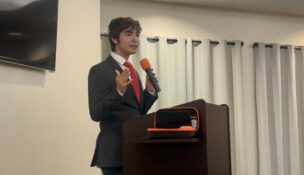
One candidate has even gone so far as to create an entire political ad with AI, featuring memes of President Donald Trump and Vice President J.D. Vance as a tongue-in-cheek criticism of the dysfunction in Washington, D.C. Rick McCartney, a Democrat running in the crowded 1st Congressional District field, said the ad aims to point out the chaos of current Republican politics.
“We know what this chaos looks like, and one of the big reasons I’m running is for us to diffuse it.” McCartney said. “We wanted to demonstrate that frivolous use (of AI), particularly in political campaigns and with this administration, to distract.”
McCartney said his team intentionally put an AI disclosure on the ad and used unbelievable imagery — like a shirtless and heavily-tattooed Trump flexing — to illustrate the inundation of content Americans face from politicians without deceiving the voters he intends to court.
“We weren’t trying to create other realities. We were trying to play on stuff that other people had created or that had gone viral in some way,” McCartney said. “It wasn’t just about getting attention, it was demonstrating what it means to create chaos and distraction.”
The congressional hopeful appears to be the first Arizona candidate to use AI to generate a campaign ad, but other politicians are also experimenting with the technology. And while McCartney’s video parodied viral memes and featured an AI likeness of himself, other candidates are creating “new realities” targeting their political enemies, who have little legal recourse.
Arizona has two statutes governing AI use in elections, though neither is particularly strict.
One requires AI disclosures on manipulated content posted within 90 days of an election. Under that law, a candidate can ask a judge to intervene and impose a $10 fine for every day the content remains online without a disclosure. Alternatively, candidates can ask a judge to declare a manipulated photo or video fake, though a judge cannot order removal of the content or impose fines solely for the creation of AI content.
Fortunately for AI-loving candidates, popular photo and video generators like Gemini and Grok automatically add watermarks to content manipulated or created by AI.
Senate Majority Leader John Kavanagh’s video featuring the Fountain Hills Republican as a Ghostbuster and his primary opponent Robert Wallace as a “bathroom spirit” has a Gemini watermark in the bottom right corner.
Kavanagh also created a website featuring AI-generated photos of Wallace inspired by Reddit posts he allegedly made related to his use of psychedelics and his beliefs in reincarnation. Kavanagh told the Arizona Capitol Times that the website was designed to highlight the dangers of electing such a “weird” person, while Wallace said he found the whole thing hilarious.
Sen. Mark Finchem, R-Prescott, is also using AI to create content targeting his perceived political opponents, though he will likely be reelected handily in the deeply-red Legislative District 1.
Finchem, who runs a research institute studying “the lack of transparency” in elections, focuses his AI-generated content on election officials like Secretary of State Adrian Fontes and former Maricopa County Recorder Stephen Richer.
Finchem posted two AI photos of Fontes on April 29 and May 4, with one depicting Fontes being led away in handcuffs by police officers and another depicting him with his head bowed in front of an angry judge in a courtroom. Both posts include pleas for donations to Finchem’s reelection campaign and only one has a clearly labeled AI disclosure.
“I’m fighting to finish cleaning up their election corruption under Fontes and Richer. They want me silenced,” Finchem wrote in one post. “If we fail, the fraud machine keeps running. Rush $25, $50 or $100 now to meet our goal!”
Richer, meanwhile, is depicted in more of a cartoon-villian style with red eyes and hands clasped as ballots and dollar bills fall in front of a stormy Maricopa County Recorder’s Office. Finchem again made a call for funds and told his followers, “I’m fighting to root out the deep corruption in Maricopa.”
In response, Richer made the image his profile photo and in a post, he wrote, “I’m flattered that I’m chosen as a high-profile fundraising lure.”
Richer said AI has not changed much in terms of people’s attitudes but noted the increase in ease and detail in generated images, which “supercharges people’s ability to be awful to people.”
“Mark Finchem said deceitful stuff about me before AI was created,” Richer said. “Now he just gets to depict it.”
He beckoned back to 2021 when Congressman Paul Gosar posted an anime video of a character with his face plastered on killing another character bearing the face of Alexandria Ocasio-Cortez, a post which ultimately got him censured and stripped of his committee assignments.
“It was just this cheesy little video,” Richer said. “Now maybe he’ll use his characteristically poor judgment to make a more realistic version of that.”
Other lawmakers, like Rep. Walt Blackman, R-Snowflake, have used the technology for far more innocuous yet still slightly uncanny content creation. Blackman, who was previously criticized for using ChatGPT to help write a memoir, has posted several AI photos that appear to be him meeting with constituents or border patrol agents.
Upon closer inspection, the candidate in the photos does not actually look like Blackman and in one he appears to be meeting with constituents outside of a “mercnatile” shop, according to a misspelled sign. Blackman’s posts do not have AI disclosures, though it’s unlikely that anyone would challenge them in court since he is the only real person featured in them.
McCartney, the CD1 candidate, said his campaign will be putting up signs with an AI-generated version of himself wearing boxing gloves. While he is in favor of using AI as a tool, he said politicians still need to do more to regulate it.
“I am very much pro-AI innovation, but we also have to strongly be pro-AI regulation,” McCartney said. “It’s already starting to shape elections, it’s affecting jobs, privacy, healthcare, education, national security. All of those are very serious pieces to this and if we don’t work to create guidelines and guardrails around them, who knows what they could turn into?”