Sign In
Upcoming Event
 Free Newsletter

What is a rate case? How TEP and APS seek utility rate increases
Reagan Priest, Arizona Capitol Times//May 8, 2026//
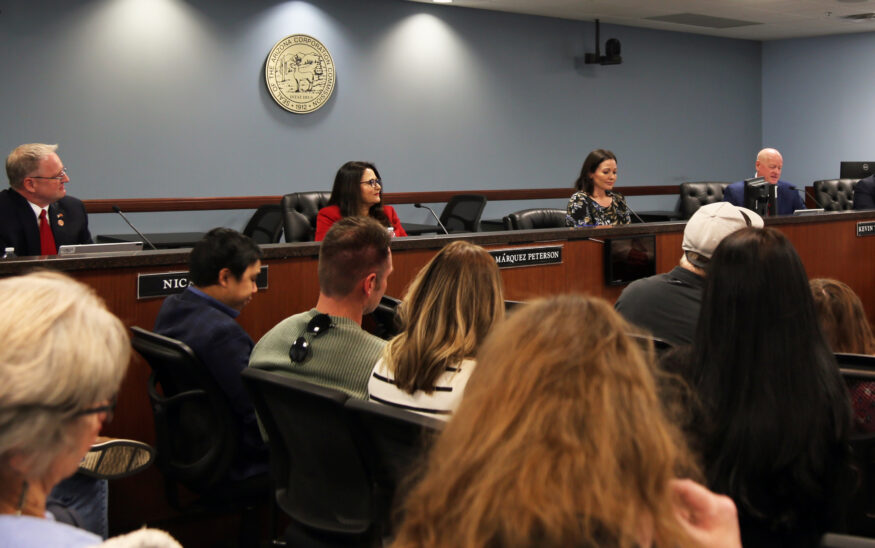
Members of the Arizona Corporation Commission sit at the dais during a swearing-in ceremony on January 6, 2025. (Reagan Priest / Arizona Capitol Times)
What is a rate case? How TEP and APS seek utility rate increases
Reagan Priest, Arizona Capitol Times//May 8, 2026//


Key Points:
-
APS and TEP are each asking for a 14% rate increases
-
Increase could affect nearly 2 million Arizona customers
-
Customers and consumer advocates are pushing back, but a full rejection is unlikely
Two of the state’s largest utility companies are asking the Arizona Corporation Commission for double-digit rate increases, both of which are being rigorously examined in rate cases this summer.
Arizona Public Service and Tucson Electric Power are seeking to increase customer rates by around 14%, which could spell higher utility bills for nearly 2 million Arizonans. The companies are investor-owned monopoly utilities, meaning they cannot set their own prices for electric service and instead must ask the commission to approve those prices.
“Their rate application is not the final say,” said Commissioner Lea Márquez Peterson. “We go through this incredibly complex process to have hearings, public comments, a judge puts out their recommended order and then we ultimately make changes to it. People don’t necessarily see that.”
For a proposed rate increase to succeed, companies must engage in a quasi-judicial hearing process known as a rate case. TEP is in the midst of defending its request before a judge during a three-week long hearing, while APS is scheduled to kick off its rate case hearings on May 18.
Márquez Peterson, the longest serving member of the commission, noted that commissioners hear up to 40 to 50 rate cases for electric, gas and water utilities each year, though rate cases for large utilities like APS and TEP often get the most public attention.
“The challenge in any rate case, whether it’s water, gas, electricity, is balance,” Márquez Peterson said. “We need to have a financially stable utility while we’re making sure there are affordable rates. And ultimately, the highest priority is reliability.”
Cynthia Zwick, director of the Residential Utility Consumer Office, said one of the biggest misconceptions about the rate case process is that commissioners can flat out reject a rate increase.
“A lot of the feedback that we see is, ‘Don’t authorize a rate increase, just say no.’ Which is very unlikely to happen,” Zwick said. “The process doesn’t really allow for the commission to step in and say ‘we’re not going to hear this.’”
So what is the rate case process?
A rate case begins when a utility files an application to the commission in order to recover the costs of serving its customers. Utility companies typically undergo rate cases every three to five years.
Applications are based on what’s known as a “historical test year,” or the actual expenses and investments accrued by a utility company during a recent 12-month period. Utility companies file rate cases when their expenses and investments cannot be adequately covered by the rates customers are currently paying.
“(Ratepayers) don’t realize that the utilities have taken the risk and spent the money, and they’re coming in asking for cost recovery,” Márquez Peterson said.
The commission staff reviews the utility’s application for completeness and a hearing schedule is set so other interested parties can apply to intervene in the case. RUCO is one of the most common intervenors in a rate case, as the state agency represents all residential utility customers at the commission.
Other intervenors can include the Attorney General’s Office, environmental groups like the Sierra Club, commercial ratepayers like Walmart and industry advocates like the Arizona Solar Energy Industries Association.
Rate cases function similarly to civil court cases, with utilities and intervenors presenting testimony and evidence to an administrative law judge during hearings. The length of the hearing process depends on the size of the utility; TEP’s rate case is scheduled for around three weeks of hearings, while APS is scheduled for about a month and a half.
During the hearing, parties present their case on a wide variety of issues, like which utility expenses should be charged in rates, whether investments were prudently made, whether facilities are needed to provide utility service and how much of a return on investment shareholders should be allowed to earn.
The administrative law judge is tasked with reviewing all of the evidence and arguments to make a decision on the contested issues and what rate increase, if any, the utility should receive. That decision is issued as a recommended order, which then goes to the Corporation Commission for review, modification and a final decision.
“(Commissioners are) taking a scalpel to even the recommended order that the judge has put together,” Márquez Peterson said.
The commission discusses the recommended order at a public meeting where commissioners will ask the judge, utility company and intervenors questions, propose amendments to the order and ultimately make a final determination on the requested rate increase.
Once a final decision is made by the commission, the new rates typically take effect a few weeks later. When all is said and done, the rate case process can last anywhere from 12 to 18 months.
APS and TEP rate cases
APS and TEP are both asking for nearly 14% rate increases. Those increases incorporate the actual cost of serving utility customers — power plant investments, transmission equipment, wages for linemen and utility operations staff — as well as the rate of return on investment that utility companies are legally allowed to collect.
TEP attorney Michael Patten said during April 23 opening statements in its rate case that the company is willing to drop its requested increase down to 12%, but defended its double-digit rate of return, or return on equity, request as essential for helping the utility weather inflation and the state’s increasing demand for electricity.
“A competitive return on equity will assist in maintaining TEP’s financial stability and allow it to meet its capital needs to address these challenges,” Patten said.
TEP is requesting a 10.5% return on equity, while APS is requesting 10.7%.
In its rate application, APS said its request is “a reasonable return commensurate with the Company’s current investment risks and would enable APS to effectively compete for the capital necessary to ensure a reliable and resilient grid.”
RUCO and commission staff are advocating for returns closer to 9% in both cases, while Attorney General Kris Mayes has proposed a 6% rate of return for both utilities.
Both companies are also asking the commission to approve new formula rate structures that will allow them to adjust rates annually based on more recent costs rather than historical test years. Attorneys for both APS and TEP say formula rate mechanisms will reduce the regulatory lag created by the lengthy rate case process, meaning customers could see small rate adjustments every year rather than large rate increases every three to five years.
It’s a concept known as gradualism, though intervenors like RUCO aren’t convinced it will actually help customers, since nearly every major utility company is seeking a formula rate mechanism.
“Depending on where you live, not only will you see an increase in your electric bill, you will likely also see one in your gas bill and you will likely see one in your water and your wastewater bill,” Zwick of RUCO said. “So you could see one, two, three or four increases on an annual basis and we just simply think that doesn’t make sense.”
The commission already approved a formula rate mechanism for UNS Gas earlier this year, though RUCO is challenging that decision in court.
Additionally, APS is hoping to increase its rates for data centers and other large load customers as they use increasingly larger amounts of electricity each year. Many residential customers are raising concerns about data center costs being passed on to them, but since APS and TEP both rely on historical test years, the most recent boom in data center electricity demand is unlikely to be reflected in the rates approved by the commission this year.
The next steps
APS and TEP ratepayers likely won’t see an increase on their utility bills until late 2026 or even early 2027. In the meantime, Márquez Peterson and Zwick encourage those ratepayers to submit public comments to the commission to make their voices heard on the potential rate increases.
“I can tell you that (RUCO) definitely pay(s) attention to those, the judge pays attention to those comments and we believe the commission does as well,” Zwick said.
The commission accepts written public comment and holds in-person and by-phone meetings for ratepayers who want to give input on the utility’s proposed rate increase. Márquez Peterson encourages ratepayers to make their public comments as personal as possible, as commissioners are often reading or listening to thousands and thousands of customer opinions in large rate cases.
“I prefer when they give me a copy of their bill or they’re giving us their particular concerns or telling us their story,” Márquez Peterson said. “That has a lot more impact.”